Quick answer
Sweden Oscar II stamp value depends on printing, paper and condition. On 11 October 2026, Frimärks-Netto asked SEK 33 for a 5 öre single and SEK 50 for an engraved 10 öre single in its ** category. Duzik asked GBP 1.80 for a used 1886 10 öre single. These are offers, not sales or a family-wide range.[7][13][15]
Start with the portrait, denomination and whole object
Read SVERIGE and the denomination before searching a price. Write öre or krona as printed rather than converting a historical face value into a modern selling price. Keep the entire object in your record. A loose single, joined pair and stamp on an envelope are different comparisons, even when the portrait looks identical. The ordinary engraved denomination checklist is 5, 8, 10, 15, 20, 25, 30 and 50 öre, plus 1 krona.[1] The earlier letterpress group discussed here is the 10 öre portrait.[2][3]
Do not turn an album heading into an issue date. The engraved family begins in 1891, but not every denomination appeared that year.[1][4] A dated postmark records a cancellation, not necessarily the printing date. Keep the number you can read and mark incomplete dates as incomplete. An inherited label is useful background, not proof that the loose stamp beneath it belongs to the stated catalog entry.
Photograph the whole front with all perforations visible. If the back is safely accessible, take a separate image. Leave stamps on covers and connected pieces intact. Start with a candidate family and work toward an exact entry. This guide prices ordinary dealer categories, not specialist plate flaws, shade certificates, trials or unusual postal-history usages.
Separate the 1885 and 1886 letterpress 10 öre
SAFE Album / Frimärks-Netto identifies the 10 öre without the blue reverse posthorn as Facit 39, officially issued on 1 January 1885. Its account also records December 1884 cancellations.[2] That early-use evidence does not make every red portrait an 1884 issue. The letterpress 10 öre with the blue printed posthorn on the reverse is Facit 45. The specialist dates its release to 24 February 1886 and notes December 1885 cancellations.[3]
The blue posthorn is a printed control mark on the back. It is not the crown watermark of the later engraved issue.[1][3] Inspect the actual reverse rather than interpreting a faint shape seen through a front photograph. A hinge, album paper or an envelope can obstruct the relevant area. If you cannot inspect it safely, record the distinction as unresolved and do not choose the costlier listing by default.
There are also documented type I and type II differences within Facit 39. The specialist uses an extra dot near the upper-left posthorn on type I and a clearer white line between the neck and background on type II.[2] These are physical comparison clues, not a premium established by this price table. Use the specialist's illustrated reference before assigning a type. Do not invent a type from the king's expression or a blurred phone image.
Recognize the engraved family and its paper question
The 1891 Oscar II group is recess or engraved printing, called koppartryck in the Swedish reference. SAFE Album describes it as Sweden's first copperplate-printed stamp issue and identifies crown-watermarked paper. It also records 20 and 25 öre printings without that crown watermark in 1911.[1] This is why the same portrait cannot settle the paper identification. An ordinary design match is only the start of a catalog comparison.
Use the watermark inspection guide for a careful physical check. Record what you actually see, not what a dealer listing needs you to see. No watermark visible in a photograph is not the same as a verified absence of watermark. Keep paper findings separate from cancellation, surface stains and printing impressions. Do not detach an adhered stamp or disturb gum merely to complete a worksheet.
Evert Klaseboer's broad online checklist calls the 1891 paper posthorn-watermarked.[4] That conflicts with the specialist's crown description and the Postmuseum 50 öre record.[1][8] This guide follows those two more specific records for crown paper and does not repeat the conflicting checklist label. The checklist remains useful as a broad design comparison, not the deciding authority for this paper distinction.
Use the genuine 50 öre scan for visible design only
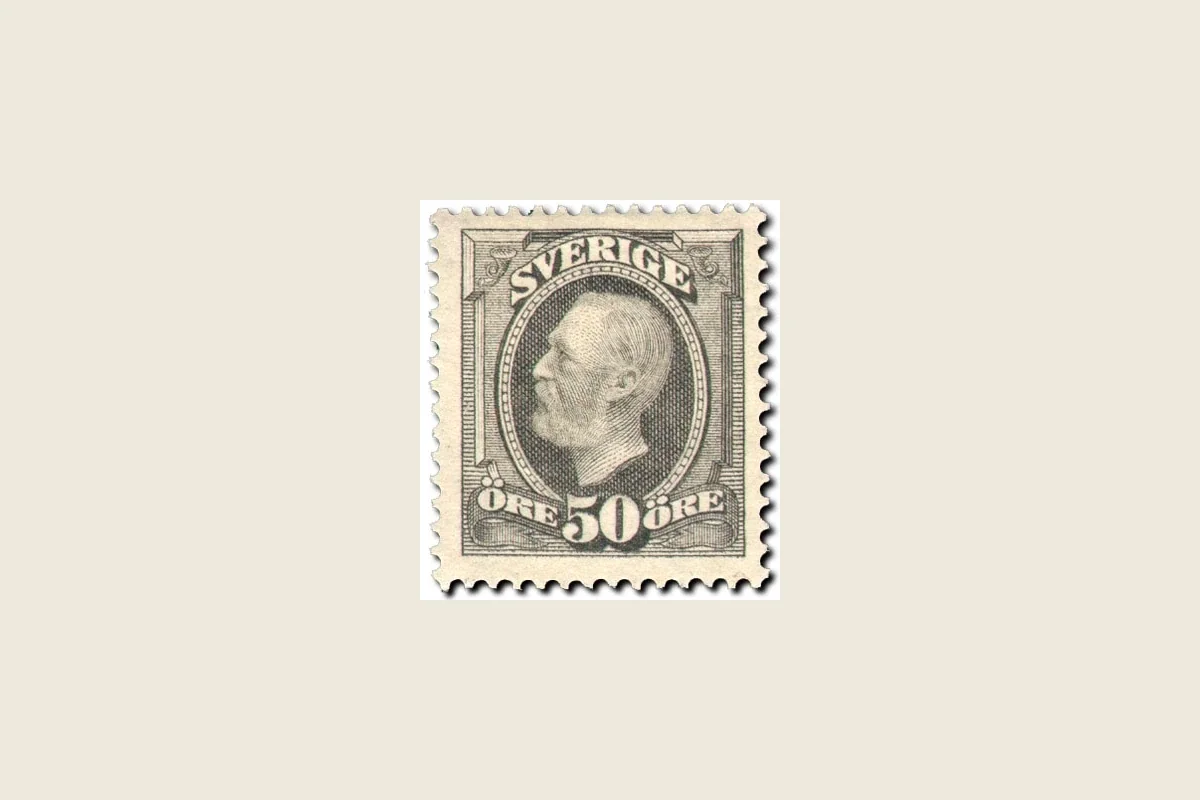
The genuine image reproduced here is Postmuseum item POST.054094, identified as a Swedish 50 öre stamp of the 1891 issue. The file page names Postmuseum as creator and releases the image under CC0 1.0.[8] The scan shows SVERIGE, the large 50, ÖRE, a left-facing portrait and perforated edges. It offers a real design reference instead of a generated reconstruction of the stamp.
It is a front image, with no prominent cancellation visible. It cannot show the gum, certify unhinged condition or demonstrate the watermark. Do not compare the exact screen color with a specialist shade chart. The source image is only 360 by 400 pixels, so the page places it within a larger neutral canvas without claiming that enlargement reveals extra printing detail.[8] No 50 öre price is inferred from this museum object.
Compare your denomination before comparing the portrait. A 10 öre stamp and a 50 öre stamp are not interchangeable evidence. Keep the image's museum identity separate from dealer stock numbers. The scan is not a photograph of any specimen offered in the price table, and the generated desk illustrations elsewhere in the guide are not stamp specimens at all.
Keep documented lookalikes outside an ordinary price match
The specialist's engraved 10 öre page describes imperforate material in two groups. It distinguishes proofs without crown watermark or gum from normal proofs with crown watermark and gum.[17] Consequently, missing perforations alone do not establish a scarce ordinary postage variety. A trimmed perforated stamp also needs exclusion before any imperforate attribution. Preserve margins and connected material, and seek a reference that addresses the complete object.
The same specialist warns that light copies of the common e shade can be confused with the less common c shade.[17] This guide does not supply a color-standard comparison or a priced shade premium. Write an uncertain shade as uncertain. A brightened scan, fading or paper discoloration is not enough to select a specialist entry. None of the simple dealer prices below is evidence for a named plate flaw or experimental paper.
Another documented case is the 10 öre with a C.I. BJELKE advertising mark on the reverse. The specialist also illustrates a Wollmers bazaar label beneath the postage stamp and explains the importance of a cancellation linking the pieces.[18] Do not peel off a backing label or split the combination. A printed advertisement, a posthorn control mark and a watermark answer different identification questions.
Compare these exact dealer asks, not a universal range
All six observations below were checked on 11 October 2026. Frimärks-Netto's currency selector explicitly maps kr to SEK, Swedish kronor. Its category states that catalog numbers follow FACIT Special.[5] The offers describe singles, not sets. The seller's ** category is retained without assigning a gum grade. Do not silently apply these category asks to used album copies, or call them completed sales.
The dealer explains that its images are reference images and that all category entries have an inserted stock balance of 100. Its terms say that 100 denotes a normal stock item, not a unique pictured specimen.[5][16] It is therefore wrong to claim that a photographed stamp is the one you will receive or that 100 verified copies were counted. Availability remains subject to sell-out. Ask for a reverse and exact condition description when a purchase depends on gum.
Duzik's listing is a separate used-single comparison. Its product metadata confirms SKU 1909, GBP 1.80 and a blue posthorn on the reverse.[7] Retain the seller's 1886 attribution as a listing description, not independent certification of your copy. These prices exclude any unestablished transaction charges or shipping comparison. No auction realization, buy-in offer, currency conversion or family-wide resale estimate is established here.
| Stock and source | Identity | Seller condition and quantity | Ask |
|---|---|---|---|
| S39 [11] | letterpress 10 öre, no reverse posthorn | Seller's ** category; 1 single | SEK 3,300 |
| S45 [12] | letterpress 10 öre, blue reverse posthorn | Seller's ** category; 1 single | SEK 1,100 |
| S52gg [13] | engraved 5 öre yellow-green | Seller's ** category; 1 single | SEK 33 |
| S53 [14] | engraved 8 öre violet | Seller's ** category; 1 single | SEK 45 |
| S54 [15] | engraved 10 öre red | Seller's ** category; 1 single | SEK 50 |
| Duzik SKU 1909 [7] | 1886 10 öre rose, perf 13, blue reverse posthorn | Used; 1 single | GBP 1.80 |
Compare condition before comparing a cheaper or dearer offer
The 5 öre yellow-green offer is SEK 33, while the ordinary engraved 10 öre is SEK 50.[13][15] That comparison changes denomination. The SEK 3,300 Facit 39 and SEK 1,100 Facit 45 offers change the earlier letterpress identity.[11][12] None of those differences isolates a universal condition premium. The used Duzik 10 öre and Frimärks-Netto's ** category also differ in condition and seller terms.[7][12]
Use the stamp condition guide to describe your own copy. Check teeth, corners, creases, stains and thinning before selecting a comparison. Write the cancellation and centering separately. A clean-looking front does not establish original gum. Do not remove a cancellation or hinge, wash the paper or flatten a crease to resemble a reference picture. Record faults as part of the identification and price comparison.
Keep the seller's label alongside your observations. If you only have a front photograph, say that reverse condition is unknown. When gum is material to the price, ask for evidence rather than converting a hopeful guess into a mint description. A retail asking price includes the dealer's selling context. It does not establish what that dealer would pay you for an apparently similar stamp.
Make a catalog record another collector can check
Write country, denomination, candidate printing, the reverse posthorn observation, paper finding and whole-item format in separate fields. Add the catalog publisher to a number. The catalog-number guide explains why Facit 54 and a seller's S54 stock label do different jobs. Preserve Duzik SKU 1909 as a stock identifier, not a new catalog entry.[7][15]
If you measure perforations, record the horizontal and vertical readings separately using a physical gauge. Use the perforation guide instead of counting teeth in a resized screen image. A reading does not replace the printing and paper checks. If a damaged edge prevents measurement, retain the uncertainty. Do not restore a missing tooth digitally and then use that edited image as identification evidence.
Save the dated URL and seller description with each price comparison. An item page can change or disappear. Keep the observation date and original currency attached to the number. For an inherited group, sort unresolved examples separately rather than copying one expensive label across the page. A record that admits an unknown back or paper is more useful than a confident number another collector cannot reproduce.
Decide whether you need a sale comparison or specialist opinion
For a selling decision, seek completed transactions for the same identified printing, condition and format. Record the sale date and any buyer's premium basis. The old stamps price list shows why a dealer ask and a realized sale belong in separate evidence columns. None of this guide's six offers establishes a cash resale price for a loose stamp in your album.
Keep an intact cover when the cancellation, route or attached label may matter. A loose-single comparison does not price that postal-history object. Send full images and a literal transcription of the readable date to a suitable specialist. Avoid proposing an early-use premium before someone has checked both the stamp and the cancellation. This guide records the specialist's early-date discussion but supplies no realized-price evidence for early use.[2][3]
Seek specialist comparison for proofs, suspected altered perforations and disputed paper. Explain which physical observation is unresolved. Do not ask only whether the stamp is rare. An exact question about the reverse control mark or paper is easier to check. Ordinary identification can still be useful when the right answer is that the current photograph cannot decide the catalog entry.
Use a scan to plan the next physical check
Photograph one whole object straight on, without cutting off the perforations. Include the denomination in your question. For a red 10 öre, ask whether the image suggests letterpress or engraved printing, then state whether you can inspect the reverse. Save a back image only if it is safe to obtain. Do not expect the front image to prove a hidden watermark or untouched gum.
Stamp Value Identifier & Scan supports individual photo scans and saved discoveries as a collection. Installation is free on iPhone and Android, with in-app purchases or a paid option shown in the stores.[9][10] Use it for a preliminary identification lead and estimated collector context. It is not an official authentication, certification, grading or appraisal service. The tool cannot establish invisible paper features or certify the dealer's condition label.
Save the likely family together with the unresolved question. A useful record might say 10 öre Oscar II, printing unresolved, reverse not inspected, comparison not yet selected. Finish the physical checks before borrowing a price from the table. The blank-paper illustration is a workflow scene, not evidence for the two printing methods, a reverse posthorn or a crown watermark.
Drop a stamp photo here
Show the full stamp, every perforation, and as much front detail as possible in even light.
Organize your Oscar II stamp collection
Install Stamp Value Identifier & Scan free on iOS or Android. Scan individual Oscar II stamps and save the results in your collection. Keep unresolved printing and back questions with your records until you can check the stamps physically.
Frequently asked questions
Is every red Oscar II 10 öre the same stamp?
No. The earlier letterpress 10 öre without and with a blue reverse posthorn differs from the later engraved 10 öre.[1][2][3] Start with printing and back evidence before choosing a dealer category. A shared portrait and denomination do not finish the identification.
Is the blue reverse posthorn a watermark?
No. The earlier letterpress posthorn is a printed reverse control mark.[3] The specialist and Postmuseum record crown paper for the engraved issue.[1][8] Do not infer one feature from a photograph that only shows the other side.
Does a front scan prove that a stamp is mint unhinged?
No. It cannot establish gum or hinge history. The museum 50 öre scan is a front design reference, not a certified condition comparison.[8] Ask for safely obtained reverse evidence and retain the seller's exact condition label.
Do missing perforations prove a valuable error?
No. The specialist documents engraved 10 öre proof material with different paper and gum characteristics.[17] Missing teeth alone do not distinguish a proof, an altered stamp and a cataloged postage variety. No imperforate premium is priced in this guide.
What are the prices in this guide actually measuring?
They are six dated dealer asking prices for described singles, in SEK or GBP, checked on 11 October 2026.[7][5] They are not realized sales, appraisals or a range for every Oscar II stamp. Frimärks-Netto uses reference pictures and an administrative stock marker of 100.[5][16]
Sources and further reading
Primary references and specialist resources used to prepare this guide.
- [1] Oscar II overview
- [2] 1885 letterpress
- [3] Letterpress posthorn
- [4] Evert Klaseboer Sweden catalogue
- [5] Dealer category
- [7] Duzik used 1886 10 ore
- [8] CC0 50 ore museum scan
- [9] App Store
- [10] Google Play
- [11] Frimärks-Netto S39
- [12] Frimärks-Netto S45
- [13] Frimärks-Netto S52gg
- [14] Frimärks-Netto S53
- [15] Frimärks-Netto S54
- [16] Frimärks-Netto terms
- [17] 10 ore engraved and proof lookalikes
- [18] Advertising and bazaar pieces