Quick answer
Bluenose stamp value depends on the original issue, condition and format. For Canada's 1929 dark-blue 50-cent Scott 158, Arpin lists a used single with a small thin at CAD 34.95, a lightly hinged mint single at CAD 244.95 and a never-hinged mint single at CAD 499.95. These are separate dealer asking prices checked on 5 October 2026.
Start with the original 50-cent design
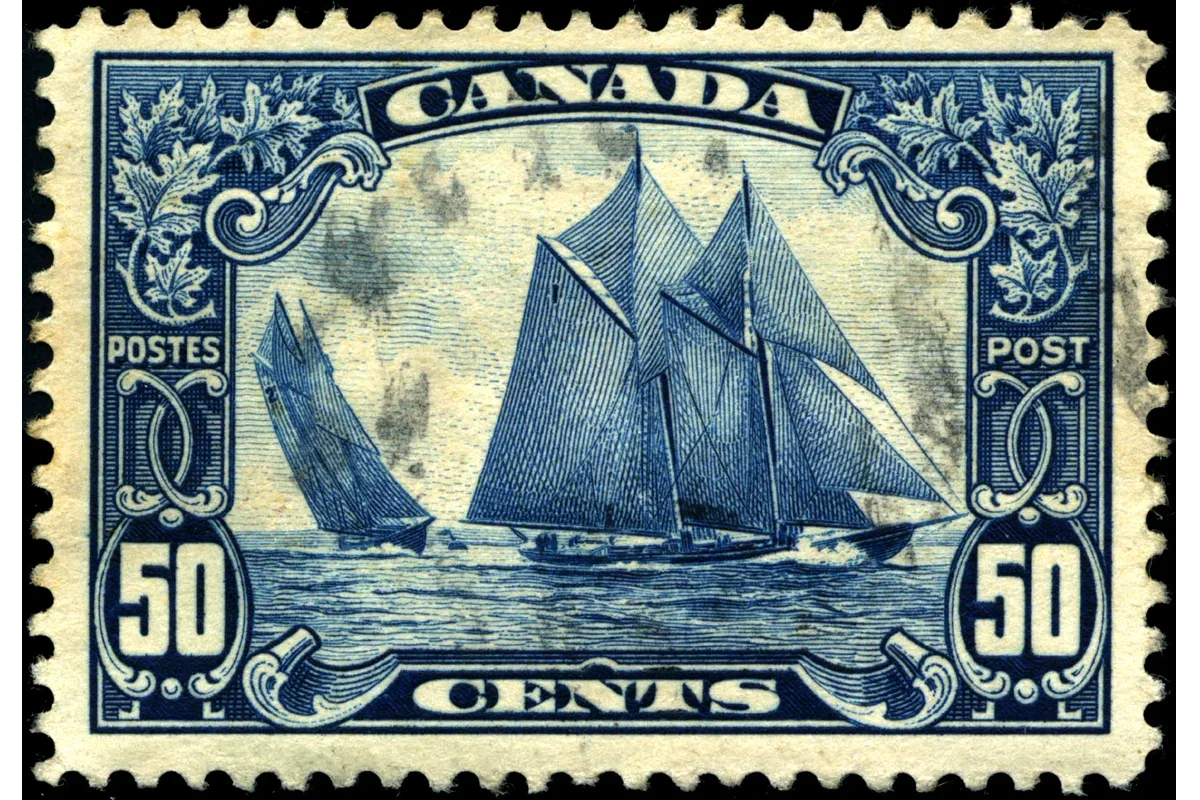
The stamp covered here is Canada's horizontal, dark-blue 50-cent Bluenose of 1929. Arpin identifies it as Scott 158 in the King George V Scroll issue. The central scene shows a sailing schooner within an engraved-looking ornamental frame. Read the country inscription and both denomination corners before using a price attached to the name Bluenose. The subject alone is not an issue identification.
A later stamp can show the same ship or reproduce the old design inside a new design. In that case, the denomination printed on the outer stamp is the first clue to the object you own. A picture of a 50-cent stamp on a larger stamp does not make the outer stamp Scott 158. Album illustrations, postcards and other reproductions also need separating from actual postage stamps.
Compare the complete outline with the genuine scan below, not just the sails. It is a used example for design reference, not one of the dealer specimens in the price table. Its cancellation and condition should not be read as a grade for your stamp. Use the catalog-number workflow if an album label supplies only a number without naming the catalog.
| Feature | Original issue | What to check |
|---|---|---|
| Authority and denomination | Canada, 50 cents | Read the actual outer stamp, not a design reproduced inside it |
| Period and reference | 1929, Scott 158 | Keep the catalog publisher with the number |
| Color and perforation | Dark blue, perforation 12 | Measure an intact edge; do not judge from a resized image |
Five described singles, five different comparisons
These offers were visible on Arpin's Scott 158 page on 5 October 2026. Each row is one loose stamp, in Canadian dollars. The identifiers distinguish actual photographed stock from a generic condition category. Retain those identifiers when checking whether the offer is still available. The listed amounts do not establish your selling proceeds.
The three used rows show why condition should be recorded before price. One dealer calls all three very fine, but explicitly notes a small thin on one specimen. That description is more useful than treating the grade label as a promise of fault-free paper. For mint stamps, the lightly hinged and never-hinged examples must remain separate. Nothing in this table is a completed sale or an amount a dealer has offered to pay you.
Do not average these five amounts. The different backs and condition descriptions explain why they are not interchangeable observations. The old stamps price list gives broader asking-price examples, but the comparison for your Bluenose still needs the same issue, format and condition.
| Stock identifier | Dealer's condition description | Dealer asking price |
|---|---|---|
| U-VF-242 | Used, very fine; small thin | CAD 34.95 |
| U-VF-229 | Used, very fine; described as well centered | CAD 59.95 |
| U-VF-240 | Used, very fine | CAD 69.95 |
| M-VF-230 | Mint, very fine; lightly hinged | CAD 244.95 |
| M-VFNH-243 | Mint, very fine; never hinged | CAD 499.95 |
Gum is the first dividing line for mint examples
For an unused Bluenose, photograph the entire reverse before deciding that it belongs in the never-hinged comparison. A hinge remnant, disturbed patch, crease or missing gum changes the question. Never-hinged describes the gum history claimed for the specimen, not merely the absence of a visible cancellation. A stamp with an attractive face can still have an altered or damaged back.
The table's mint rows make that distinction concrete. Arpin describes M-VF-230 as lightly hinged and M-VFNH-243 as never hinged. Those are the dealer's descriptions of particular stamps, not two universal values for every mint Bluenose. Use consistent lighting for your photographs and do not touch the gum to test it. A smooth-looking surface in a photograph is not proof that gum is original.
If the back is hidden by a mount or an album page, leave the gum assessment unresolved until it can be inspected safely. Our hinges and mounts guide explains the handling distinction. Ask a specialist about suspected regumming rather than promoting the stamp to the more expensive category because its front appears unused.
Read centering and cancellation together
On the Bluenose design, compare the printed frame with the perforated edges on all four sides. Do not judge the margins from the ship alone. A design that leans toward one edge can be harder to compare with a centered dealer example. Look particularly at whether the ornamental frame stays clear of the perforations. Keep missing or shortened teeth separate from the centering description.
On a used stamp, the cancellation can cover the sails, rigging or frame you need for comparison. Record where it falls and whether a place or date can be read. A dark cancellation does not prove a rare variety, and a light one does not establish that the underlying paper is sound. The genuine scan illustrates the issue's design while retaining its own postal markings.
Two used stamps can share the same catalog number and still make poor price comparisons. Arpin's U-VF-229 and U-VF-240 are different stock items. Check their actual photographs alongside the descriptions rather than assuming the difference in asking price measures a single feature. Use the condition guide to describe your own specimen without assigning an unsupported numerical grade.
A small thin can outweigh a clean-looking front
Arpin's U-VF-242 is useful evidence because the dealer names the fault as well as the grade. A small thin means a localized loss of paper. Before choosing a sound used comparison, inspect the back and record any suspect area by location. Keep a crease, stain, tear and thin as different observations. A single word such as damaged hides the feature another collector needs to examine.
Do not attempt to remove a hinge remnant or brighten the paper just to improve the photograph. Such treatment can change the condition and erase evidence of an existing problem. If the stamp is stuck to an album page, photograph it in place and obtain handling advice before lifting it. A detached piece of paper is not a reversible editing mistake.
For a prospective purchase, request an unobstructed reverse image if the seller shows only the face. For a prospective sale, disclose the fault in your notes instead of presenting a centered front as a sound specimen. The table's faulty used example is a comparison for that described item, not a discount formula to apply to every Bluenose with a fault.
Keep sheet margins and blocks intact
Sparks Auctions documents a Scott 158 upper-margin block of four in its lot 241 report published on 5 July 2023. Its description includes never-hinged gum, part of a plate imprint in the margin and the centering of the four stamps. Those details identify a different collecting object from a loose single. The report is historical format evidence, not a current valuation of your block.
If your Bluenose retains a margin, photograph its complete width, any printing and the joined stamps before separating anything. The margin may preserve information absent from a loose stamp. Include the backs and the perforations joining the block, because folds or partial separation also belong to the description. Do not divide a block amount by four and call the result the value of a single.
Likewise, retain a complete envelope carrying the stamp. A loose-stamp offer cannot explain its postal use, destination or accompanying markings. Photograph the full cover before considering removal. Research the entire object first, even if the familiar schooner attracts your attention more quickly than the rest of the envelope.
An imperforate claim needs connected evidence
Sparks' lot 242 report, published on 11 August 2023, describes a mint never-hinged horizontal imperforate pair with a lower sheet margin. That is positive evidence of an identified format, not permission to call every straight-edged Bluenose an imperforate. Keep the pair and its margin together. The unperforated area between attached stamps is more informative than the outside edge of a cut single.
For the ordinary issue, Arpin records perforation 12. Measure intact edges using the perforation guide, and note which sides remain measurable. A digital photograph has no reliable physical scale unless a measurement reference was included. Teeth cut away from a perforated stamp do not create the documented imperforate format.
If you suspect an imperforate single, record its full dimensions and preserve its provenance, but leave the identity open. Ask a specialist to assess whether trimming or another alteration explains the edges. A photograph-based checker can help organize the candidate issue; it cannot certify the origin of missing perforations or replace a physical examination.
Photograph the evidence before checking value
For a loose 50-cent Bluenose, start with one straight-on photograph showing the entire country inscription, denomination, schooner and all edges. Add a reverse photograph to your own record. In collector notes, state whether the stamp is cancelled, whether gum is visible and whether a fault or hinge trace has been observed. Keep a dealer's grade separate from your own observations.
For a pair or block, keep the connected format visible and name the number of attached stamps. If a plate imprint or sheet margin remains, say so rather than submitting a close crop of one stamp. The existing checker below offers a preliminary identification and value context. Compare any suggested Scott reference with the physical features in this guide before using it for a sale description.
Drop a stamp photo here
Show the full stamp, every perforation, and as much front detail as possible in even light.
Keep your Bluenose photographs with their condition notes
Install Stamp Value Identifier & Scan for free on iOS or Android. Scan stamps individually, save their results and organize your collection while you return to uncertain gum or format questions.
Turn the comparison into a next decision
Choose the next step from the evidence, not from the largest amount you found. A cancelled single with a visible thin needs a faulty-used comparison. An unused stamp with uncertain gum needs reverse-side examination. An intact margin block needs block evidence. An apparently straight-edged single needs identification work before it can enter an imperforate comparison.
Keep the source URL, stock identifier, condition wording, currency and date beside each amount. When you later find a completed sale, add its actual sale date and whether the amount includes a buyer's premium. Do not substitute the publication date of an auction report for the sale date. New evidence can refine your comparison without changing the identity of the object already in your album.
Frequently asked questions
Which Bluenose does this price table describe?
The original Canadian dark-blue 50-cent issue of 1929, Scott 158. It does not value every later stamp showing Bluenose, a printed reproduction or an image of the old stamp on another stamp. Read the outer denomination and compare the entire frame.
Is a used Bluenose worth the never-hinged price?
No. The CAD 499.95 observation is Arpin's offer for its mint, very fine, never-hinged specimen M-VFNH-243. A cancelled stamp needs a used comparison. Even two used specimens can differ because of centering, the cancellation and faults.
Why does a thin matter if the front looks attractive?
A thin is lost paper, usually best assessed from the reverse and under transmitted light. Arpin describes U-VF-242 as having a small thin and asks CAD 34.95. That fault remains relevant even though the dealer places the stamp in its very fine used category.
Does a straight edge mean I have the imperforate variety?
Not by itself. A documented imperforate pair retains both stamps and an unperforated joining area. Cutting the teeth off a perforated single creates a trimmed stamp, not evidence of the issued imperforate format. Preserve connected material and ask for specialist examination.
Should I separate a Bluenose block to sell the stamps?
Research the intact block first. An attached sheet margin, imprint, gum and the centering of all stamps belong to its description. Separating it removes format evidence and prevents comparison with an intact-block lot. Photograph both sides before making a decision.
Sources and further reading
Primary references and specialist resources used to prepare this guide.