Quick answer
The most valuable stamps by country are exceptional, precisely identified items, not every old stamp from those places. British Guiana’s 1856 one-cent magenta and the United States’ 1868 one-cent Z Grill illustrate how rarity, exact variety and documentation matter. The examples below distinguish single stamps, a block and a cover, and show how to check your own collection responsibly.
What does “most valuable by country” actually mean?
A country list is a useful way to discover famous issues, but a country name alone does not establish value. Postal administrations changed borders and names, and many celebrated items were issued by colonies or territories before the present-day country existed. The 1856 one-cent magenta was issued in British Guiana, now Guyana; calling it simply a modern Guyanese stamp hides the historical identification that matters.
Nor are all record prices prices for a single loose stamp. A cover is an original mailed envelope or letter, sometimes bearing several stamps. A block contains joined stamps. The form of the lot, its provenance, certificate, and sale date belong beside any headline figure. A very expensive historical result is evidence for that documented object at that auction, not a prediction for another copy or for all stamps from its issuing place.
This guide therefore presents selected, source-documented examples from eight issuing places. It is not a world ranking or a claim that each entry is the absolute record for its country. Amounts remain in the reported currency; we do not convert historical prices using today’s exchange rates.
Notable stamp results by country and issuing place
Use the table as a starting point for identification. Each amount is a reported auction result for a particular lot, with the form of that lot stated explicitly. Follow the source, confirm the sale date and examine the description before comparing any stamp you own. The entries mix single stamps, a block and a cover deliberately to show why an unqualified “most valuable” list can mislead.
| Issuing place | Issue and format | Reported result | What the result refers to |
|---|---|---|---|
| British Guiana (now Guyana) | 1856 1¢ magenta; single stamp | US$9.48 million, 2014 | The sole universally recognized example; later sales can differ. (Sotheby’s) |
| United States | 1868 1¢ Z Grill; single stamp | US$4,366,000, 2024 | A certified rare grill variety, not an ordinary 1¢ issue. (Siegel) |
| Mauritius | 1847 Post Office Bordeaux cover; two stamps on one cover | CHF 6,123,750, 1993 | The intact mailed cover, not either loose stamp alone. (David Feldman) |
| Sweden | 1855 Treskilling Yellow; single stamp | CHF 2,875,000, 1996 | A rare color error with a documented auction history. (David Feldman) |
| Japan | 1871 500 mon centre inverted; single stamp | €4,620,000, 2023 | An inverted-centre error reported by the auctioneer. (David Feldman) |
| Canada | 1851 12d Black on laid paper; single stamp | US$253,700, 2021 | A specific early Canadian example recorded by Siegel. (Siegel) |
| India | 1854 Four Annas Inverted Head; single stamp | £90,000, Spink sale | A particular inverted-head example, not every Four Annas stamp. (Spink) |
| Great Britain | 1840 Two Pence Blue; mint block of four | £96,000, Spink sale | An intact mint block of four rather than one loose stamp. (Spink) |
British Guiana and the United States: look beyond the face value
The Smithsonian National Postal Museum identifies the British Guiana 1856 one-cent magenta as the sole universally recognized example. Sotheby’s records its 2014 sale at US$9.48 million. That story is fascinating precisely because the object is singular and extensively documented. An old stamp marked “one cent” or a stamp from Guyana is not a comparable. The exact colonial issue, shape, paper, cancellation and provenance must all agree. Do not infer that every British Guiana stamp has a high value from one celebrated sale.
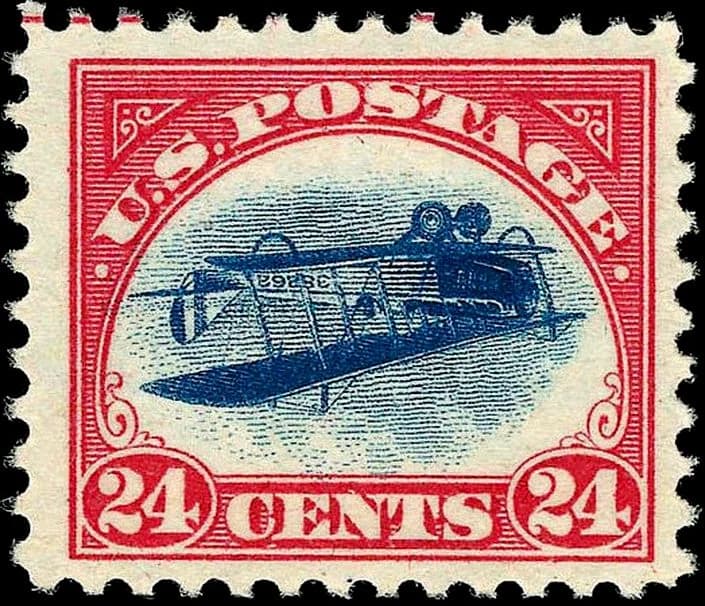
For the United States, the 1868 one-cent Z Grill demonstrates the importance of a tiny physical variety. The grill is an embossed pattern pressed into paper; identifying the correct Z pattern takes more than recognizing the portrait on the front. Siegel’s census reports a US$4,366,000 result in 2024 for a particular example. A common-looking one-cent stamp with a different grill, no grill, or an altered back belongs to a different comparison set. Our perforation guide and catalog-number guide show how to record physical distinctions before searching prices.
Mauritius, Sweden and Japan: format and printing errors matter
The Mauritius Bordeaux cover is an especially important warning about format. David Feldman reports CHF 6,123,750 for its 1993 sale. The object is an original cover carrying both an 1847 one-penny and a two-penny “Post Office” stamp. The price is for the whole postal-history artifact and its history, not a price tag to attach to either stamp separately. If you own a Mauritius stamp, compare it with the same issue and format; do not use a cover result as a loose-stamp estimate.
Sweden’s Treskilling Yellow is famous for its unusual color. David Feldman records a CHF 2,875,000 sale in 1996. A color difference can indeed identify a major rarity, but print, paper, shade and expert opinion matter: faded ink or a photograph’s color cast can mimic a surprising variety. Japan’s 1871 500 mon centre-inverted issue is another error example. The auctioneer reports a €4,620,000 result in 2023 for a particular stamp. An inverted centre must be established against the correct normal issue and supported by documentation; a rotated album scan does not create an error variety.
These results are in different currencies and decades. Even within one country, a current auction estimate, an old realized price and a dealer asking price measure different things. The amounts above are historical sale reports. They should not be placed in one numerical league table without explaining inflation, exchange rates, fees, format and condition.
Canada, India and Great Britain: famous designs still need an exact match
Siegel lists a 2021 sale of an 1851 Canadian twelve-pence Black on laid paper at US$253,700. The words “on laid paper” are part of the identification, not decoration: paper and other production details separate catalog varieties. If a stamp merely resembles an early Canadian issue, first establish the design, denomination, paper and cancellation. The watermark guide explains one other paper feature that can separate lookalikes without damaging them.
India’s 1854 Four Annas Inverted Head is a printing error, not a synonym for every stamp with that design. A Spink lot records £90,000 for a particular example. Authentication is essential when a major error is suspected because the head position, margins, repair and provenance determine whether the item is genuinely comparable. Keep the stamp mounted safely while you document front and back; avoid cleaning, soaking or cutting it from an old cover.
Great Britain provides a useful check against fame-based assumptions. In a Spink report, an 1840 Two Pence Blue mint block of four brought £96,000, while a Penny Black block of four in the same report brought £60,000. These are blocks, not ordinary singles. The Penny Black’s historical importance does not make every surviving example a fortune. Compare an individual Penny Black with an individual stamp of the same plate and condition. A famous design can have a broad range of prices, as our old stamps price list illustrates with ordinary dealer offers.
Why your stamp may not match a record price
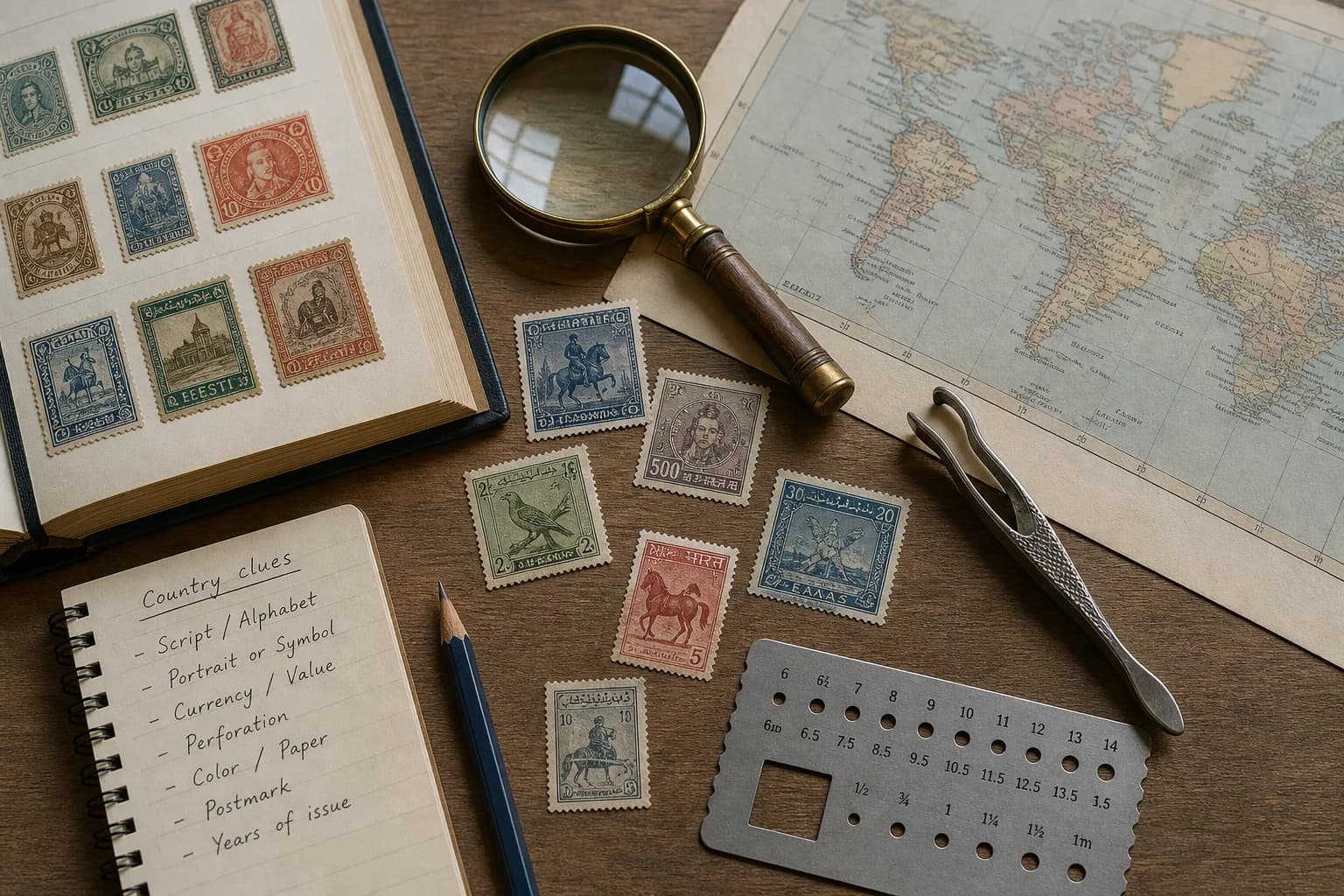
First, establish the issuing authority and date. A modern country label in an album can be wrong for a colonial or pre-independence issue. Look at inscriptions, denomination, script, postmark and the original page label, but treat the album label as a clue, not proof. Our foreign-stamp identification guide can help with inscriptions and scripts.
Second, confirm the exact catalog variety. Color, perforation, paper, watermark, overprint, engraving, grill, center orientation and plate details can change the identity. Many apparent rarities are a common related issue, a reproduction or an altered stamp. A photograph can narrow candidates but may not prove a watermark, grill or expertized color. Record what you can actually observe and leave uncertain features unresolved rather than guessing.
Third, assess condition and format. Missing perforations, thin spots, creases, regumming, repairs, trimming, heavy cancellation and poor centering can change a comparison sharply. Mint and used examples are different markets. A stamp still on its original envelope may have postal-history value that disappears if it is removed. Read our condition-grading guide before selecting a comparable sale.
Finally, check what the number means. The Smithsonian explains that catalog values generally represent estimated dealer retail prices, not what an owner is paid. Dealer listings are asking prices; auctions report completed bids plus any stated buyer’s premium. A real valuation requires matching the same issue, format, authenticity, condition and market date. If the potential value is significant, an expert certificate and specialist auction appraisal may be worth seeking.
A practical way to search a collection by country
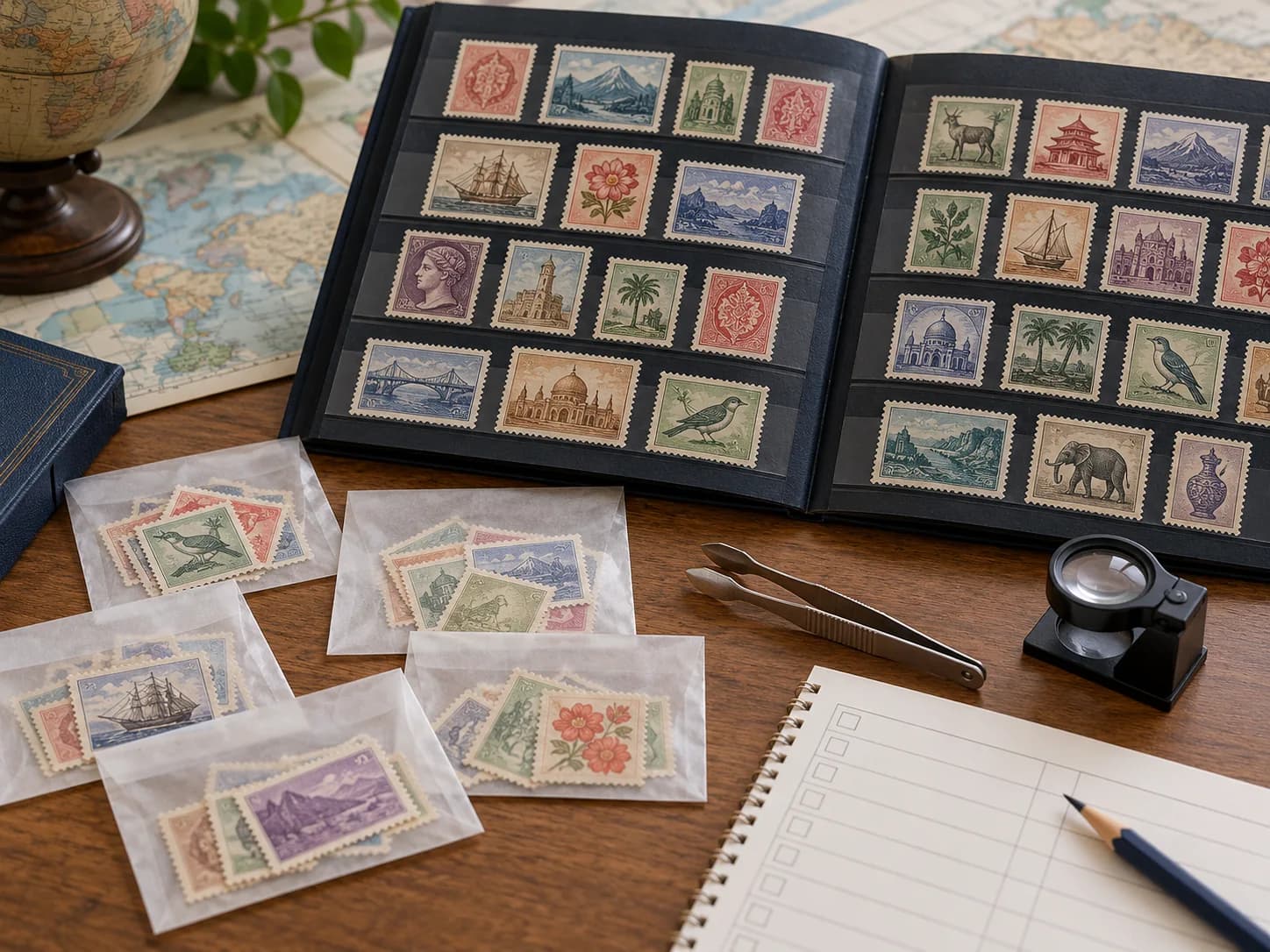
Begin with an inventory, not a hunt for the one famous stamp in every album. Photograph each page before rearranging it. Note the country or issuing place printed on the stamp, any older country name, the denomination, approximate issue period, whether it is mint or used, and whether it remains on a cover. Set aside possible printing errors and early high denominations for closer review; leave fragile or mounted material in place.
For each candidate, take a clear front image and, where safe, a back image. Compare the exact issue in a reliable catalog and check perforations, paper and watermark only with methods appropriate to that stamp. Save a short evidence note: “possibly 1851 Canada 12d Black; paper unconfirmed” is much more useful than “valuable Canada stamp.” Our free old stamp value checker can provide a preliminary photo-based identification and prompts for a single stamp; it does not authenticate a rare variety or appraise a collection.
When a candidate survives those checks, find recent sold examples of the same variety and condition. The old stamps price list is useful for seeing how dealer asking prices are described across countries, but its 201 listings are not auction results. For a whole album, our stamp collection value guide explains how to prioritize pages, record possible highlights and decide when a specialist assessment is worthwhile. The app can help scan stamps one by one and keep the findings together, especially when the collection is large.
How to use this list without overvaluing a find
Treat the table as a map of questions to ask, not a shortcut to a dollar figure. Does your item have the same issuing authority, year, denomination, production variety and physical format? Is the sale figure for a single stamp, joined block or intact cover? Can you see the feature that makes the record example rare, and can an independent expert verify it? If any answer is uncertain, keep the identification provisional.
A good next step is to compare one carefully identified item with several genuinely similar sold lots, then state a range with the condition differences explained. If you only have a seller’s offer, call it an asking price. If you have a catalog figure, call it a catalog value. If you have a rare-error claim, seek expertization before listing or insuring it. This evidence-first approach is slower than a headline list, but it protects a collector from both false excitement and missing a genuine rarity.
Frequently asked questions
Which country has the most valuable stamp?
There is no useful country-wide answer without defining a date, currency and lot format. A famous example is the British Guiana 1856 one-cent magenta, sold for US$9.48 million in 2014, but that is one documented stamp, not a value for other Guyanese issues.
Does an old stamp from one of these countries have value?
Possibly, but age and country alone do not determine price. Identify the exact issue and variety, inspect condition, confirm authenticity where needed, and compare equivalent recent sales.
Is a price for a cover or block the same as a single-stamp price?
No. A cover includes its postal use and history, while a block contains joined stamps. A result for either should not be applied to a loose single stamp.
Can a phone photo prove I own a valuable error?
A clear photo can help narrow the issue, but it may not establish paper, watermark, grill, color authenticity or repairs. Significant error claims should be checked by a qualified expertizing service.
What should I do if I think I found a rare stamp?
Leave it in its current mount or on its original cover, photograph both sides where safe, write down observable details, compare the correct catalog variety and seek expertization before selling, cleaning or insuring it.
Sources and further reading
Primary references and specialist resources used to prepare this guide.
- Smithsonian National Postal Museum, British Guiana 1856 one-cent magenta
- Sotheby’s, Three Treasures Collected by Stuart Weitzman
- Robert A. Siegel Auction Galleries, 1¢ Z Grill census and sale record
- David Feldman, Mauritius Bordeaux cover sale
- David Feldman, company auction history including Treskilling Yellow
- David Feldman, Japan 500 mon centre inverted result
- Robert A. Siegel Auction Galleries, Canadian 12d Black sale note
- Spink, India Four Annas Inverted Head lot
- Spink, 1840 Great Britain mint blocks sale report
- Smithsonian National Postal Museum, FAQ on stamp catalog values