Quick answer
Kangaroo and Map stamp value depends on denomination, watermark and condition, not the animal alone. On 6 October 2026, Richard Juzwin offered a first-watermark 3d olive die 1 at AUD 150 lightly hinged and AUD 295 unhinged. These are mint-single dealer asking prices, not sales or valuations for ordinary cancelled copies.[9][10]
Start with the map, denomination and currency
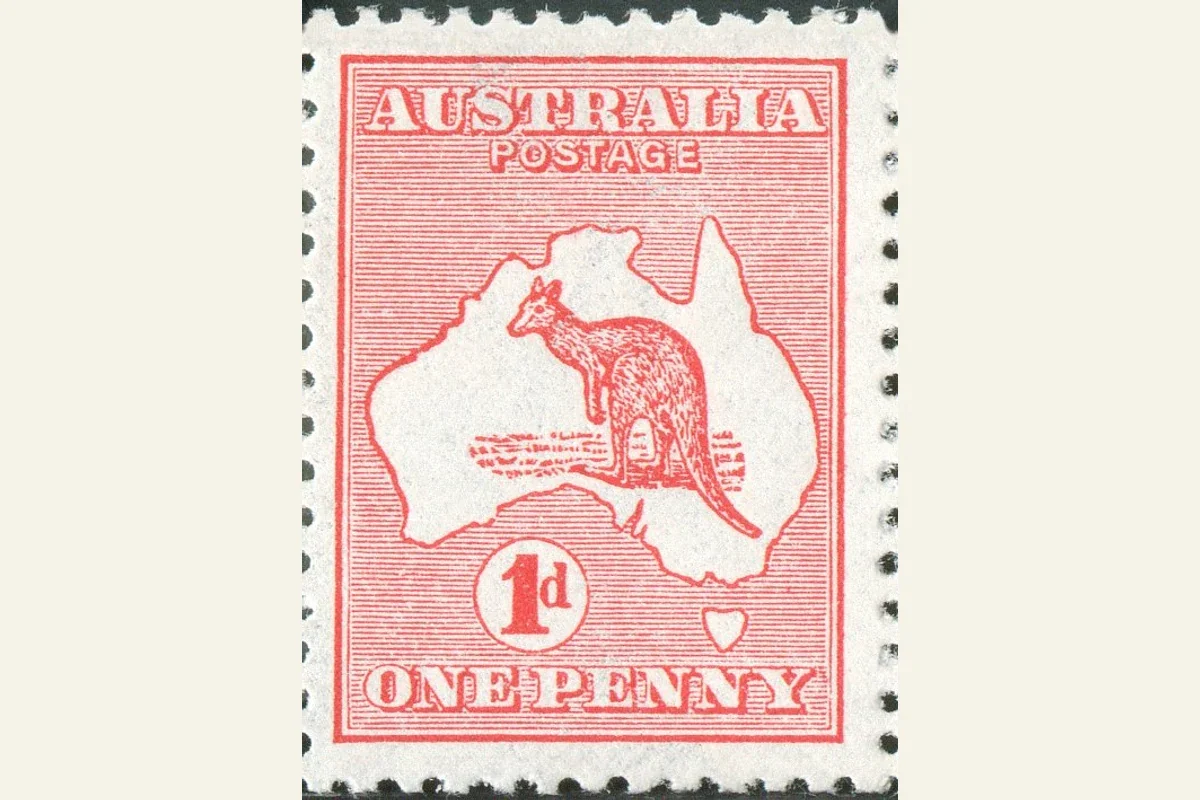
Look for AUSTRALIA above POSTAGE, a kangaroo against the pale outline of Australia, and a denomination near the foot of the design. The genuine reference scan below shows the red one-penny design. It demonstrates the family, not a particular gum state or watermark. A recognizable animal gives you a starting identification; it does not establish which printing you own.[5][7]
Transcribe the denomination before searching prices. One penny, half a penny and two and a half pence are pre-decimal amounts, not Australian cents. A shilling inscription and a pound inscription belong in different searches from a penny value. Keep the printed currency unit in your notes rather than replacing it with a modern dollar equivalent. The amount paid for postage is not a present collecting price.
This guide covers practical sorting of the definitive family and ordinary low-denomination mint comparisons. It is not a catalog of every shade, plate position or error. Do not take a price for a top denomination and apply it to a red 1d. For a publisher-specific reference, follow the catalog-number guide and retain the publisher as well as the complete number.
The original issue and the centenary are different stamps
Australia Post records the original Kangaroo and Map releases between January and April 1913. They replaced the colonial stamps used in the individual states. Its retrospective also records a $10 centenary stamp released on 10 May 2013. Those are different postal issues despite their shared subject. Read the entire outer stamp, including the denomination, before assigning an original-series identity.[4]
An album can place a modern commemorative, a reproduction and an original beside one another under a single heading. A printed image of the old design inside a newer stamp does not make the whole item a 1913 penny stamp. Equally, an old postmark tells you about use, not automatically about the first printing. Keep the postmark date separate from the catalog issue date.
If the image is cropped so tightly that the surrounding frame disappears, obtain a full view. Do not identify only the kangaroo inside the map. Check whether the object is a single adhesive stamp, part of a miniature sheet, or an illustration printed on another collecting item. The four prices below apply only to individually described original-family mint singles.
Five paper groups under one familiar design
APTA lists five watermark groups for Kangaroos: first watermark, second watermark, third watermark, small multiple watermark and C of A watermark. Treat these names as identification categories, not levels of quality. A stamp with the same denomination and similar front color can belong to a different paper group. You need the paper evidence before choosing the corresponding catalog entry.[5][6]
Glen Stephens explains that the first three all show a single crown over A and can be difficult for beginners to separate. His illustrated discussion identifies the second watermark by its broad crown with sharp corners. A partial crown or an isolated letter A may not be enough to decide. Compare the complete pattern and its proportions with a reliable illustrated reference, not a remembered outline.[6]
The names also differ across catalogs. Stephens notes that Scott, Stanley Gibbons and Michel use different watermark numbers for these same first three groups.[6] Write first, second or third watermark beside your chosen catalog publisher. Do not assume a watermark number copied from one publisher can be pasted into another publisher's listing unchanged.
| Group | What to establish | What not to assume |
|---|---|---|
| First / second / third | Which single crown-over-A form is present | A visible A alone settles the group |
| Small multiple | The repeating small watermark pattern | Similar front color identifies paper |
| C of A | The relevant C of A pattern | Every Kangaroo is a 1913 printing |
Read the reverse without forcing a result
Begin with a loose stamp, tongs and a clean dark inspection surface. Look at the back in ordinary and oblique light. Record the crown, lettering and which fragments are actually visible. Keep the stamp's front orientation consistent when recording the reverse. A watermark described as inverted concerns the paper pattern relative to the design, not a phone photograph rotated upside down.
Do not bend the stamp to test a paper group or deliberately curl it. Do not improvise with lighter fuel, household solvents or water, particularly on mint stamps. If dry inspection is inconclusive, leave watermark unresolved and use our watermark-identification guide before choosing a specialist method. An attached hinge or mount is a reason to slow down, not to pull the stamp free.
Stephens's older article includes practical techniques and historical price remarks.[6] We use its illustrated identification discussion, not those old amounts as current values or its solvent advice as a handling instruction. If the pattern remains incomplete, a specialist's in-hand comparison is better than choosing whichever watermark has the highest listed price. Record uncertainty where it affects the comparison.
Four exact offers checked on 6 October 2026
These Richard Juzwin retail listings describe one mint stamp each. Their product pages and structured offers agree on the displayed prices, stock SKUs and AUD currency. The visible dollar sign is therefore Australian dollars, not an assumed US-dollar amount. Retain the SKU as well as the catalog reference because two SG 5 examples have different backs and different prices.[9][10][11]
All four amounts are dealer asking prices observed on 6 October 2026. No completed sale, auction estimate, hammer price or buyer's premium is claimed. Shipping and destination-specific adjustments are not a price for the stamp itself; the dealer's payment page describes its overseas GST treatment.[13] The table records the displayed item amounts without converting currencies or recalculating an export total.
The useful comparison is narrow. The first-watermark 3d examples separate lightly hinged from unhinged stock. The 2½d examples separate first and third watermarks, but also carry different color and condition wording. They do not isolate a pure watermark premium. See the old stamps price list for how to read retail evidence without treating an asking price as an offer to buy your stamp.
| Identity and stock SKU | Dealer condition description | Dealer asking price |
|---|---|---|
| SG 5, first watermark, 3d olive die 1; SKU 35362 [9] | Fresh, mint lightly hinged | AUD 150.00 |
| SG 5, first watermark, 3d olive die 1; SKU 32570 [10] | Fresh, mint unhinged | AUD 295.00 |
| SG 4, first watermark, 2½d indigo; SKU 35566 [12] | Very fresh, mint unhinged | AUD 275.00 |
| SG 36, third watermark, 2½d deep blue; SKU 35684 [11] | Very fine mint unhinged | AUD 100.00 |
An ordinary used copy needs a used comparable
A cancelled 3d is not comparable to a never-hinged mint 3d simply because the front design matches. The table deliberately preserves the dealer's gum categories and includes no price for an ordinary used 1d or 2d. There is no verified used-low-value range in this packet. Do not extrapolate one from the mint rows or from a famous error result.
When researching a used copy, first match the denomination and watermark. Then compare the cancellation, centering and paper faults. A retailer's neatly cancelled single, a bulk packet and a damaged album stamp are different offers. Retain the quantity and condition with the amount. A price for a packet of assorted Kangaroos cannot be divided into a reliable value for your exact loose stamp.
Describe what you can see without assigning a dealer's grade to your own item. If a heavy postmark hides the value, improve the front photograph before choosing a catalog reference. If the back is not accessible, keep both watermark and paper condition open. An incomplete identification is useful research progress, but it is not yet a matched price comparison.
Gum and faults change the mint comparison
No postmark does not prove unhinged original gum. On a safely accessible back, note a hinge remnant, a disturbed patch, missing gum and any thin or tear. If the mount hides the back, write gum unexamined. Do not rub or moisten the gum. The condition category is part of the identity of a retail offer, not an optional footnote.
The AUD 150 and AUD 295 SG 5 rows show two differently described mint singles.[9][10] They do not establish a universal multiplier for unhinged stamps. Centering, freshness and any unreported differences still belong to the actual specimens. Keep the original descriptions rather than calculating a percentage deduction for every hinge mark you find in an album.
Look around the full printed frame for clipped or shortened teeth, a close cut, stains and creases. Our condition-grading guide helps record these separately. A clean kangaroo image does not cancel a thin on the back. If regumming, repairs or altered perforations are suspected, preserve the stamp and seek an in-hand opinion before using a sound-mint offer.
OS punctures and overprints are not ordinary damage
APTA records large and small OS punctures and black OS overprints for official use. It also illustrates a stamp punctured for official use in New South Wales.[5] Deliberate letter-shaped holes deserve a separate identity check. Do not automatically classify them as random damage, and do not assume every perforated letter pattern carries the same specialist value.
Photograph the complete hole pattern from both sides if safe. Transcribe printed overprints separately from punctures and postal cancellations. A written album label such as official is a lead, not proof that the marking is genuine. This guide does not price any OS stamp; the unoverprinted mint table should not be applied to an official item without verifying its proper listing.
A suspect marking changes your next step. Compare its shape, placement and catalog description before looking for a price. Do not add a speculative surcharge to the ordinary stamp's offer. Keep the object intact and retain any earlier certificate or dealer description, since physical examination may be needed to distinguish a genuine official marking from a later alteration.
Shade, die and plate claims need their own evidence
The two SG 5 listings both specify 3d olive die 1.[9][10] A listing for another die or a named plate flaw is not interchangeable with them. Before using a specialist description, compare the exact diagnostic feature against an illustrated catalog or specialist reference. A pale spot in a compressed image may be paper wear or a cancellation break rather than a constant printing flaw.
Color alone is a poor shortcut. The 2½d offers use indigo for SG 4 and deep blue for SG 36.[11][12] Phone white balance and screen brightness can move a photographed blue. Preserve the denomination and watermark evidence, and do not claim a scarce shade from an edited picture. Keep any specialist shade attribution as a claim until a suitable reference comparison supports it.
If an unusual feature seems repeatable, save unedited close-ups and a complete front image. Do not clean the stamp or improve the appearance of the suspected flaw. Our errors and varieties guide explains the evidence needed before treating an anomaly as a cataloged variety. No rarity price is supplied here for an unverified die, watermark inversion or plate flaw.
Keep joined stamps and covers in their original format
A pair, block or complete cover is not the single offered in the price table. Photograph the whole object before cropping a detail. For joined material, preserve any margin and inscription that survives. For a cover, keep the address, dated cancellation and other stamps together. Do not cut out or soak off the Kangaroo merely to make a loose-stamp comparison easier.
Write the number of stamps and the format in your record. A block with different hinge states across its stamps needs more than a single mint label. A cover with an interesting postal route needs a postal-history comparison, not multiplication of a mint price. Our selling guide explains how retaining context helps a specialist assess the actual object.
Photograph the front and state what remains unresolved
For the checker, use a straight-on image with all edges visible. Add the printed denomination, the observed color, cancellation and whether you inspected the back. If you think it is a third-watermark 2½d, explain what part of the pattern you saw. A note saying watermark unresolved is more useful than a confident rare-variety label unsupported by the photograph.
The shared checker can suggest an issue and collector context. A front photo cannot establish a hidden watermark, original gum or the authenticity of OS punctures. Keep a full-object image of covers and blocks in your records and mention that format in the notes. Return to any proposed catalog match after you obtain the missing physical evidence.
Drop a stamp photo here
Show the full stamp, every perforation, and as much front detail as possible in even light.
Keep your Kangaroo paper groups separate
Install Stamp Value Identifier & Scan for free on iOS or Android. Scan stamps individually, save results and organize the collection while you record denominations, watermark observations and unresolved gum questions.
Choose the next comparison from the missing feature
If the denomination is clear but the watermark is not, work on paper identification before collecting more prices. If the watermark matches but the gum is hidden, obtain a safe reverse view. If the object has an official marking or a suspected variety, switch to that identity rather than using the ordinary table. These decisions prevent the most tempting but least useful high-price comparisons.
Keep the source URL, SKU, condition, currency and observation date together. A later completed sale can strengthen your market evidence only if the identity and format match and the transaction date is recorded. Until then, the four offers here are traceable retail observations for specific mint singles. They are not a guaranteed selling price, a whole-album valuation or evidence that every Kangaroo is scarce.
Frequently asked questions
Does every Kangaroo and Map stamp date from 1913?
No. Australia Post records the original releases between January and April 1913, while APTA lists five watermark groups across the family. Australia Post also records a separate $10 centenary issue on 10 May 2013. Identify the complete design, denomination and paper rather than dating the animal alone.[4][5]
Can I tell the first three watermarks from the front?
Not reliably. They all use a single crown over A. Compare the paper pattern on the reverse with an illustrated reference. A partial letter A or a similar front color is not enough to choose the first, second or third group.[6]
What is the price evidence for a 3d olive Kangaroo?
On 6 October 2026 Richard Juzwin offered first-watermark SG 5 die 1, SKU 35362, mint lightly hinged at AUD 150, and SKU 32570, mint unhinged at AUD 295. Those are dealer asking prices for singles, not completed sales or used-copy values.[9][10]
Are OS holes always damage?
No. APTA documents large and small OS punctures used for official stamps, as well as black OS overprints. Record the pattern separately and verify the marking. This guide does not assign an official-stamp price.[5]
Can a red one-penny stamp use the mint prices in this table?
No. The table covers specified 2½d and 3d mint singles. A red 1d needs its own watermark, condition and format match. The reference scan shows its design only; it is not a priced stock specimen or evidence of gum.
Sources and further reading
Primary references and specialist resources used to prepare this guide.
- [4] Australia Post: original 1913 releases and the 2013 centenary
- [5] APTA: five watermark groups and official markings
- [6] Glen Stephens, August 2017: separating the first three watermarks
- [7] Wikimedia Commons: public-domain one-penny design reference
- [9] Richard Juzwin: SG 5, SKU 35362, checked 6 October 2026
- [10] Richard Juzwin: SG 5, SKU 32570, checked 6 October 2026
- [11] Richard Juzwin: SG 36, SKU 35684, checked 6 October 2026
- [12] Richard Juzwin: SG 4, SKU 35566, checked 6 October 2026
- [13] Richard Juzwin: payment and description policies