Quick answer
Australia George V stamp value depends on the exact head issue, paper and condition. On 7 October 2026, a dealer asked GBP 0.80 for a fine-used SG 20 halfpenny. Another asked AUD 795 for a used 1d green with a reversed C of A watermark and a dealer certificate. These are retail asks, not completed sales.[2][3]
Identify the Australian head design first
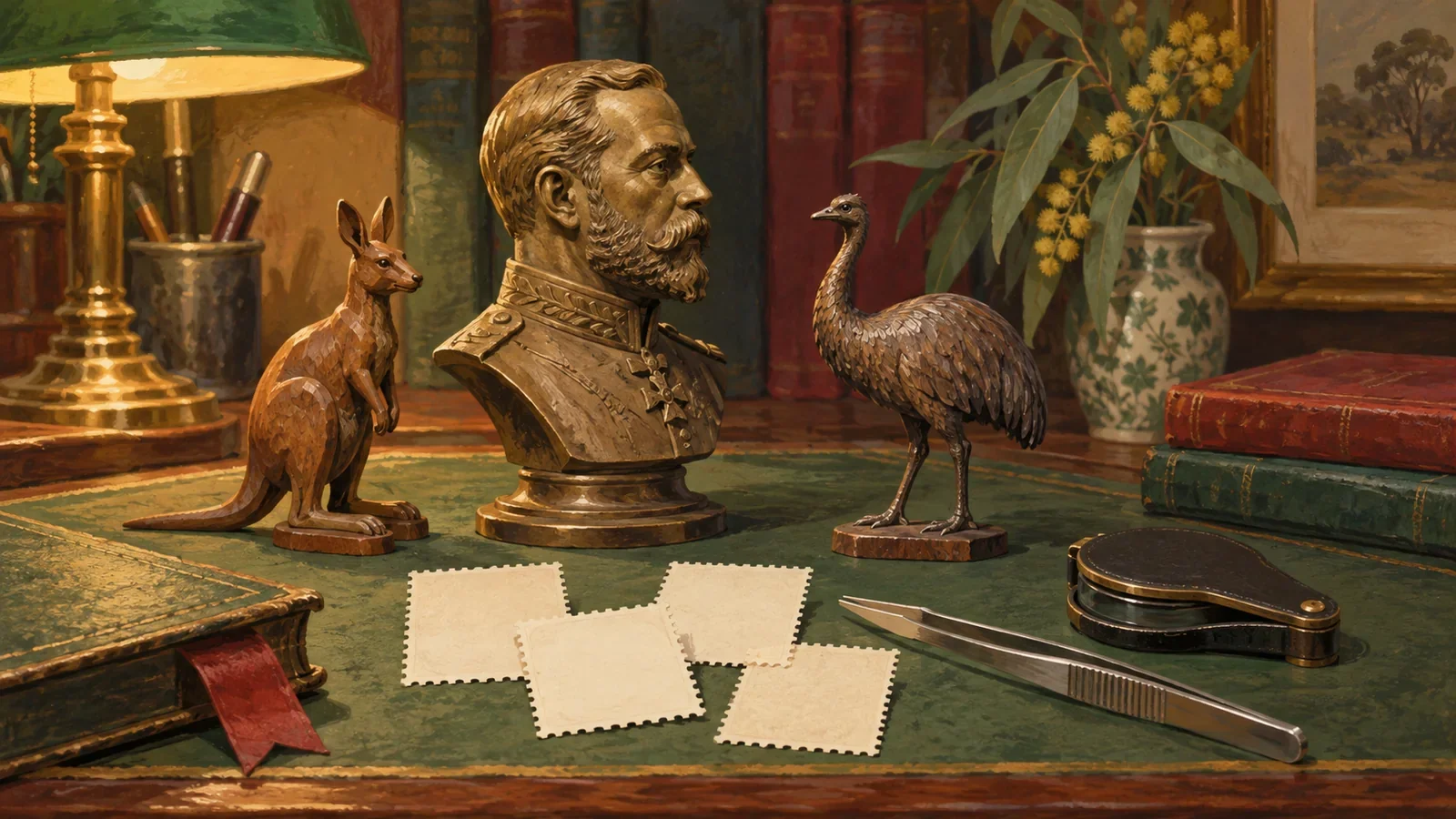
Start with the complete stamp, not the face alone. APTA describes the Australian KGV head design as George V's portrait with a kangaroo at the left and an emu at the right. Its examples include several denominations and an OS overprint.[1] Check the country inscription, value and side ornaments before assigning this family. A monarch's portrait is not enough to identify a country.
This guide concerns Australia's George V head definitives. It does not price every stamp issued during his reign. The Kangaroo and Map family has a different central design and its own paper groups. Canada's George V portraits also need Canadian catalog listings. Do not carry an Australian catalog number or a watermark assumption into a Canadian album page.
Write the printed denomination exactly, including halfpence or pence. A 1d inscription is one penny, not one modern Australian dollar. Record whether you have a loose single, joined stamps or an envelope. Take a complete photograph before enlarging a detail. Those first notes prevent an attractive portrait match from turning into the wrong price search.
The front cannot settle the paper group
APTA separates single watermark, large multiple watermark, small multiple watermark, C of A watermark and paper without a watermark.[1] These are paper categories, not a ladder of increasing value. The last category is not permission to call any stamp unwatermarked when your first inspection reveals nothing. A faint or incomplete pattern can remain unresolved.
Use the watermark guide to record what you actually see. Keep the front upright in your reference photograph and note how you viewed the back. Compare the pattern with the illustration for the selected catalog entry. A crown fragment, one letter or an album caption may leave more than one possible listing.
Do not reuse the first, second and third watermark sequence from a Kangaroo listing as if it automatically describes this head stamp. Work within the head issue's own catalog section. When you cannot reach the back safely, write watermark unexamined. That answer is more useful than assigning the paper with the largest advertised price.
| Paper group | Evidence to record | Common mistake |
|---|---|---|
| Single watermark | Visible pattern and orientation | Naming the paper from front color alone |
| Large or small multiple | Pattern scale and repetition | Treating a partial mark as a complete pattern |
| C of A | Lettering, crown and orientation | Calling a rotated photo an inverted watermark |
| No watermark | Positive identification of the correct issue | Equating an unseen mark with unwatermarked paper |
Measure perforations without changing the stamp
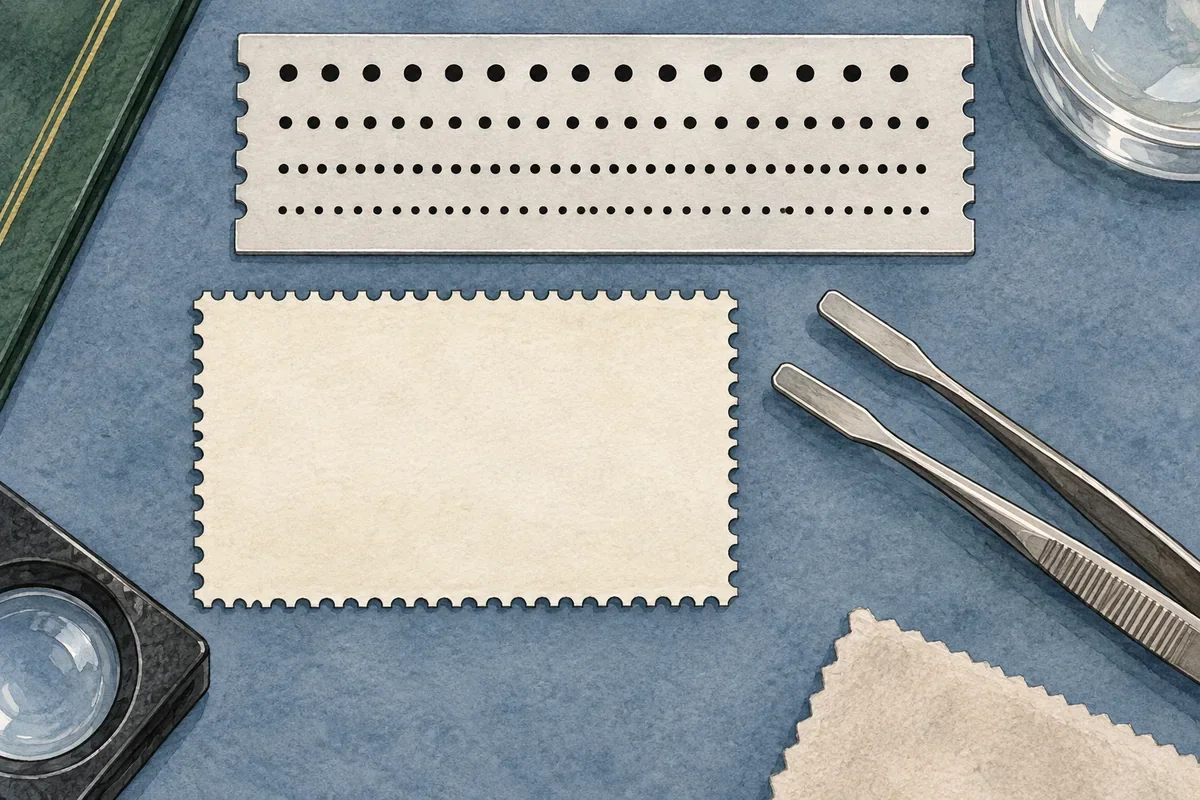
Perforation evidence belongs beside the paper identification. Use a gauge to measure the horizontal and vertical edges separately, following the perforation-measuring guide. Keep both readings even when they agree. A phone photograph can show a toothed edge, but enlargement does not turn it into a reliable gauge measurement.
Avoid pushing teeth against a ruler or trimming an untidy edge. Record a short or missing tooth as a fault. A straight-looking side may reflect trimming, a damaged separation or the item's original format; it does not prove an imperforate rarity. If joined stamps or margins survive, keep them attached while you research the format.
Scott Starling's shade-set description explicitly distinguishes line-perforated entries and also names thin paper and die III entries.[4] That is a useful warning against grouping every red penny under one label. This guide supplies no complete perforation-to-catalog crosswalk. Confirm the exact denomination, paper and measured gauge in a current specialist reference before choosing a number.
Keep catalog systems and stock codes separate
The used halfpenny offer below identifies SG 20 and Scott 19. The reversed-watermark penny offer identifies ACSC 82Baa and SG 125x.[2][3] Those pairs show why a bare number is not a complete identification. Keep the publisher name and every suffix. A dealer's product code is another identifier, not a substitute for the catalog number.
Use the catalog-number guide if an inherited album gives only a handwritten number. Record that label as an earlier attribution, then test it against the stamp. If your chosen catalog lists a different paper or perforation, stop rather than editing the physical evidence to fit the label.
A workable record reads country, head design, denomination, observed color, watermark status, perforation readings, condition and catalog candidate. Add the dealer's stock code only when you save a comparable offer. This separates what you own from what another person is selling and makes a later expert correction easier to follow.
Three retail offers checked on 7 October 2026
The table preserves original currencies and the actual offer formats. Commonwealth Stamp Store's selected currency and structured offer both identify GBP. Scott Starling prints AUS$ on the product pages, so those amounts are Australian dollars. No amount here is assumed to be USD.[2][3][4] Shipping is not included in these displayed item amounts.
The inexpensive halfpenny is a fine-used single. The green penny has a specified reversed watermark and a Starling certificate. The red-penny offer is a whole shade set, not one loose red stamp.[2][3][4] None establishes a family-wide price range. Ask whether a comparable matches your item before deciding whether its amount is informative.
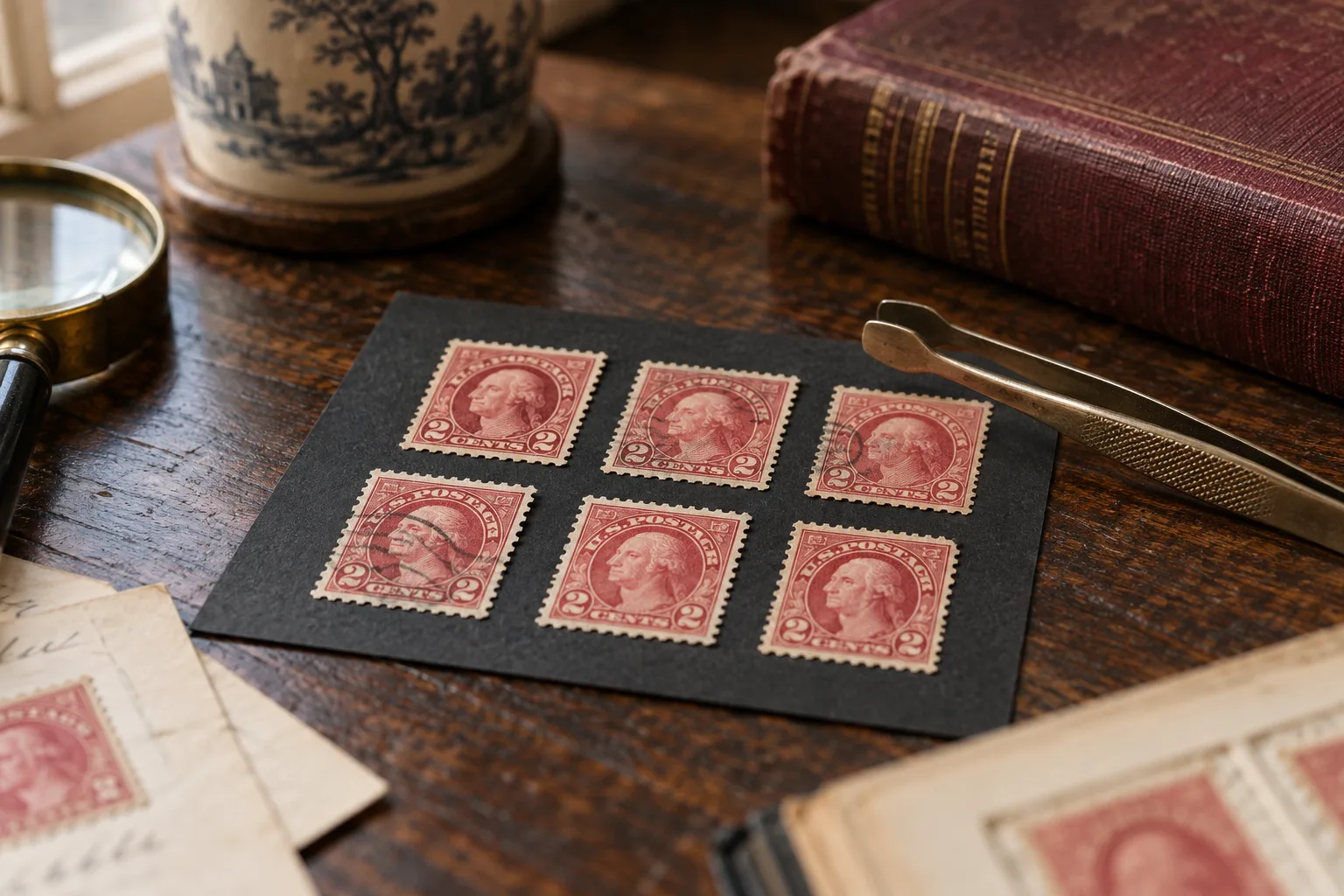
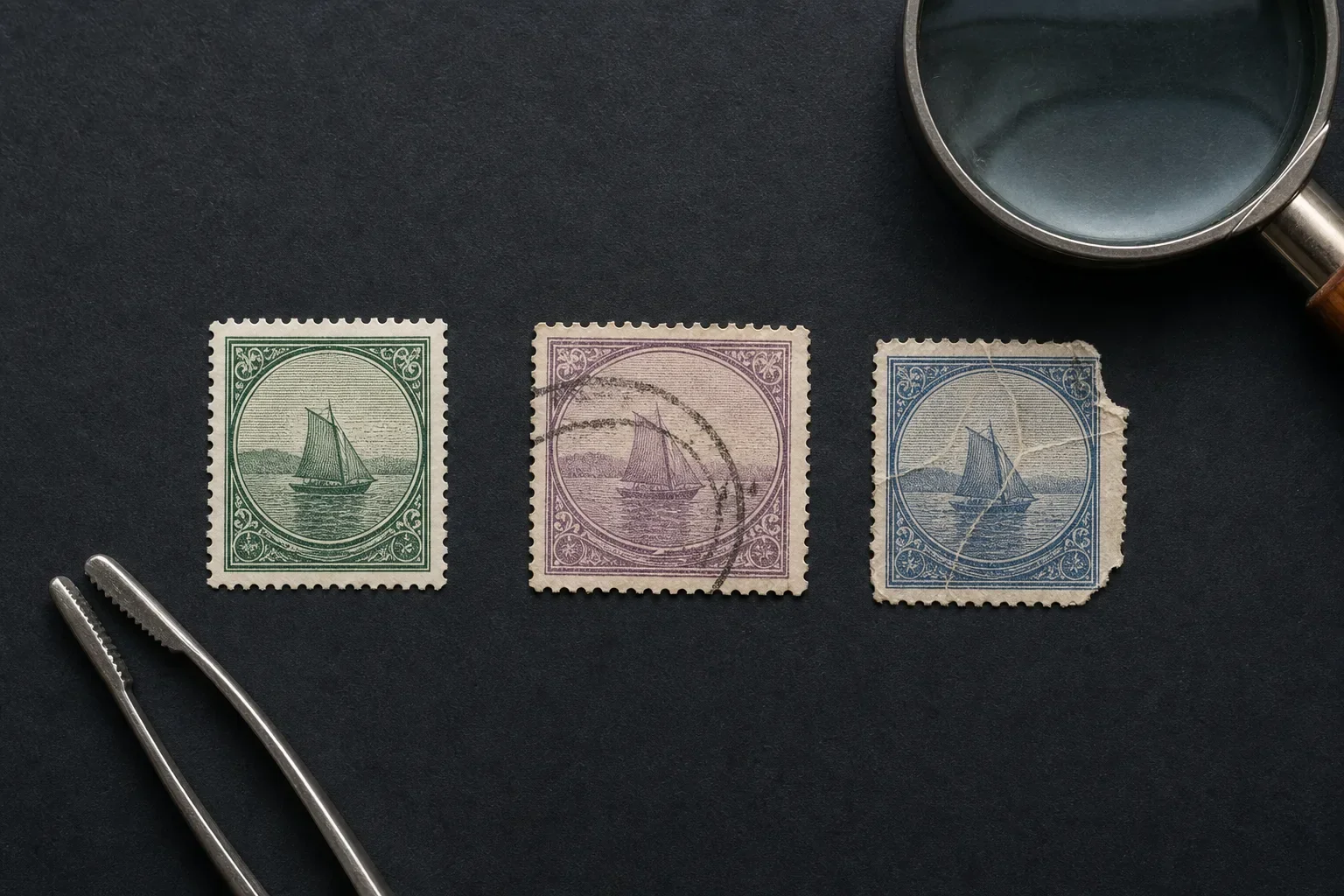
Availability is a dated observation, not a promise that stock remains unsold. Commonwealth also states that its photograph is representative rather than the exact item supplied.[2] We do not reproduce dealer pictures as evidence. The illustrations in this guide depict equipment and themes, not the actual retail specimens.
| Dealer, identity and stock reference | Condition and quantity | Original-currency ask and availability |
|---|---|---|
| Commonwealth Stamp Store; halfpenny; SG 20 / Scott 19; product 28908 [2] | Fine used; one stamp; representative stock photo | GBP 0.80; In Stock; exact stock count not disclosed |
| Scott Starling; 1931 1d green; reversed C of A; ACSC 82Baa / SG 125x; product code 25298, URL product_id 23932 [3] | Used; one stamp; dealer reports no thins, tears or bends and a Starling certificate | AUD 795.00; Availability 1 |
| Scott Starling; 1914-1920 1d red G1-G111 basic shade set; individual ACSC entries in listing; product code 27553, URL product_id 26108 [4] | Used; one whole set; dealer reports no thins, tears or bends | AUD 325.00 for the set; Availability 1 |
Why the low and high asks are not interchangeable
Do not read GBP 0.80 and AUD 795 as the bottom and top of one usable valuation range. They refer to different denominations and different identities, in different currencies.[2][3] The expensive row cannot value an ordinary green penny until its particular watermark claim and condition match. The halfpenny row cannot value every ordinary head issue either.
A retail asking price records what a seller requests. It does not show that a buyer paid it or what a dealer would pay you. For a selling decision, look for completed transactions with matching identity, condition and quantity. Retain the sale date and any premium basis. No completed-sale evidence or auction result is claimed in this guide.
Keep foreign-currency offers in their original units in your research notes. If you later convert them, record the conversion date and rate separately. Conversion cannot repair a poor identity match. For an album with many ordinary used copies, ask about the lot as a lot rather than multiplying a specialist single's retail ask by the number of stamps.
A red penny needs more than a shade name
The G1-G111 label is the dealer's range of shade references, not a claim that the set contains every intervening integer. The offer lists individual entries and notes several distinctions beyond color.[4] Retain the whole-set quantity. Dividing its asking price by an assumed number of stamps does not produce an offer for your unidentified red penny.
Use an unedited photo with neutral light to describe apparent color, but do not certify a specialist shade from a screen. Ink appearance can be confused by illumination, paper staining or image adjustments. Compare actual reference material where a named shade matters. A strong red in a family photograph is not proof of an aniline printing.
Paper, die and shade claims should support one another, not compete for the highest price. Leave a specialist attribution open when the reference evidence is missing. Keep a close-up of the suspected diagnostic feature and a full front view. Do not remove a stain or alter contrast to make the stamp resemble a scarcer catalog illustration.
Inspect condition before borrowing a sound-copy price
Record centering, all edges, cancellation and any stain or crease. On a safely accessible back, look for thins, tears, hinge remnants and disturbed gum. Use the condition guide to separate these observations. A clean portrait does not cancel a fault on the reverse.
An unused-looking front does not prove never-hinged original gum. Do not peel a hinge, moisten the back or press a crease flat. If a mount hides the reverse, say gum and back unexamined. The priced rows here are used material; there is no verified mint or never-hinged price comparison in this packet.
The dealer's sound-condition description belongs to its offer.[3][4] Do not adopt that wording for your stamp without examining it. Suspicion of regumming, repairs or altered teeth calls for an in-hand opinion, especially before paying a specialist premium. Retain earlier certificates and descriptions, but check that each document concerns the actual item.
Official marks and watermark claims need proof
APTA illustrates an OS-overprinted head stamp.[1] Keep such a marking in a separate identification search. A cancellation, a printed overprint and punched letters are different physical features. Do not assume a visible marking belongs to an ordinary unoverprinted listing or add a fixed premium for it.
The AUD 795 offer attributes a reversed C of A watermark, not merely an unusual-looking front.[3] Reversed and inverted are different claims. Preserve the stamp's orientation in your notes and compare the exact catalog wording. Turning a photograph over or rotating it on screen does not establish either variety.
For a proposed plate flaw or unusual marking, the errors and varieties guide explains how to separate damage from a repeatable diagnostic feature. This article prices no OS example or plate flaw. A dealer certificate mentioned in one offer is not independent authentication of another stamp found in your album.
Preserve covers and joined material
If the stamp is on an envelope, photograph the whole cover, its back and the postmark before enlarging the stamp. Keep the address, other adhesives and postal markings together. Do not soak off the portrait to make a loose-single comparison easier. A postal-history item needs a comparable in the same format.
For a pair or block, record the number of stamps and any surviving margin. Avoid separating joined examples to sell them individually before understanding the object. Follow the collection-selling guide to prepare a concise description with photographs, faults and unresolved identifications. A careful description helps a specialist answer a specific question without guessing from a cropped portrait.
Use a photo check to choose the next physical check
Upload one straight-on front photograph with every edge visible. Add the printed value, apparent color, cancellation and format. Say whether you inspected the back and measured perforations. If paper is unresolved, say so instead of entering a rare-variety name as fact. The useful result is a research candidate and a list of remaining checks.
Stamp Value Identifier & Scan offers photo-based identification, follow-up questions and saved scans, with a free tier on iPhone and Android. Use it to organize likely matches while you record paper and condition separately. It is not an authentication, grading or official appraisal service. A photograph cannot establish hidden paper details or guarantee a selling price.
Drop a stamp photo here
Show the full stamp, every perforation, and as much front detail as possible in even light.
Check the head design, then verify the paper
Try Stamp Value Identifier & Scan for free on iOS or Android. Save each KGV head separately and ask follow-up questions while you record denomination, watermark uncertainty and condition.
Frequently asked questions
Is every Australian George V head stamp valuable?
No family-wide value follows from the portrait. The checked fine-used SG 20 halfpenny ask was GBP 0.80, while a specifically attributed reversed-watermark penny was AUD 795. These are different retail offers, not an ordinary-copy valuation range.[2][3]
What should I check on a red Australian 1d?
Record the country, head design, paper, both perforation readings and condition before choosing a specialist shade. The checked AUD 325 red-penny offer is a whole shade set, not the price of one unidentified red penny.[4]
Does an invisible watermark mean no watermark?
No. A faint mark, partial pattern or inaccessible back may leave the paper unresolved. APTA lists unwatermarked paper as a separate category, but failure to see a mark does not prove that listing.[1]
Can I use Kangaroo or Canadian George V prices?
No. Use the Australian head issue's own catalog entry. A shared reign or portrait does not make another design or country's watermark, denomination and market evidence interchangeable.
Can a scan confirm the AUD 795 watermark variety?
A front scan can suggest the family, but it cannot confirm a hidden reversed watermark or authenticate the stamp. The priced offer describes one used single with a Starling certificate. Your own stamp needs its own physical evidence.[3]
Sources and further reading
Primary references and specialist resources used to prepare this guide.