Quick answer
Thomas Jefferson 3-cent stamp value depends on format and condition. On 5 October 2026, Mystic asked USD 0.35 for a used Scott 807 single, USD 2.75 for a used Scott 851 single and USD 25.00 for a complete BK102 booklet containing twelve Scott 807a stamps. These are dealer offers, not completed sales.[1][3][4]
Read the name and denomination before the price
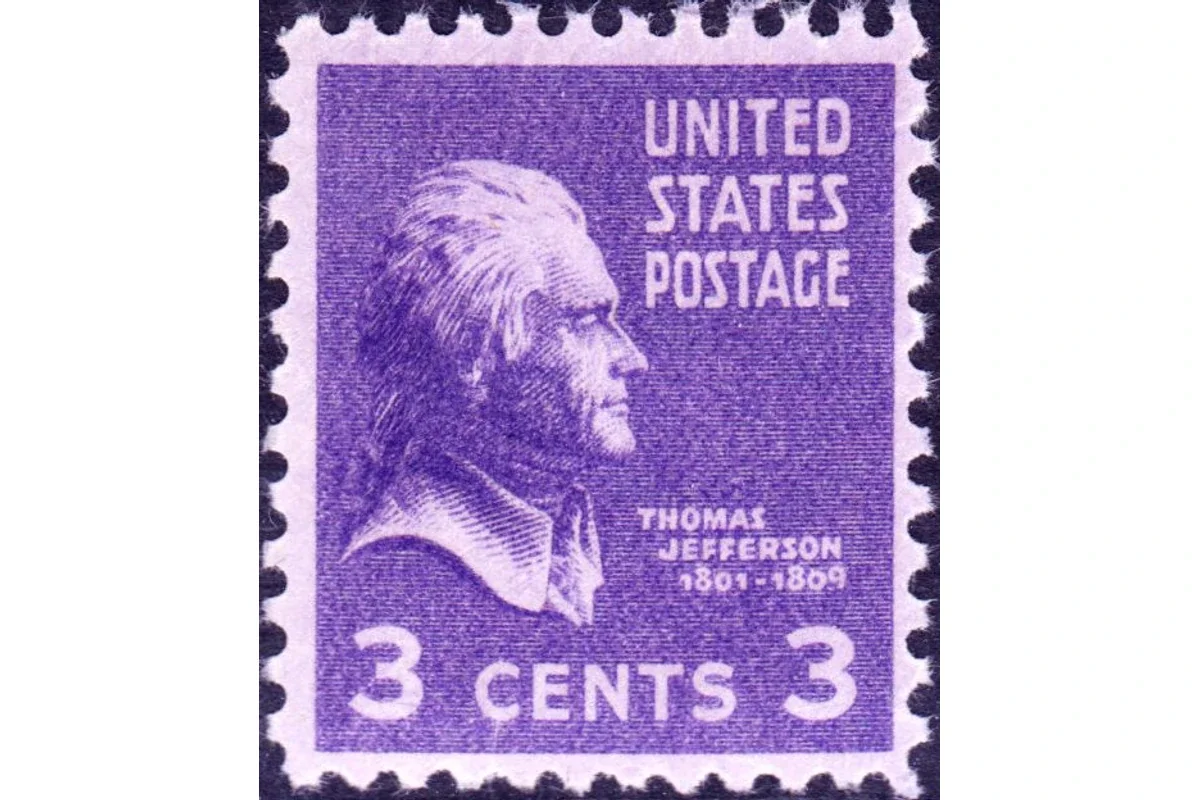
The stamp covered here is the upright violet United States three-cent Thomas Jefferson from the Presidential series, often called the Prexies. Jefferson faces right, UNITED STATES POSTAGE sits at upper right, and the name and presidential dates appear beside the lower portrait. The bottom reads 3 CENTS 3. The genuine scan below shows that design. It is not a specimen from the dealer price table, and the photograph alone does not establish its gum condition.[9][10]
Start with those inscriptions rather than the album heading or a seller's title. A different denomination with Jefferson's portrait needs a different catalog entry. A purple stamp showing another president is not this family either. If the name cannot be read, photograph it more clearly before borrowing a value from a visually similar stamp. The catalog-number workflow explains why the catalog publisher belongs beside the number.
This page groups one Presidential design with its sheet, booklet and two coil formats. It does not turn each format into a separate portrait issue. Washington portraits and the three-cent Statue of Liberty belong to different designs; their prices are not Jefferson comparisons. Color can narrow the search, but the name, denomination and edge pattern decide which section of a catalog you should inspect.
The coil direction is not the perforation direction
A horizontal coil runs across the page, with one stamp beside the next. Its joining perforations are vertical. That is Scott 842, described as perforated 10 vertically. A vertical coil has one stamp above the next, with horizontal joining perforations. That is Scott 851, perforated 10 horizontally. The words describe different aspects of the same object, so they are not contradictory.[2][3][10]
Write down which opposite edges are straight before measuring. Then use a physical gauge on the intact perforated edges. Scott 807's compound 11 × 10½ measurement is not the coils' gauge 10. Count the pattern over a gauge's calibrated length rather than counting the teeth on one stamp. The perforation guide walks through this distinction without relying on the apparent size of a resized photograph.
Do not make a coil by trimming a sheet stamp. Cutting away two edges changes the object and destroys evidence. If a pair survives, keep its joining perforations and straight outer edges visible in your record. Those physical relationships are more useful than a cropped image of only the portrait. If an edge is damaged, record the missing measurement rather than forcing a catalog match.
Dealer offers checked on 5 October 2026
These are exact advertised comparisons in U.S. dollars. Mystic's numeric identifiers select its condition and format options, rather than naming individually certified specimens. Eagle's identifier combines a plate number and margin position. Neither dealer offer is a completed sale. Do not silently turn a listing marked mint into a never-hinged example unless the option says so.[1][2][7]
The low used-sheet offer answers a different question from the complete-booklet offer. A twelve-stamp booklet retains an arrangement and covers that a loose single no longer has. The line-pair offers also describe connected pairs, not a price for one stamp. These observations show why format matters without establishing a guaranteed resale amount for an inherited album. Use the broader price hub for other families, not to average unlike Jefferson objects.
No current completed-sale range is claimed here. Before accepting a buying offer, compare the exact catalog reference, quantity, centering and gum description, then check transaction costs separately. Retail selection and handling are part of a dealer's business; an asking price does not tell you what that dealer would pay to buy the same stamp from you.
| Issue and dealer identifier | Object and stated condition | Dealer asking price |
|---|---|---|
| 807 · Mystic 343915[1] | One used single; grade not specified | USD 0.35 |
| 807 · Mystic 343911[1] | One mint single, Very Fine, never hinged | USD 2.00 |
| 842 · Mystic 344569[2] | One mint single; grade and hinge status not specified | USD 1.00 |
| 842 · Mystic 344579[2] | Mint line pair, two stamps; grade and hinge status not specified | USD 3.00 |
| 851 · Mystic 344759[3] | One used single; grade not specified | USD 2.75 |
| 851 · Mystic 344758[3] | Mint line pair, two stamps; grade and hinge status not specified | USD 12.50 |
| 807a · BK102 · Mystic 836037[4] | Complete mint booklet, twelve stamps; grade and hinge status not specified | USD 25.00 |
| 807 · Eagle plate 23528, LL[7] | One plate-number single, Fine, margin fault; hinge status not specified | USD 0.10 |
Keep booklet panes and line pairs connected
Scott 807a denotes the six-stamp booklet pane, not every detached stamp with a straight edge. BK102 is the complete booklet product containing twelve stamps in two panes of six. A pane and an entire booklet are different objects. Preserve the binding tab, covers and any attached material before describing yours. Mystic's BK102 listing and 1847us agree on the six-stamp pane format.[4][10]
For the coils, the 1847us reference lists joint line pairs, and Mystic separates line-pair offers from ordinary coil pairs. Look at the intact connection for the printed line and compare it with the specific catalog description. A pair of adjoining stamps is not automatically a line pair. A crease, cancellation stroke or sleeve reflection can also look like a line in a photograph.[2][3][10]
A single straight edge cannot recover the lost pane arrangement. An intact pair, pane or booklet gives the next examiner more information than separated pieces. Photograph its complete outline first, followed by a detail of the connection. Keep a loose single described as a single; do not assign the price of the parent pane or booklet to it.
Centering and gum still matter on an ordinary stamp
Read the dealer's condition words rather than assuming every mint stamp is alike. The USD 2.00 sheet example specifically says Very Fine and never hinged. The mint coil and booklet options in the table do not specify those qualifications. They cannot support a like-for-like claim that all mint formats command the same premium.[1][2][3]
Inspect the reverse without wetting or rubbing it. Note a hinge remnant, disturbed gum, a thin, a crease or staining separately from the front's centering. If the back remains inaccessible in an album, leave gum status unresolved. A scan of the front cannot establish never-hinged status. The condition guide separates soundness from centering so that an attractive face does not hide a fault.
Eagle's plate 23528 lower-left single is explicitly described as Fine with a margin fault. Its USD 0.10 offer is useful precisely because it discloses that defect. Do not treat it as a sound Very Fine price floor, or infer a precise damage discount by comparing it with another dealer's differently graded stamp.[7]
An unusual perforation can signal a counterfeit
The Jefferson design has a specific counterfeit history, so an unexpected gauge is not automatically a valuable error. 1847us notes a perforation-12 counterfeit. Mystic's counterfeit reference contrasts less distinct, ink-blotched background lines with the genuine recessed engraving and 11 × 10½ perforation. Those are reasons to seek examination, not a photo-only authentication test.[8][10]
Measure first and repeat the reading on another intact edge. A short damaged edge or a sloping gauge can produce a false result. Then photograph the background lines in focus and retain the reverse and full margins. Do not clean the stamp to make the printing appear sharper. If you suspect a counterfeit, describe the observation itself rather than writing a confident variety name on the album page.
Likewise, missing teeth or shifted perforations need a specific explanation. A trimmed single cannot establish an imperforate pair. Connected evidence and an appropriate expert opinion matter more than the size of a seller's headline price. The errors-and-varieties workflow helps prepare a suspect item without altering it.
A dated envelope is a separate collecting object
The three-cent Jefferson served the ordinary first-class letter rate when issued. That postal role explains why a used example is not rare merely because it is old. The 1938 rate reference gives three cents per ounce for a domestic letter, while the Presidential reference describes the stamp's broad use in other postage combinations.[5][10]
Keep the whole envelope if one survives. Record the origin, destination, date, other stamps and any service markings before thinking about removal. A cancellation dated 1945 does not turn the design into a 1945 issue. Nor does an ordinary later cancellation make it a first-day cover. Match the postmark to the format's actual first issue date, not just the series year.
None of the table's loose-stamp offers values a cover. A cover may interest a postal-history collector for a route, rate or usage that a detached stamp cannot show. It may also be entirely ordinary. The correct next step is to photograph both sides and research the full postal object, rather than destroy that context by soaking off the stamp.
Check a Jefferson with the edge notes attached
Use the existing free checker after recording the denomination and edge pattern. Upload a sharp, square-on front image that includes all edges. In the notes, state whether the top and bottom or the sides are straight, give your measured gauge, and say whether you have a single, pair, pane or booklet. Add the reverse description in words if only the front is uploaded.
Ask for a preliminary identification and compatible price context. A photo can show the design and visible arrangement; it cannot settle hidden gum condition, prove a disputed counterfeit or authenticate a rare format. If the result suggests Scott 807 but your physical gauge is 10 on only two opposite edges, keep that disagreement in the record and check the coil entries rather than accepting the first answer.
Drop a stamp photo here
Show the full stamp, every perforation, and as much front detail as possible in even light.
Keep the Jefferson formats in separate records
Install Stamp Value Identifier & Scan free on iOS or Android to scan stamps individually, save results and organize your collection. Keep your edge measurements and booklet or pair notes with the appropriate entry, then return to uncertain items later.
Choose the next comparison, not the largest price
For an ordinary cancelled four-edge stamp, begin with a used Scott 807 comparison. For two opposite straight edges, measure the remaining perforations before deciding between the coils. For a pane or booklet, inventory the surviving stamps, tab and covers without breaking them apart. If the printing or gauge remains anomalous, preserve the object and seek specialist examination.
Write a short evidence record with the catalog publisher, tentative number, format, quantity, condition and the date of the comparison. Keep an unresolved feature explicitly unresolved. That record is more useful to a buyer or another collector than a single value copied from a marketplace title. The collection-value guide explains how to use such records without treating every common duplicate as a separate retail sale.
Frequently asked questions
Is every purple Jefferson three-cent stamp worth USD 25?
No. The USD 25.00 observation is Mystic's complete BK102 mint booklet of twelve Scott 807a stamps, option 836037. It is not a loose-stamp valuation. Mystic's used Scott 807 single, option 343915, was offered at USD 0.35 on 5 October 2026.[1][4]
Why is Scott 842 called horizontal if its perforations are vertical?
Horizontal describes the direction of the coil strip. Vertical describes the joining perforation rows between side-by-side stamps. Scott 842 has gauge-10 perforations at left and right, while Scott 851 has them at top and bottom.[2][3][10]
Does a straight edge prove that a single is Scott 807a?
No. Scott 807a is the six-stamp booklet-pane entry. Retaining the pane and tab supports that format identification. A detached straight-edged single loses arrangement evidence, and a cut edge must not be mistaken for an issued booklet edge.[4][10]
Was the booklet first issued in 1938 or 1939?
The Presidential sheet design dates to 16 June 1938. The booklet-pane first issue is 27 January 1939. Mystic's BK102 title uses the series year 1938, but its detailed first-day field agrees with 1847us on the 1939 booklet date.[1][4][10]
Is a Jefferson measuring perforation 12 a rare printing error?
That measurement alone cannot establish an error. 1847us records a perforation-12 counterfeit, and Mystic describes printing differences from genuine Scott 807. Repeat the gauge reading, preserve all edges and seek specialist examination before assigning a counterfeit or error identity.[8][10]
Sources and further reading
Primary references and specialist resources used to prepare this guide.
- [1] Mystic Stamp Company: Scott 807 sheet stamp and condition-specific offers
- [2] Mystic Stamp Company: Scott 842 horizontal coil and line-pair offers
- [3] Mystic Stamp Company: Scott 851 vertical coil and line-pair offers
- [4] Mystic Stamp Company: BK102 complete twelve-stamp booklet and first issue
- [5] 1847us: 1938 issues and domestic letter rate
- [7] Eagle Stamps: Scott 807 plate-number singles and disclosed faults
- [8] Mystic Stamp Company: perforated Jefferson counterfeit reference
- [9] Wikimedia Commons: public-domain U.S. Post Office design scan
- [10] 1847us: Presidential formats, issue dates and perforations