Quick answer
New Zealand 1935 pictorial stamp value depends on the printing, condition and format. On 10 October 2026, Eastamps asked NZD 5.00 for a used 1d Kiwi with a blunt corner and NZD 40.00 for a separate LHM single. These are dealer offers, not sales or a family-wide range. Check watermark and perforations before comparing.[14][15]
Start with the denomination, not an album date
NZ Post dates the first release of this pictorial issue to 1 May 1935. Te Papa describes a promotional leaflet for that same release.[1][10] The family continued through later printings. A Kiwi or Captain Cook scene beneath an album heading of 1935 does not prove that the stamp came from the first printing. Paper and perforations can place a familiar design in a later group.[5][11]
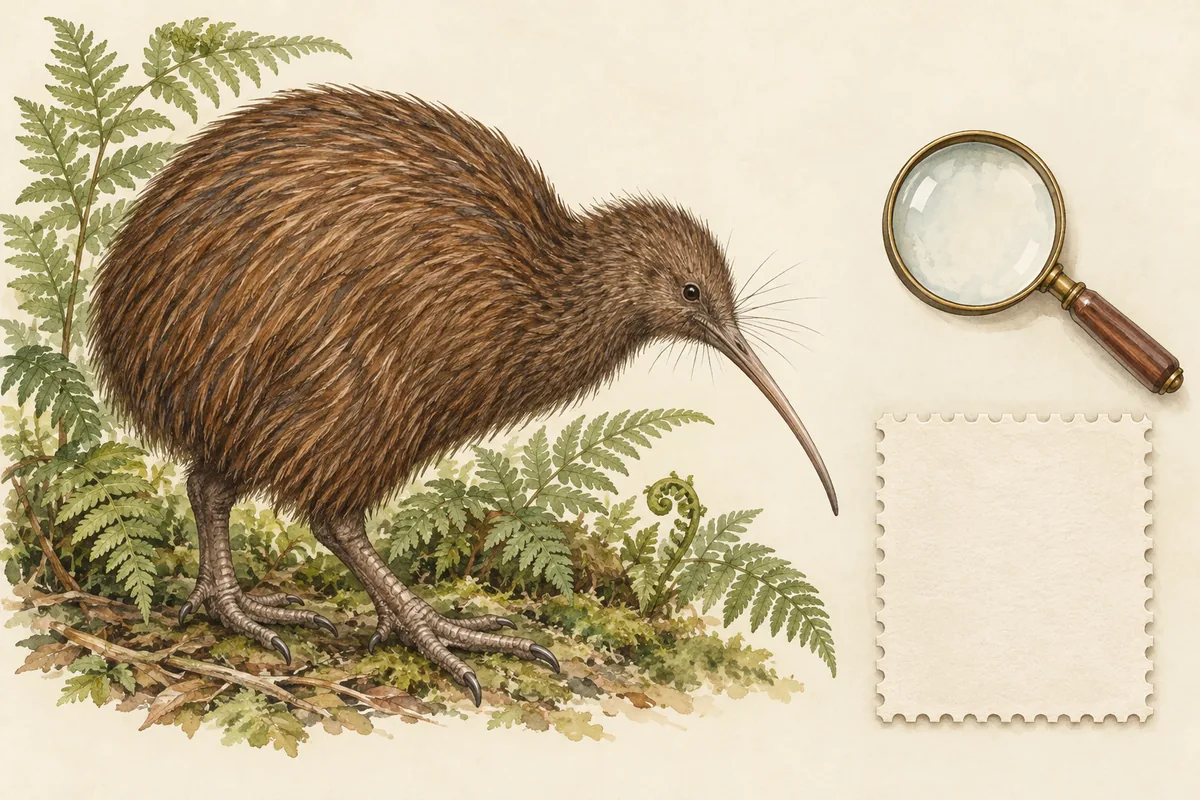
Write down the face value exactly before opening a price page. In this issue, d denotes the historical penny denomination and s the shilling denomination. Neither is a current New Zealand dollar price. The 1d Kiwi and the 1s Tui are different designs, not two versions of the same face value.[1] Fractions need care too. The brown cooking scene is 1 1/2d, not the red 1d Kiwi.
Make a record for the whole object. Is it a loose single, a joined pair, a block, a booklet piece or a stamp still on an envelope? Photograph that object before taking a close-up. Our comparisons include seven singles, a joined pair and a block. The price attached to one format cannot silently become a price for another.[14][18][19]
Match the fourteen face values to their subjects
NZ Post supplies the following denomination map. Use it to sort the family into design groups, not to assign a specialist catalog number.[1] Read the printed value on each stamp rather than relying on a neighboring album space. A loose stamp can move, and an inherited handwritten label can describe a previous occupant.
Names in older references may use historical spelling. This guide uses Māori in prose and retains catalog names when discussing a listing. Te Papa explains the colonial framing of the contemporary promotional leaflet.[10] Its period descriptions are historical evidence, not a modern explanation of Māori culture or natural history. Taranaki and the catalog name Mount Egmont identify the mountain subject on the 3s design.[1]
Within each design group, set aside overprinted or otherwise altered-looking material for another reference check. The denomination table is a base-design checklist. It does not establish an overprint, a shade, a die variety or an inverted watermark. Keep an unclear inscription in your notes rather than supplying the word that would make the item match an expensive listing.
| Face value | Subject |
|---|---|
| 1/2d | Fantail |
| 1d | Kiwi |
| 1 1/2d | Māori woman cooking food |
| 2d | Māori meeting house |
| 2 1/2d | Mount Cook |
| 3d | Wahine, young Māori girl |
| 4d | Mitre Peak |
| 5d | Swordfish |
| 6d | Harvest, the reaper |
| 8d | Tuatara |
| 9d | Māori decoration |
| 1s | Tui |
| 2s | Landing of Captain Cook |
| 3s | Mount Egmont / Taranaki |
Distinguish single and multiple NZ-and-star watermarks
NZ Post records various papers with single or multiple NZ-and-star watermarks.[1] The watermark is a paper feature. A familiar front design does not answer the paper question, and a photograph of the front alone should not settle it. Use the watermark identification guide for a careful inspection method. Do not peel a stuck hinge or disturb a booklet margin just to expose the back.
For the 1d Kiwi, Mark Wooller lists the original single-watermark L2a on 1 May 1935 and the multiple-watermark change, L2d, in April 1936.[11] For the 2s Captain Cook, his record places the original single-watermark L13a on 1 May 1935 and the multiple-watermark L13c in August 1936.[5] These are attributed specialist printing records. They help frame a comparison; they are not independent certification of a stamp in your album.
Record the pattern you can actually see and mark uncertain paper as unresolved. A partial watermark on a small stamp may need comparison with the reference pattern. Do not infer single watermark from a single visible fragment or multiple watermark from several unrelated shadows. No current inverted-watermark price or orientation premium is established by the evidence used here.
Work the 1d Kiwi example in both gauge directions
The 1d is a useful test of why the order of perforation measurements matters. Wooller lists L2a with single watermark and perf 14 by 13.5 for the original issue. His 1936 temporary L2b remains single watermark but has perf 13.5 by 14.[11] The same pair of numbers in reversed order identifies different candidates. Measure the horizontal and vertical edges separately with a gauge rather than counting teeth in an enlarged photograph.
The perforation measurement guide explains the physical check. If your readings are 13.5 horizontally and 14 vertically, compare the result with L2b and then verify the paper. Do not call every red Kiwi L2b or treat an uncertain gauge as a scarce-variety discovery. Wooller also dates the booklet issue, L2c, to 18 November 1935 with perf 14 by 13.5.[11] A sheet candidate and a connected booklet piece need separate format records.
Eastamps stock 74682 was a used 1d with perf 13.5 x 14 and a disclosed blunt corner, offered at NZD 5.00 on 10 October 2026. Stock 79349 was a separate LHM 1d with the same described gauge and seller label SG 557b, offered at NZD 40.00.[14][15] The different condition descriptions prevent a simple value range. Neither offer proves your copy's gum, exact grade or authenticity.
Work the 2s Captain Cook paper and gauge example
Wooller records the original single-watermark L13a as perf 13-14 by 13.5. His multiple-watermark L13c follows in August 1936. Later entries include fine-paper L13e, perf 12.5, in July 1941; coarse-paper L13f, perf 12.5, in 1942; and L13g, perf 13.75 by 13.5, in October 1942.[5] Preserve the source's 13-14 notation. It is a perforation description here, not money or a substitute for one exact gauge.
This sequence gives two practical checks. A 12.5 reading alone does not distinguish the fine-paper and coarse-paper candidates. A 13.75 by 13.5 reading directs attention to L13g, but the paper and full catalog description still need agreement. Write the measured gauge and your observed paper separately. Avoid assigning a specialist paper type from the apparent color of a phone image.
Two Eastamps L13g singles give a narrowly defined comparison. On 10 October 2026, stock 74770, described LHM, was NZD 3.12; stock 74773, described UHM, was NZD 5.62.[16][17] Those are the exact displayed asks, not reconstructed half-prices. They show how this seller separated two condition categories for this listing. They do not establish a universal unhinged premium or a completed sale price.
Measure the 9d and preserve connected formats
NZ Post distinguishes earlier 9d dimensions of 21 by 24 mm from later dimensions of 17.5 by 20.5 mm. It records typography for the 9d and recess printing for the rest of the issue.[1] The smaller 9d is therefore a measurable identification clue. It is not a price guarantee. Compare the dimension basis with the reference instead of measuring a cropped screen image or assuming that size alone proves every printing detail.
The issuer lists sheet stamps, 1d booklets and coils of 2d, 5d, 6d, 8d and 1s.[1] Preserve joined material, margins and any advertising. Eastamps stock 74688 was a joined first-booklet 1d pair with Parisian Ties advertising margins, offered at NZD 10.00 for the pair. Stock 20665 was a multiple-watermark 2s block of four, offered at NZD 60.00 for the block.[18][19] Neither ask describes a loose single.
Do not divide a block ask by four and present the result as an observed single-stamp value. Do not separate the booklet pair to fit two album spaces. Its joined format and margins are part of the identification evidence. Seller inventory of three units on stock 74688 means three offered product units, not three stamps in the photographed unit. The photographed unit contains two joined stamps.[19]
Read the dated dealer asks as offers, not valuations
All nine Eastamps offers below were checked on 10 October 2026. The captured product metadata states NZD, so the currency is New Zealand dollars. These were current asking prices during a displayed sale. They are not realized auction results, catalog values, appraisals or a representative market range.[14][18][19] The exact stock ID lets a reader distinguish one offer from a similar design.
Shipping and packing are excluded under the dealer's terms. Eastamps also describes its photographs as indicative.[23] A saved stock photograph supports the format check, but it does not guarantee that a delivered unit will be the photographed specimen. Availability and price can change after the observation date. The table records the checked offer, not a promise that it remains purchasable.
The brown stock 3552 is 1 1/2d according to the fetched title and photograph, despite a URL that renders the denomination as 1d.[21] Preserve that URL but use the supported denomination in the comparison. The 4d Mitre Peak stock 4158 is a wartime perf 14 line offer, not a price for any unidentified 4d mountain stamp.[22] Matching the picture alone would discard the listing's main identification constraint.
| Stock ID and source | Identity and seller condition | Format and quantity | Current ask |
|---|---|---|---|
| 74682 [14] | 1d; 13.5 x 14; Used, blunt corner | single; 1 stamp | NZD 5.00 |
| 79349 [15] | 1d; 13.5 x 14; LHM | single; 1 stamp | NZD 40.00 |
| 74770 [16] | 2s; 13.75 x 13.5; LHM | single; 1 stamp | NZD 3.12 |
| 74773 [17] | 2s; 13.75 x 13.5; UHM | single; 1 stamp | NZD 5.62 |
| 20665 [18] | 2s; 13-14 x 13.5; UHM; multiple watermark | joined block; 4 stamps | NZD 60.00 for block |
| 74688 [19] | 1d; first booklet, Parisian Ties; UHM | joined booklet pair; 2 stamps | NZD 10.00 for pair |
| 74754 [20] | 3s; 14.25 x 13.5; UHM | single; 1 stamp | NZD 6.00 |
| 3552 [21] | 1 1/2d; 14 x 13.5; UHM; single watermark | single; 1 stamp | NZD 10.00 |
| 4158 [22] | 4d; 14 line; VFU | single; 1 stamp | NZD 50.00 |
Check the reverse before comparing condition
The seller's LHM, UHM and VFU tokens remain in the table so you can compare the original descriptions. Do not expand them into a guarantee about original gum, absence of faults or an independent numerical grade. Ask for the reverse evidence when the distinction matters. The two 2s single offers describe different seller condition categories, but neither certifies another stamp that looks similar from the front.[16][17]
The blunt corner disclosed for stock 74682 is part of that offer's identity.[14] Check your copy's teeth and corners as well as cancellation, centering, stains and folds. If the back is safely accessible, record hinge marks, thinning and gum disturbance separately. The condition guide helps keep visible observations apart from seller labels. Do not erase a cancellation, flatten a crease or remove a hinge to imitate a cleaner example.
A reference with a higher ask needs the same scrutiny as a cheap one. A 4d line-perforation listing cannot establish value for an unmeasured 4d. A UHM block cannot establish value for four used singles. Keep issue identification, quantity, condition and price evidence in separate fields. If one field is missing, the comparison remains incomplete, however convincing the central design looks.
Make a catalog record that another collector can check
Record the face value and subject, the measured gauge in both directions, the watermark finding, the whole-item format and the back condition. Name the catalog publisher when entering a number. The catalog-number guide explains why a CP label, an SG label and a seller stock ID do different jobs. Retain SG 557b as the seller's label for stock 79349 rather than building an unverified crosswalk for the whole issue.[15]
Keep an attribution as a candidate until its paper, perforations and format agree. Wooller's 1d page also discusses die details, but this guide does not supply a cleared comparison figure for those distinctions.[11] No die, shade, plate-flaw or authentication premium is priced here. An expensive-looking catalog entry is a question to investigate, not the default identity for an unclear stamp.
For a sale decision, seek completed transactions for the same identified printing and format. Record the sale date, condition description and whether the figure includes a premium. The old-stamp value workflow explains the distinction between evidence types. None of the asks in this guide establishes what a dealer would pay you. Keep stamps on covers intact while seeking a postal-history comparison.
For broader comparisons, the old stamps price list keeps described retail asks separate from realized sales. Use an entry only when its issue, quantity and condition match your stamp.
Use a scan to organize your next physical check
Photograph one whole object straight on with all edges visible, then add a back image only when safe. Include the denomination and say whether it is a single, pair, block or booklet piece. For the Kiwi, ask what evidence would separate the 14 by 13.5 and 13.5 by 14 candidates. For Captain Cook, state the actual gauge instead of simply calling it a 1935 stamp.
The checker can provide a preliminary design-family lead and estimated collector context. It cannot establish a hidden watermark from the front or certify gum. Keep an unresolved paper or printing question in your notes. A likely image match should narrow the next inspection rather than supply a price before the physical evidence is complete.
Stamp Value Identifier & Scan supports photo identification, follow-up questions and saved collection records, with a free tier on iPhone and Android. Save separate scans for your Kiwi and Captain Cook items while you compare the actual stamp with the reference. The app is not an official grading, authentication or appraisal service. Use its record to preserve what you know and what remains to be checked.
Drop a stamp photo here
Show the full stamp, every perforation, and as much front detail as possible in even light.
Keep Kiwi and Captain Cook printing questions with your scans
Try Stamp Value Identifier & Scan for free on iOS or Android. Save each pictorial scan in your collection and use follow-up questions while you verify watermark, perforations and connected format.
Frequently asked questions
How much is a New Zealand 1935 1d Kiwi worth?
On 10 October 2026, Eastamps asked NZD 5.00 for used stock 74682 with a blunt corner and NZD 40.00 for separate LHM stock 79349. Both were described perf 13.5 x 14. These are different offers, not a general Kiwi value range.[14][15]
Does the 1935 design prove a first printing?
No. NZ Post dates the initial issue to 1 May 1935, but specialist records include later papers and perforations for the same designs. Identify the denomination, watermark and measured gauge before choosing a printing.[1][5][11]
Why do 1d gauges 14 by 13.5 and 13.5 by 14 matter?
Wooller lists original single-watermark L2a at 14 by 13.5 and temporary 1936 single-watermark L2b at 13.5 by 14. The direction of measurement matters. A red front alone does not settle either candidate.[11]
Can I use the 2s block price for a loose single?
No. Stock 20665 was a joined multiple-watermark block of four at NZD 60.00 for the block on 10 October 2026. The 1d booklet stock 74688 was NZD 10.00 for a joined pair with advertising margins. Keep both formats intact.[18][19]
Is a smaller 9d automatically valuable?
No. NZ Post lists earlier 9d dimensions of 21 by 24 mm and later dimensions of 17.5 by 20.5 mm. Size helps identification; the sources used here include no current 9d price or size premium.[1]
Sources and further reading
Primary references and specialist resources used to prepare this guide.
- [1] NZ Post: issue date, designs, printing, dimensions, watermarks and formats
- [5] Mark Wooller: 2s Captain Cook printing record
- [10] Te Papa: contemporary promotional leaflet and historical context
- [11] Mark Wooller: 1d Kiwi printing record
- [14] Eastamps: stock 74682
- [15] Eastamps: stock 79349
- [16] Eastamps: stock 74770
- [17] Eastamps: stock 74773
- [18] Eastamps: stock 20665
- [19] Eastamps: stock 74688
- [20] Eastamps: stock 74754
- [21] Eastamps: stock 3552
- [22] Eastamps: stock 4158
- [23] Eastamps: postage, packing and indicative photographs