Quick answer
Machin stamp value depends on the exact denomination, printing, paper, phosphor bands and format. The two identified mint singles below are offered at £0.20 and £0.35. Separate collector value from postage: Royal Mail’s ordinary non-barcoded definitives are no longer valid for mailing, although eligible unused decimal stamps can be exchanged.
A named variety is more useful than a color price list
GB Stampline’s offers below identify small-denomination mint examples with specialized references and phosphor details. They are examples of ordinary collector prices, not a tariff for every stamp with the Queen’s head. A differently printed stamp, a complete booklet or a specialist error needs its own evidence. Keeping the catalog system and suffix prevents a similar-looking example from silently replacing yours.
The dealer describes its stock as unmounted mint unless otherwise stated. A used stamp or a hinged example is therefore not a condition match. Nor should a bundle of hundreds of duplicates be multiplied by retail single prices: sorting, shipping and the buyer’s need for particular varieties affect the practical comparison.
| Mint specimen | Asking price | Distinguishing description |
|---|---|---|
| U050n, ½p, 1977 example | £0.20 | Fluorescent coated paper, PVAD gum, two 9.5 mm bands |
| U061d, 1p, short-band example | £0.35 | Center phosphor band, fluorescent coated paper, PVAD gum |
Recognize the design, then date the individual stamp
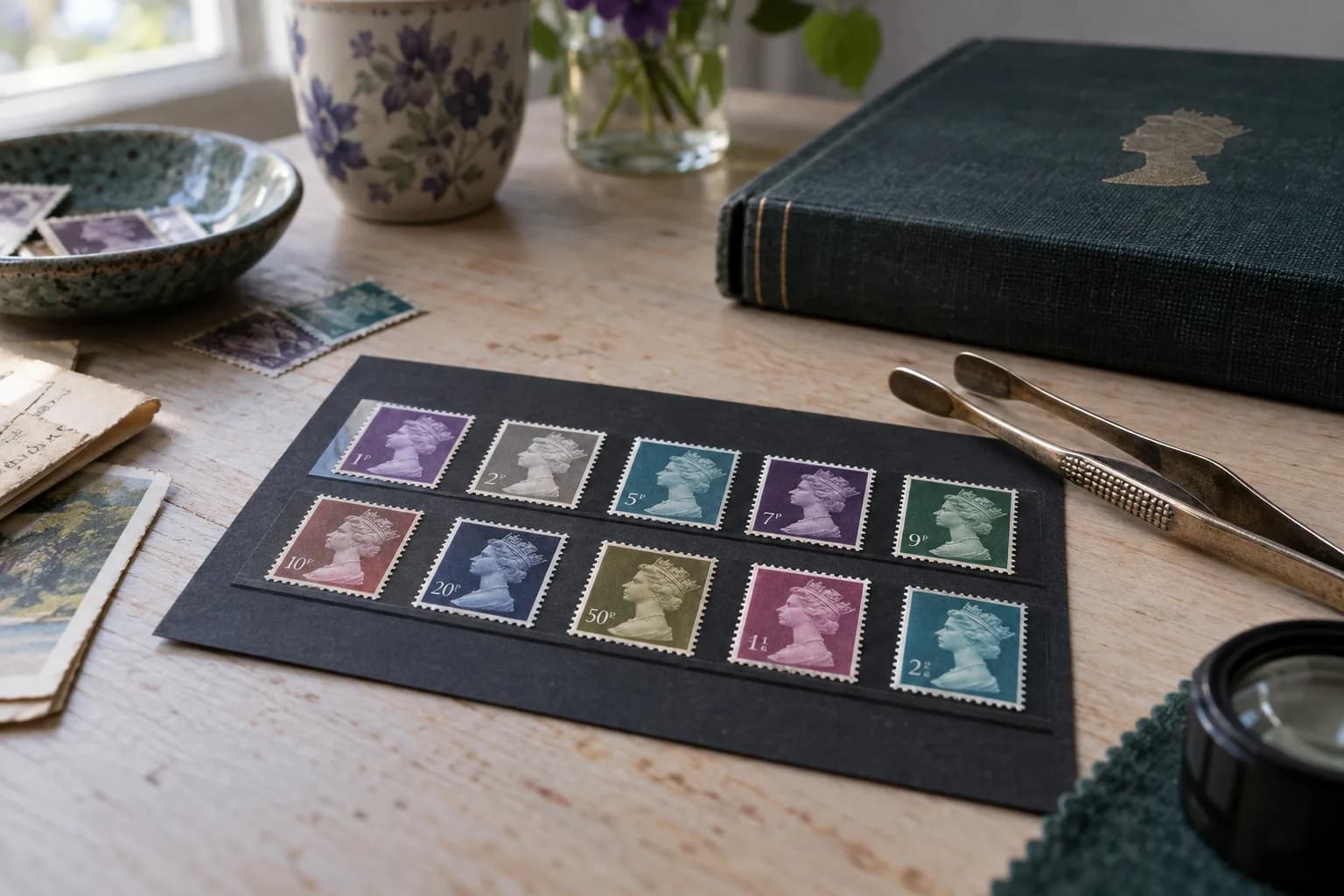
The Machin design uses Arnold Machin’s sculpted profile of Queen Elizabeth II against a plain background. The Postal Museum dates its first appearance to 5 June 1967. That is the start of the design family, not the issue date of every later color, value or printing. A decimal half-penny specimen cannot be dated solely from the original 1967 introduction.
Older Wilding definitives use a photographic portrait with surrounding design elements. Pictorial commemoratives and regional issues also need separate identification. Record the actual face value, inscription and portrait before applying a Machin reference. If the country remains uncertain, the foreign stamp identification guide helps establish the issuing authority first.
Sort pre-decimal, decimal and service inscriptions
Keep values in pence and shillings from the pre-decimal period apart from decimal pence. Copy the denomination exactly, including fractions and currency marks. A 4d is not a 4p. Stamps marked 1st or 2nd describe a service rather than an ordinary printed monetary amount; record that wording instead of inventing a face value from a past postal rate.
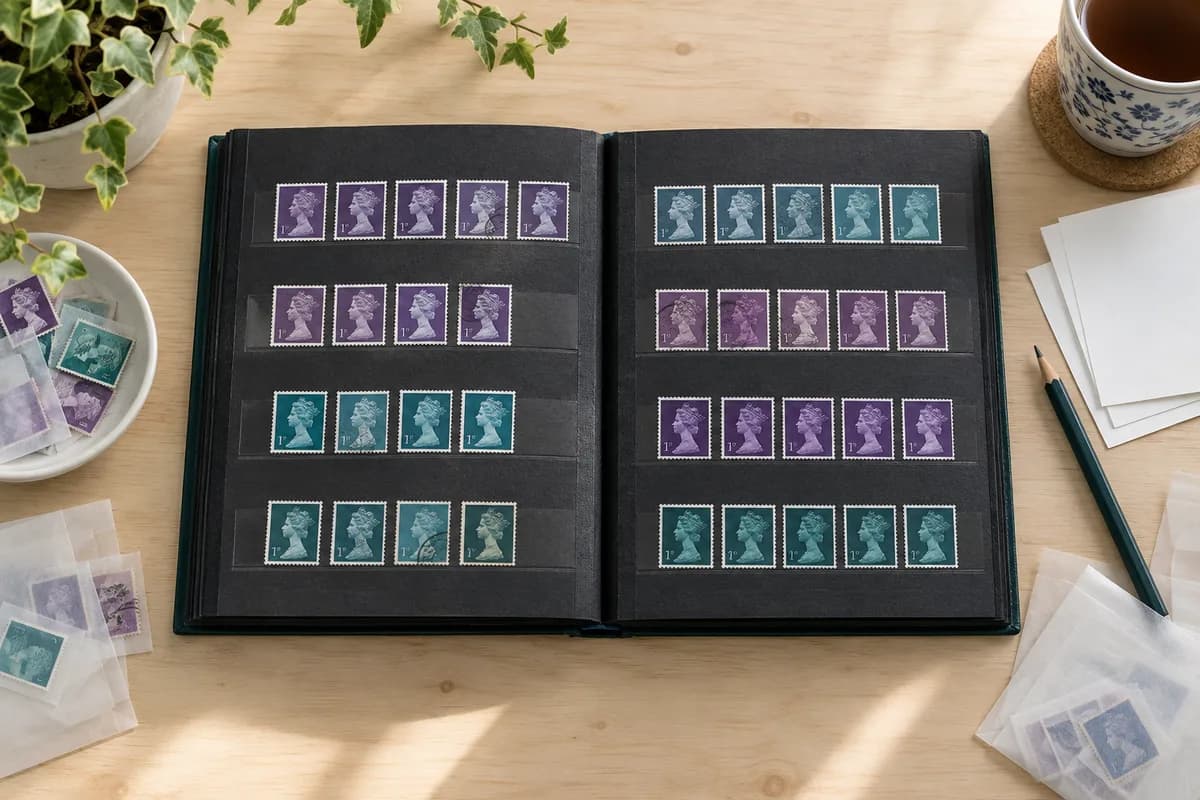
Next separate sheet singles, coils, booklet pieces, blocks and intact booklets. Retain attached margins, cylinder numbers and any booklet information. A specialist listing may depend on those features. Do not split a connected piece to fit a single-stamp photograph, and do not assume a straight edge is damage until you have checked the original format.
Use phosphor and paper clues to narrow the printing
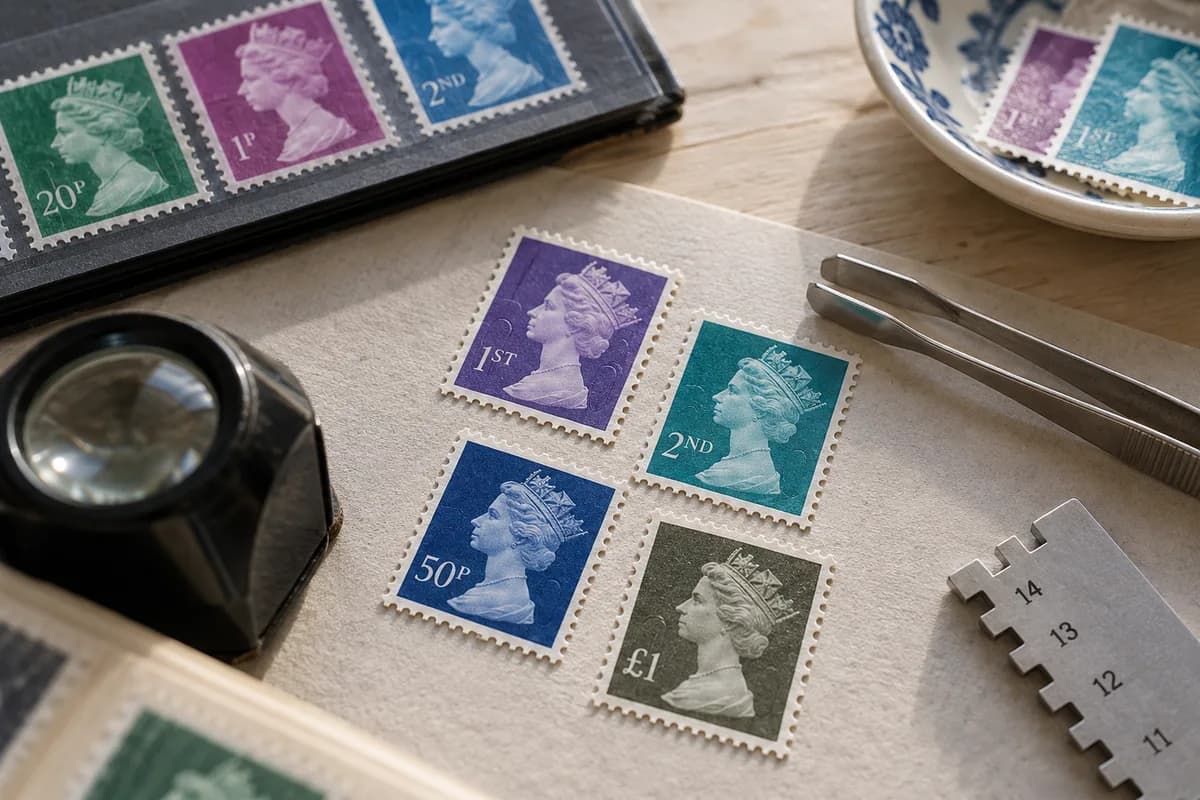
Similar Machins can differ in phosphor bands, paper, gum, perforation or printing. Normal daylight can show the portrait and denomination, but it does not establish every phosphor variety. A specialist examination may need an appropriate UV lamp and a catalog reference. Record equipment and observations so that an absent-looking band is not automatically called a missing-band error.
The U050n offer describes two 9.5 mm bands; the U061d offer describes a center band and a short-band variety. These are attributes of those specimens, not every half-penny or one-penny stamp. Consult the catalog-number guide before mixing a concise reference with a specialized U-number. Both can be useful, but they answer at different levels of detail.
Check postage eligibility separately from collector value
Royal Mail’s current guidance says regular non-barcoded definitives are no longer valid for postage. Eligible unused standard decimal Machins from 1971 onward can go through Stamp Swap Out. Pre-decimal stamps are excluded because they no longer have postage value. Used specimens are collection material, not unused postage for exchange.
Non-barcoded Christmas stamps and special pictorial issues are exceptions that remain valid under Royal Mail’s guidance. The scheme currently has no end date. Before sending stamps away, identify complete booklets, unusual printings or connected pieces you want to retain for collecting. Use the linked Royal Mail instructions for the exchange itself rather than an old postage-rate table.
Create a useful shortlist from a large accumulation
Sort a handful by exact value and format first, keeping one ordinary example beside any suspected difference. Photograph them under the same light. Write what differs: the inscription, band position, paper appearance, edge arrangement or attached margin. Color names alone are difficult to reproduce across faded paper, lighting and screen settings.
For an inherited collection, the album sorting guide helps preserve the owner’s groupings while separating duplicates. Bring a specialist the candidate variety, measurements and reference rather than every matching portrait. A focused question about a band or printing gives you a better next step than assigning all Queen Elizabeth stamps the price of an exceptional error.
Compare a like-for-like price
Use the catalog identity, format and condition together when looking for a comparable. A single, pair, booklet pane and complete cover belong in different searches. A catalog number without its suffix can leave out the very feature that explains the price. Keep the catalog publisher and edition in your notes so another collector can reproduce the identification.
Our old stamps price list gives a broader set of dealer offers to compare after identification. Make two lists: currently offered examples and completed sales. In the first, record the asking price and whether postage is extra; in the second, record the date, currency, lot contents and any buyer’s premium. Keep the original currency until you have made the comparison.
An expensive listing can be an optimistic seller, a different variety or a much better specimen. Read the description and examine the photographs before adding it to your comparison. If three apparent matches disagree widely, investigate their differences rather than averaging their prices. A small bundle of ordinary stamps also needs a bundle comparison, because selling costs can exceed the value of a single.
Inspect the front, back and edges
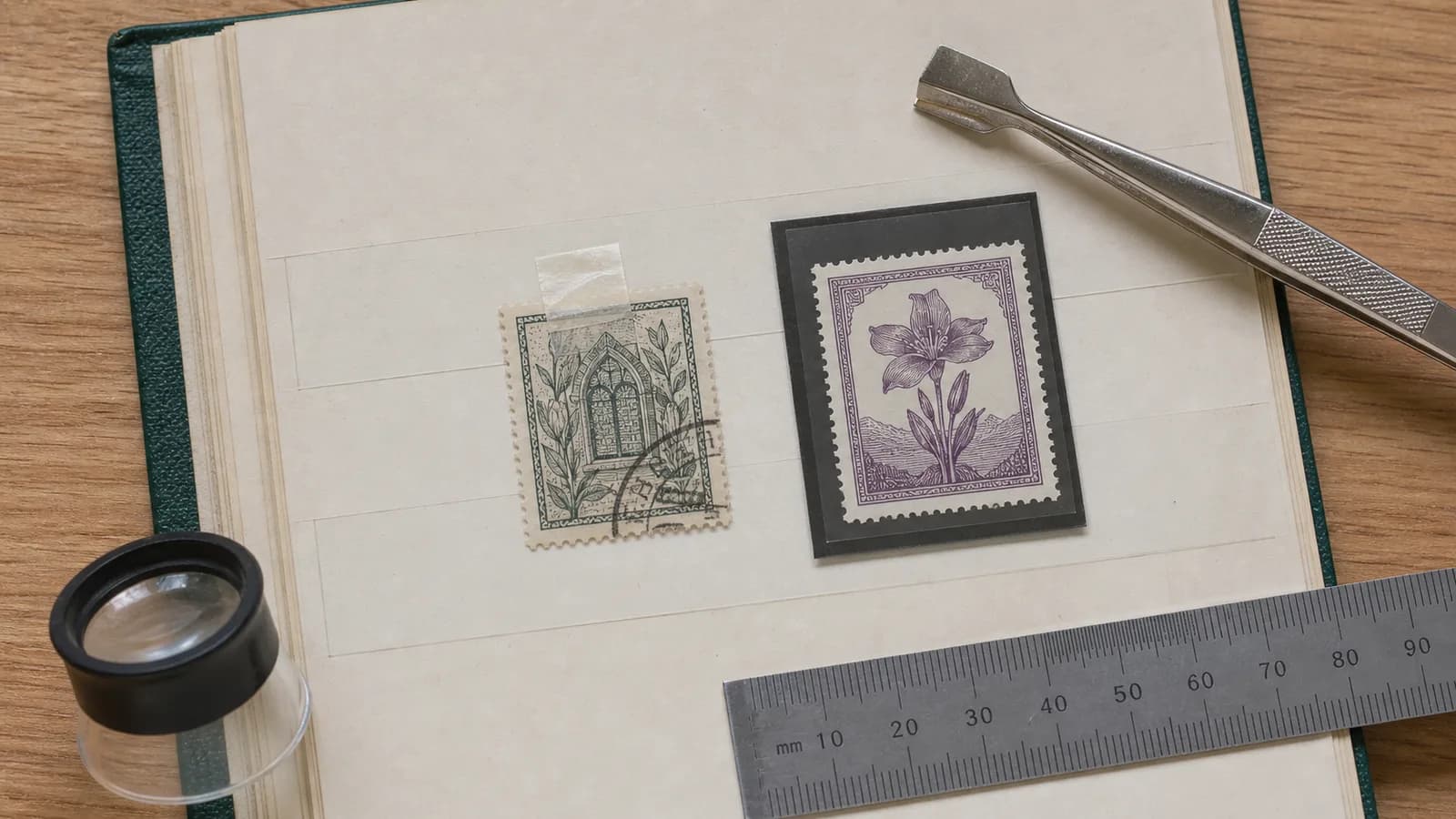
Begin with the item as you found it. Photograph the front and reverse under neutral light and keep every edge visible. Look for tears, thin spots, creases, missing perforation teeth, staining and repairs. Describe a fault by its location, such as a short tooth at the upper right, so it can be checked against the image.
For an unused stamp, record whether gum is present and whether a hinge mark or residue remains. For a cancelled stamp, note how much of the design is covered and whether a place or date can be read. The stamp condition guide explains the vocabulary for a useful description. Do this before comparing a sharp, centered dealer example with your own copy.
Keep a stamp on its complete envelope or card while researching it. The address, date, rate and other postal markings can explain how it was used. A loose-stamp price will not describe that combination. Avoid cleaning the paper, tracing a faint mark or trimming an edge to make the item look tidier; each would change evidence you are trying to read.
Check your stamp from a photo
Place one stamp on a plain background and photograph it straight on. Include the full outline and focus on the printed design, not the album page behind it. Use the free checker below for a first identification and value estimate, then compare its suggested issue with the specific features in this guide.
Add collector notes with observations that the picture does not show clearly: a measured perforation, a legible inscription, original gum, an attached envelope or a catalog reference already written in the album. Write observations rather than the rare variety you hope to find. Save the original photograph so you can compare it with a later close-up.
See the photo identification workflow for lighting and focus. If several stamps are attached as a pair or block, keep them connected and describe that format in your notes. For a whole album, take individual photographs of representative issues before working through duplicates.
Drop a stamp photo here
Show the full stamp, every perforation, and as much front detail as possible in even light.
Sort and save your Machin collection in the app
Install Stamp Value Identifier & Scan for free on iOS or Android. Scan your stamps one by one, save their results together and return to the issues you want to research next.
Build a useful collection record
Assign the item a simple reference and keep its photographs, candidate catalog number, measurements, condition notes and price comparisons together. Separate what you have observed from what still needs checking. For example, a visible numeral is an observation; a catalog identity that depends on a watermark is a candidate until that watermark is established.
When asking a specialist for help, send the full front and back, a close-up of the disputed feature, the measurements you took and the reference you used. Ask one concrete question: which issue fits these features, is the plate reading correct, or does this format match the catalog description? That makes a response easier to assess than a photograph accompanied only by a large price.
If you have several similar stamps, keep the ordinary examples for comparison. Differences are easier to see when the specimens are side by side under the same light. Store each securely without adhesive touching its surface, and keep any certificate with the corresponding item. Revisit the record when you obtain better evidence rather than giving every duplicate the most expensive identity.
Frequently asked questions
Are all Machin stamps from 1967?
No. The design began in 1967 and continued through many denominations and printings.
Can ordinary non-barcoded Machins still pay postage?
No. Royal Mail directs eligible unused decimal stamps to Stamp Swap Out; pre-decimal issues are excluded.
Are Christmas stamps treated the same way?
No. Royal Mail says non-barcoded Christmas and special pictorial stamps remain valid.
Does an apparently missing band prove an error?
No. Establish the expected printing and examine phosphor with suitable equipment before assigning an error.
Should I split a booklet or block for scanning?
Keep it connected and record the format. Photograph individual details without destroying the original piece.
Sources and further reading
Primary references and specialist resources used to prepare this guide.