Quick answer
Canada Small Queen stamp value starts with the denomination and exact printing. On 7 October 2026, Arpin offered a used Fine Scott 35 single for CAD 0.50 and a used Very Fine Scott 36 for CAD 2.25. These are retail asking prices, not sale results or offers to buy your stamp.[1][2]
Identify the Small Queen design before pricing it
Read CANADA, the denomination and the complete frame before relying on an album's heading. Confirm that the object is ordinary postage rather than a registration stamp or another postal label. The ordinary Small Queen design has Victoria's left-facing profile in an oval. Compare the actual ornament and lettering with a reference for that denomination. A Victorian portrait alone does not separate this family from Canada's Large Queens or later issues. Photograph the entire stamp, including every edge, instead of cropping around the head.
The Royal Philatelic Society of Canada's gallery places the main Small Queen issues within 1870 to 1897 and separates Scott 34 to 40, the later Ottawa group 41 to 45, and the 1893 Widow Weeds, 46 and 47.[4] This article's price table covers ordinary 1-cent, 2-cent and 3-cent singles. It does not transfer their prices to Widow Weeds, registration stamps or Large Queens.
If you see conspicuous maple-leaf ornament in a different Victoria design, use the separate Canada Maple Leaf guide. Keep uncertain family assignments open until the frame matches. Do not measure the portrait on a resized screen image to decide whether a stamp is a Large Queen. Use the physical item's design dimensions and the relevant catalog illustrations.
Record denomination, format and the missing evidence
Start a record for each object, not each album space. Write its printed value, broad color, loose single or joined multiple, cancellation and whether you can inspect the back. Add the horizontal and vertical perforation measurements when available. If the stamp is on an envelope, record that format first and retain the complete cover. Its postal markings need their own comparison.
A useful provisional note is Canada, Small Queen candidate, 2 cents green, used, loose single, perforations unmeasured, reverse unseen. That note distinguishes observation from attribution. A seller's description of a different green stamp should not fill the missing fields. The article's green price comparison becomes relevant only after your stamp matches the offered identity and condition.
Do not turn these checkpoints into a rare-variety checklist. Their purpose is to prevent a wrong comparison. If the denomination is unreadable beneath bars, save a neutral photograph and leave it unresolved. If an edge is damaged, describe the damage rather than pretending that every measurement is equally reliable.
| Field | What to record | What not to infer |
|---|---|---|
| Design and value | Full frame, CANADA and printed cents | Exact variety from the portrait alone |
| Perforations | Horizontal × vertical measurements | Gauge from a tooth count or a cropped scan |
| Paper and gum | Physical observations; back unseen if unavailable | Original gum from an uncancelled front |
| Format and marks | Single, pair, block or cover; legible cancellation | Loose-single value for a whole cover |
Current dealer offers for ordinary Small Queens
The following offers were read directly on Arpin Philately's live pages on 7 October 2026. Each row is the unit asking price for one stamp, not the number available in stock. The pages explicitly showed CAD. Keep that Canadian-dollar currency rather than converting an ambiguous dollar sign into US dollars. Stock keeping units and condition codes make the observations traceable.[1][2][3]
Arpin labels the ordinary illustrations Generic Image. The used Fine and Very Fine rows are stock grades, not a promise that a photographed specimen will be delivered. Compare your own centering and faults before accepting the seller's condition as a match. An inexpensive ordinary entry does not establish the price of a specialist shade, compound perforation, plate variety or precancel.
The source also displays figures marked Cv., and prices for unavailable conditions. Neither belongs in this table as a current in-stock asking price. Taxes, delivery and any checkout coupon are outside the listed stamp price. Keep the date with the offer because a later visit may show a changed price or no stock.
| Identity and offer ID | Seller's condition | Unit asking price | Availability when checked |
|---|---|---|---|
| Scott 35, 1¢ yellow; CAN-0035 / U-F [1] | Used, Fine; generic stock grade | CAD 0.50 | In stock |
| Scott 35, 1¢ yellow; CAN-0035 / U-VF [1] | Used, Very Fine; generic stock grade | CAD 1.50 | In stock |
| Scott 36, 2¢ green; CAN-0036 / U-F [2] | Used, Fine; generic stock grade | CAD 1.00 | In stock |
| Scott 36, 2¢ green; CAN-0036 / U-VF [2] | Used, Very Fine; generic stock grade | CAD 2.25 | In stock |
| Scott 41, 3¢; CAN-0041 / U-F [3] | Used, Fine; generic stock grade | CAD 0.50 | In stock |
| Scott 41, 3¢; CAN-0041 / M-FNG [3] | Mint, Fine, no gum; generic stock grade | CAD 10.00 | Five available |
Separate Ottawa and Montreal without a shortcut
Printing location is a classification question, not something the stamp normally spells out for you. Brixton Chrome's specialist article compares perforations, shade, paper, printing clarity, position dots, dates and gum. It warns that several of those clues have exceptions.[5] Record the evidence separately before deciding which combination supports a printing. Do not let one apparent dot override contradictory measurements.
RPSC's gallery headings and a dealer's product year serve different purposes. A gallery can group stamps across several years, while a product title may give the basic issue's date. Neither supplies a manufacture date for every stamp with that design. Treat the entry's scope as part of the identification, and retain a suffix only when the catalog actually defines it.
For a valuable claimed printing, ask what the attribution rests on. A response naming paper, measured perforations and comparison material is more useful than one naming only an attractive shade. If the evidence is a compressed online image, request the missing observations before paying for the claim. A specialist can inspect the physical stamp when the remaining distinction cannot be photographed reliably.
Measure compound perforations in the right order
Use a perforation gauge along an intact horizontal edge, then an intact vertical edge. Record the two readings in that order. A compound measurement such as 11½ × 12 describes different spacing in the two directions. Counting visible teeth does not establish a gauge, and a phone photograph without a scale should not become a precision measurement.
Brixton Chrome discusses 11½ × 12 among the Montreal printing clues, while also showing why a plain 12 measurement does not by itself separate every printing.[5] Use that as a reason to measure, not as permission to assign a catalog suffix from a casual impression. A damaged edge may leave the compound classification unresolved even when the portrait is clear.
Follow the perforation measurement method without forcing the stamp against the gauge. Compare another sound edge in the same direction if a corner is torn. Keep missing teeth in the condition record. Trimming an edge to make it look regular destroys evidence and cannot legitimately create an imperforate variety.
Check paper and shade without changing the stamp
Photograph under neutral diffuse light and save the unedited image. An orange-looking 3-cent stamp is not identified simply because a web listing uses orange in its title. White balance, aging and scanner settings interfere with shade comparisons. Separate a broad visual color from a specialized catalog shade, and use physical reference material when a subtle difference changes the claim.
Inspect the paper dry, with the front and back accessible if safe. Note thinning, discoloration and visible texture before attempting any classification. Do not scrape fibers, bleach a stain or increase image saturation until the stamp resembles a rare example. An alteration can remove the very evidence that a specialist needs to assess paper and ink.
Hillson and Nixon's Small Queen book, described by the Greene Foundation, covers shades, prominent re-entries and printing characteristics.[7] That description identifies suitable further reading; it is not evidence that this article inspected every plate or paper type in the book. For an unresolved specialist attribution, consult the actual reference and compare the item in hand.
Condition and gum belong to the actual specimen
Check centering against all four sides of the printed frame, then inspect shortened teeth, creases, thins and repairs separately. An attractive portrait can distract from an edge fault. Keep the reverse photograph with the front so that a valuation request does not hide the stamp's weakest area. The condition guide helps you describe observations without inventing a professional grade.
Arpin's CAN-0041 / M-FNG is explicitly no gum.[3] It must not become a never-hinged comparison merely because its front looks unused. For your stamp, record gum unexamined when you cannot see the back. Do not pull away an old hinge or peel a stamp from an album to settle the question quickly. Ask for safe handling advice when removal would risk paper loss.
Brixton Chrome warns about regumming in this issue.[5] A glossy back therefore does not authenticate original gum. If a substantial purchase depends on untouched gum or a scarce printing, ask for an appropriate in-hand opinion. The ordinary used prices above cannot support a multiplier for mint status, nor a fixed deduction for a thin or crease.
Keep cancellation and postal history with the stamp
Transcribe a readable town, date or numeral exactly and mark missing characters as unreadable. A postmark records use, not the day a stamp was printed. An older printing may receive a later cancellation, so the latest legible date should not replace the paper and perforation checks. Keep the whole strike in your photograph when the stamp is on a cover.
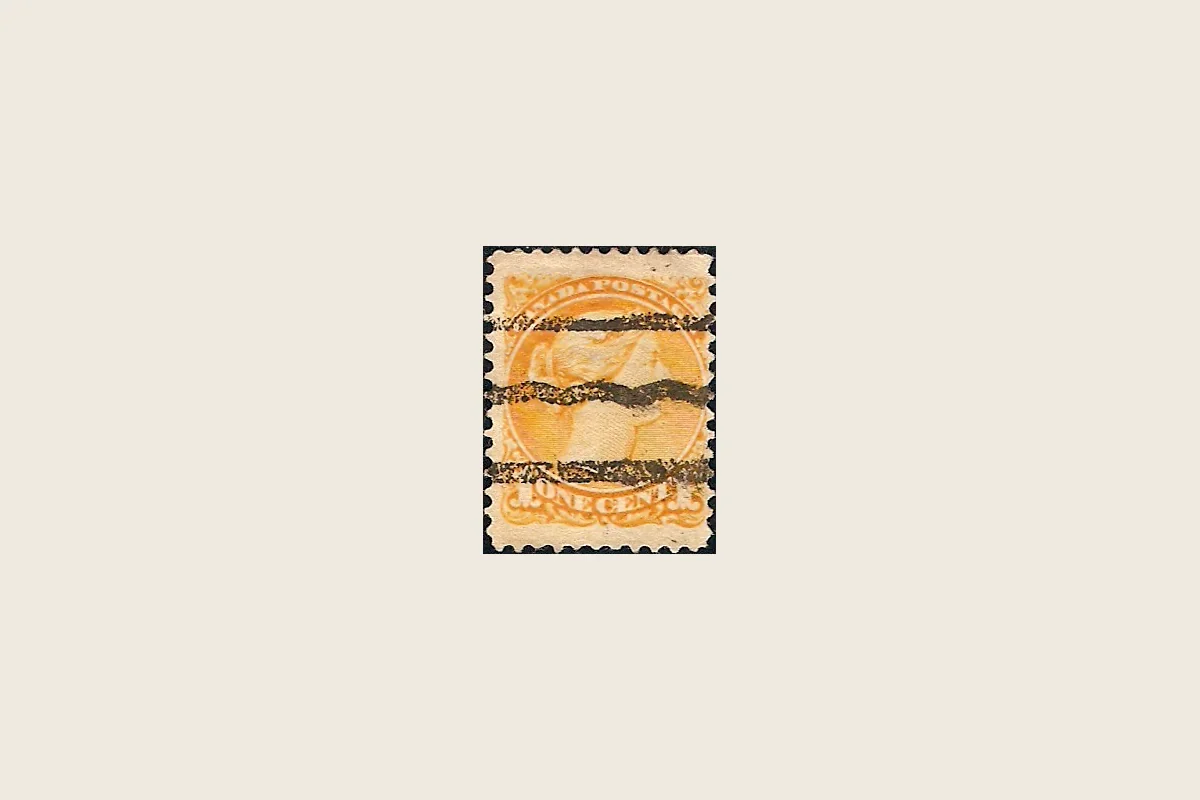
The genuine reference image here has precancellation bars.[6] It illustrates a recognizable design but is not a substitute for the ordinary used stock in the table. Bars crossing the portrait are not automatically a defect or a rare postmark. Identification of a specific precancel needs its own reference and comparable material. Read the cancellation guide before attaching a premium to a mark.
Do not soak a Small Queen from an envelope just to compare it with a single-stamp listing. Photograph both sides of the complete cover and any other stamps. Pairs, blocks and margin pieces should also remain joined. A unit retail price multiplied by the number of stamps is not evidence of a cover or block value.
Use catalog references and prices as separate records
Write the catalog publisher alongside each number and keep any suffix exactly as printed. The Arpin offers in this article identify their basic entries as Scott 35, 36 and 41.[1][2][3] A number copied from another catalog is not interchangeable just because it also has two digits. The catalog-number guide explains how to preserve the publisher and edition.
A catalog valuation, retail asking price, completed sale and dealer buying offer answer different questions. This table contains retail asks only. No auction realization is presented, and no commission or buyer's premium has been reverse-calculated. Use the old-stamp price list for the wider comparison method, rather than treating the highest visible online amount as your expected proceeds.
If you own a group of similar low-value stamps, first separate distinct identities and document representative condition. Do not add the retail asks for every duplicate and call that the collection's sale value. A buyer will evaluate the actual group, its faults and the cost of handling it. Keep specialist candidates apart so that routine duplicates do not obscure a stamp needing further examination.
Photograph the unresolved feature before checking value
Begin with a straight-on front photograph showing CANADA, the value, full oval and complete edges. Save a second photograph of the back when the loose stamp can be handled safely. In your notes, say which fields are measured and which remain unknown. Keep the complete-cover photograph too when the stamp is attached. Do not crop away context to produce a cleaner-looking match.
Use the checker below for a likely design match and estimated collector context. It cannot measure a hidden edge, prove a subtle paper variety, authenticate original gum or certify a rare printing from an ordinary front image. When the result suggests several similar entries, return to the missing physical check rather than choosing the most expensive one. Save the identification as provisional until the evidence supports a specific reference.
Drop a stamp photo here
Show the full stamp, every perforation, and as much front detail as possible in even light.
Keep your Small Queen observations with each scan
Install Stamp Value Identifier & Scan for free on iPhone or Android. Scan individual stamps, ask follow-up questions and save results while you record perforations, condition and any unresolved printing attribution. The app is not an authentication or appraisal service.
Frequently asked questions
Are ordinary used Small Queen stamps valuable?
Some ordinary stock grades have low retail asking prices. On 7 October 2026 Arpin's used Fine Scott 35 offer was CAD 0.50 for one stamp. That observation does not price every printing, cancellation or condition, and it is not an offer to buy your stamp.[1]
Does perforation 12 prove an Ottawa printing?
No. Brixton Chrome's printing discussion shows that a plain 12 measurement is not sufficient to separate every printing. Measure both directions and assess the other physical clues before adopting a printing attribution or catalog suffix.[5]
Can I use the price of a Small Queen for a Large Queen?
No. They are different designs and catalog groups. Confirm the full frame and physical design dimensions first. The table here contains ordinary Small Queen singles only, not Large Queens or the separate Widow Weeds high values.
Is an uncancelled Small Queen automatically never hinged?
No. The front does not establish original gum or hinge history. Arpin separately offers Fine no-gum Scott 41 stock. Keep gum unexamined until the reverse is safely inspected, and obtain specialist help when a purchase depends on gum authenticity.[3]
Can the app authenticate a rare Small Queen printing?
No. Stamp Value Identifier & Scan provides assistive photo identification and estimated collector context. Precise perforations, subtle paper or shade differences, repairs and original gum can require physical examination. Treat a photo match as a research lead, not certification.
Sources and further reading
Primary references and specialist resources used to prepare this guide.
- [1] Arpin Philately: Scott 35 stock grades and CAD asking prices, checked 7 October 2026
- [2] Arpin Philately: Scott 36 stock grades and CAD asking prices, checked 7 October 2026
- [3] Arpin Philately: Scott 41 stock grades and CAD asking prices, checked 7 October 2026
- [4] Royal Philatelic Society of Canada: Small Queen gallery and catalog groups
- [5] Brixton Chrome: distinguishing Small Queen printings
- [6] Wikimedia Commons: Jacques Ducloy's genuine precancelled 1-cent scan and public-domain rights
- [7] Greene Foundation: Hillson and Nixon's Small Queen reference book description