Quick answer
Canada Maple Leaf stamp value depends first on the lower corners, denomination and condition. The original Victoria issue has maple leaves, not large value numerals, in both lower corners. On 6 October 2026, Arpin asked CAD 0.75 for a Fine used 1-cent category and CAD 112.45 for a specifically described Very Fine used 10-cent single. These are different dealer offers, not a universal value range.[1][7][10]
Read the lower corners before the album label
The useful first distinction is the frame around Victoria, not her portrait alone. On the original Maple Leaf issue, leaves occupy all four corner spaces and the denomination is spelled out around the lower part of the oval. The later Numeral design replaces the two lower leaves with large figures. Both show Victoria, so a handwritten album heading such as Queen Victoria or Maple Leaf is not enough.[7]
Hold the country inscription upright and inspect both lower corners. If a cancellation hides one corner, use the other and read the complete value wording. A large 1, 2, 3 or other denomination in the lower corner directs you to the Numeral issue rather than the ordinary unsurcharged stamps priced here. Do not choose an 1897 reference solely because the stamp is green or purple.
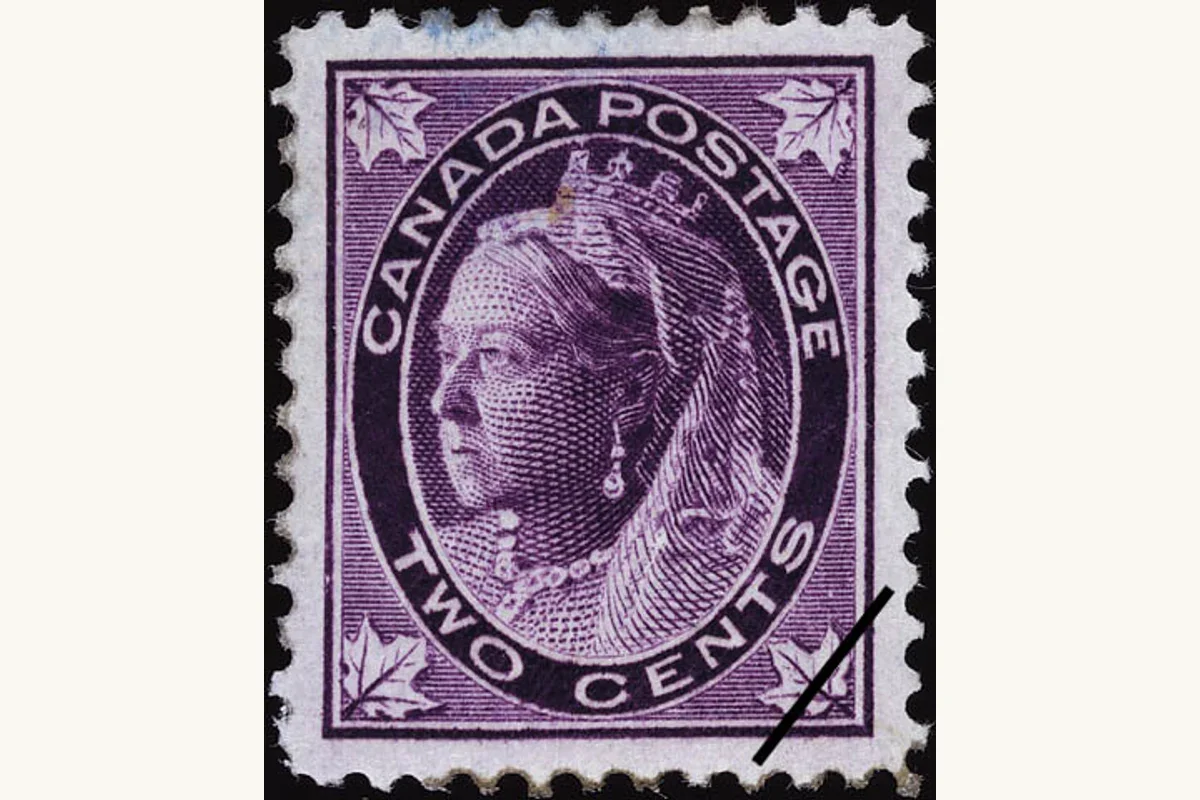
This family covers Canada's original late-Victorian Maple Leaf definitives, Scott 66 through 73, with the Numeral issue as the main lookalike.[7] The genuine purple 2-cent reference below shows the leaf corners and TWO CENTS. It has a visible diagonal dark mark and is not an Arpin stock photograph. Its image cannot establish gum, soundness or a sale price. Use the catalog-number guide to record the publisher as well as the number.
Match the value wording to the eight ordinary stamps
The eight-value set runs from half a cent to ten cents. The colors help you sort an album, but the value wording and lower-corner design control the identification. Bertram Poole's historical reference lists the denominations and Scott numbers below. Arpin independently identifies the 1-cent, 5-cent and 10-cent offers as Scott 67, 70 and 73.[1][8][10]
Read HALF CENT, ONE CENT, TWO CENTS or the corresponding higher wording rather than estimating the value from color. A faded brown stamp is not automatically the 6-cent value, and a violet-looking scan does not distinguish the purple 2-cent from the brown-violet 10-cent. Photograph the lettering in focus. Retain the original color description in your notes if the lighting makes it uncertain.
These are Canadian cents. The printed face value and the dealer's Canadian-dollar asking price describe different things. Ten cents on the design does not mean an offer of ten Canadian dollars. Nor does a shared Victoria portrait make this set equivalent to the earlier Jubilee commemoratives, which have two portraits. Keep those objects separate before comparing prices.
| Scott | Printed denomination | Basic color |
|---|---|---|
| 66 | ½ cent | Black |
| 67 | 1 cent | Green |
| 68 | 2 cents | Purple |
| 69 | 3 cents | Carmine |
| 70 | 5 cents | Dark blue |
| 71 | 6 cents | Brown |
| 72 | 8 cents | Orange |
| 73 | 10 cents | Brown-violet |
Eight dated dealer offers, not one price for the set
The following Arpin listings were read on 6 October 2026. Each row is one loose stamp or one single-stamp condition category. CAN-0067, CAN-0070 and CAN-0073 identify the product families; the condition codes distinguish the actual comparison. Rows without a numbered suffix are stock categories, not uniquely photographed specimens. Arpin's pages explicitly state CAD, and their currency metadata also specifies CAD.[1][8][10]
The amounts are dealer asking prices, not completed sales, auction estimates or catalog values. No sale date or buyer's premium applies because no transaction is claimed. The table uses the item asking amount without adding shipping or tax. We omit the dealer's separate Cv. figures rather than presenting them as money paid for the listed stamps.
Compare within the same denomination first. The 1-cent used categories help with a cancelled green single; the 10-cent observations do not price it. For an uncancelled stamp, inspect the reverse before choosing the never-hinged row. The old stamps price list explains the broader retail evidence, but an asking price is not an offer to buy your collection.
| Issue and exact stock code | Dealer condition and relevant note | Dealer asking price |
|---|---|---|
| Scott 67, CAN-0067 / U-F [1] | Used, Fine; stock category | CAD 0.75 |
| Scott 67, CAN-0067 / U-VF [1] | Used, Very Fine; stock category | CAD 2.00 |
| Scott 67, CAN-0067 / M-VF-026 [1] | Mint, Very Fine; hinge remnants and small thin | CAD 14.95 |
| Scott 67, CAN-0067 / M-F-VFNH-031 [1] | Mint, Fine to Very Fine, never hinged | CAD 99.95 |
| Scott 70, CAN-0070 / U-VF [8] | Used, Very Fine; stock category | CAD 10.50 |
| Scott 70, CAN-0070 / M-VFNH-042 [8] | Mint, Very Fine, never hinged | CAD 584.95 |
| Scott 73, CAN-0073 / U-VF-043 [10] | Used, Very Fine, vertical wove; lightly cancelled | CAD 112.45 |
| Scott 73, CAN-0073 / U-F-VF-047 [10] | Used, Fine to Very Fine, vertical wove; thin | CAD 49.95 |
Why 1897 and 1898 are not a simple date test
The Maple Leaf family is commonly called the 1897 issue, while specialist references also describe it as 1897-1898. Poole describes a staggered introduction as old supplies ran out, followed by the redrawn Numeral issue in 1898. The change added visible lower-corner figures after complaints about denominations given only in English words. That design change is a better sorting clue than a postmark year.[3][7]
Do not give every denomination one exact first-sale date. Poole's early account and Arpin's product dates are not fully aligned for the 10-cent value. This guide therefore does not assign an exact day to the whole set or claim a first-day cover from those records. The unresolved day does not change the visible distinction between leaf corners and numeral corners.[7][10]
A cancellation dated after the introduction of the Numeral issue can still appear on an older Maple Leaf stamp. Read the design independently of the postmark. If the stamp remains on an envelope, preserve the entire cover while researching its date and route. The cancellation guide helps separate the postal marking from the stamp's issue identity.
Mint prices require a reverse-side description
The 1-cent table deliberately includes a mint stamp with hinge remnants and a small thin beside a never-hinged example. Both are uncancelled, yet they are not comparable conditions. The CAD 14.95 M-VF-026 listing expressly records the faults. The CAD 99.95 M-F-VFNH-031 listing uses a never-hinged category. A clean-looking face cannot resolve that difference.[1]
If safe to inspect, use tongs and record original gum as a seller's claim unless you can support it. Look for hinge remnants, disturbance, missing gum, creases and paper loss. A thin concerns the paper, not just the adhesive. If the back remains inside an old mount, write reverse unexamined rather than assuming the stamp qualifies for a never-hinged price.
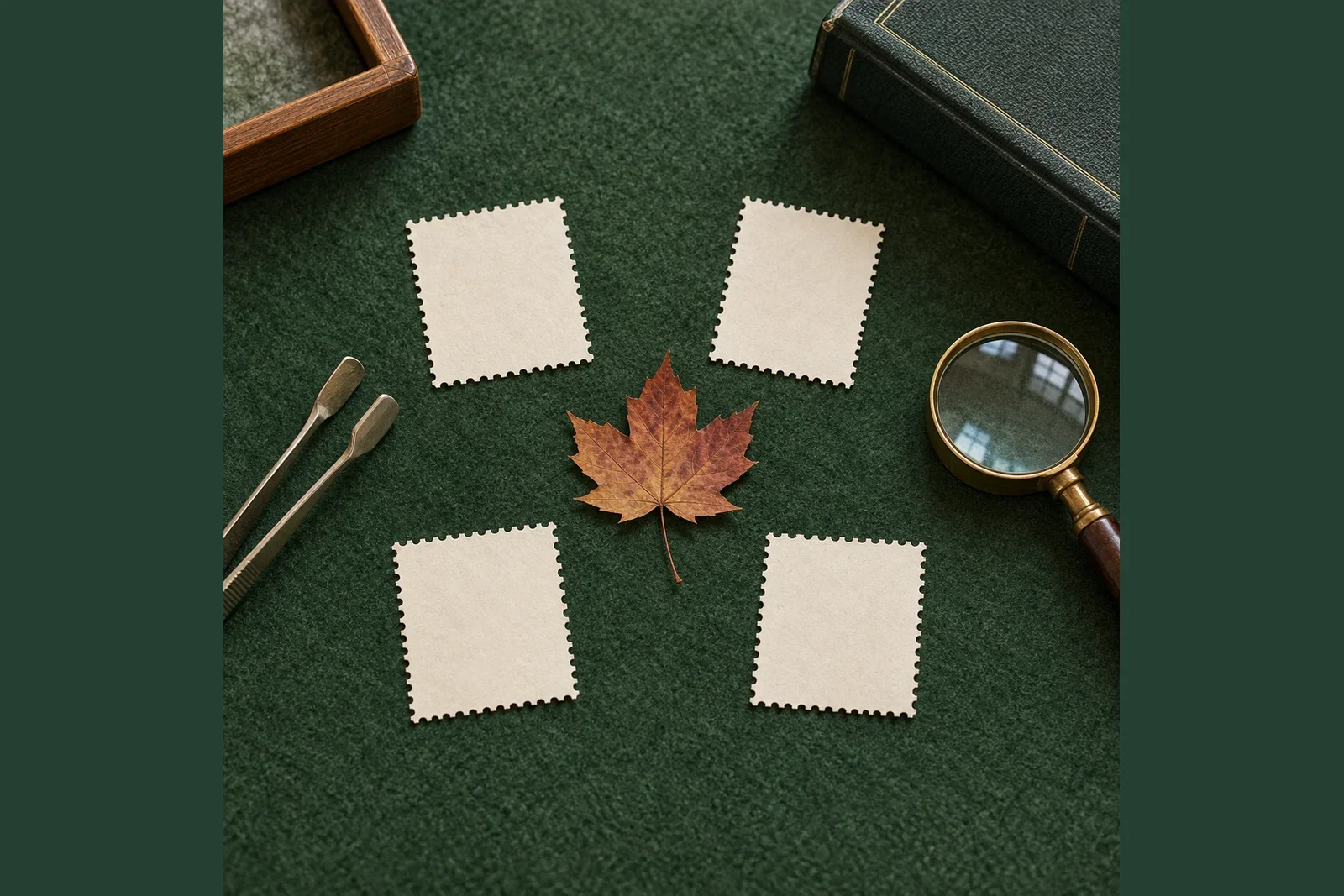
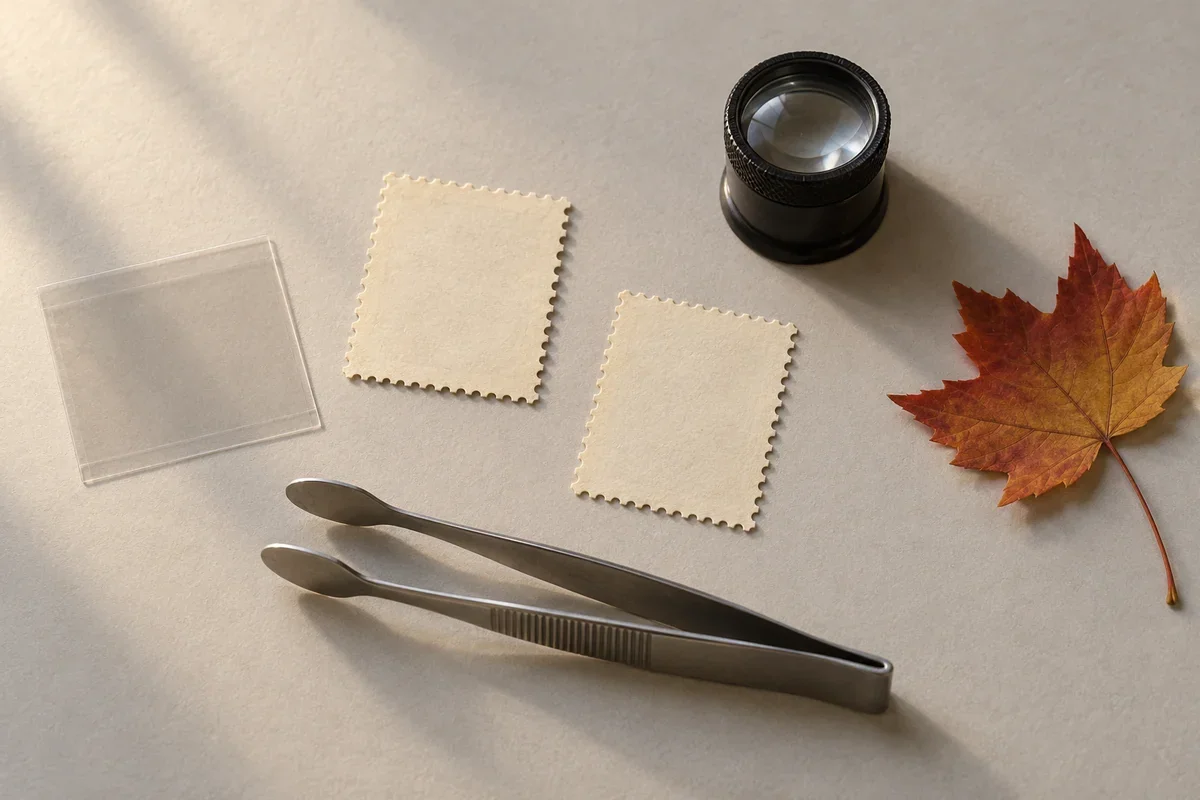
Do not peel a firmly attached hinge or wet the gum to make the back look cleaner. Those actions can destroy evidence or create damage. The hinges and mounts guide explains safe housing choices. The blank paper in the illustration below shows an inspection arrangement only. It is not a Maple Leaf specimen and provides no evidence of original gum.
Centering, cancellations and thins change the comparison
Examine the distance between the full outer frame and each perforated edge. Do not judge centering from Victoria's head alone. Note whether the border touches an edge, whether teeth are shortened and whether corners are missing. Dealer labels such as Fine and Very Fine are condition descriptions, not a guarantee that your stamp meets the same standard.
The 10-cent U-VF-043 offer describes four attractive margins and a light cancellation. The U-F-VF-047 offer identifies a thin. Their CAD 112.45 and CAD 49.95 asks belong to those particular descriptions. They do not establish a fixed discount for every thin or cancellation. The 10-cent product page identifies vertical wove paper; do not transfer that confirmed listing detail to an unidentified stamp merely from its front.[10]
Retain a full front and safe reverse photograph before asking for a condition opinion. A heavy marking may obscure TWO CENTS or a lower leaf, so resolve the design before trying to grade it. Our condition-grading guide provides terms for observable faults. Do not assign a numerical grade or an expert certificate to an ordinary photograph.
Measure the edges without inventing an imperforate error
The ordinary issue is described as perforation 12 in Poole and Arpin's records.[1][8][10] That is a gauge over a measured distance, not twelve teeth per side. Compare intact horizontal and vertical edges with a physical gauge. A phone image with no scale cannot establish the measurement, and missing teeth should be recorded as damage rather than ignored.
Brixton Chrome's working study records measurements around the nominal gauge and differing paper and shade observations. It explicitly says its table is a work in progress.[3] Treat that as specialist context, not a rule that a small measurement difference automatically earns a rare catalog suffix. The perforation guide explains how to align the edge without forcing it.
One straight edge does not establish an entirely imperforate stamp. Poole describes early half-cent sheets cut into halves, with close straight edges at the cut.[7] Preserve the paper and any joined stamps before investigating. A trimmed single also can have straight edges. Do not remove teeth, split a pair or cut a sheet margin to make an item match a supposed error.
Separate surcharges and verified plate details
If an extra printed value crosses the original denomination, stop using the ordinary unsurcharged rows. Brixton's Maple Leaf study includes a 2-cent-on-3-cent category, distinct from the base 3-cent stamp.[3] Record the underlying design, original wording and added inscription separately. An overprint on a leaf-corner stamp does not make it the Numeral design, but it does change the identification task.
For suspected plate varieties, compare specific repeated features, not any dark spot. Ralph Trimble's specialist reference identifies a misplaced entry on the 6-cent Scott 71 at plate position 72. It describes frame details and explains that the feature was once mistaken for a slipped retouch.[9] That is a reason to preserve a sharp close-up and consult the specialist illustration, not assign the ordinary brown stamp a rarity premium.
Keep any sheet margin or joined multiple intact. A number in the margin and a plate position are different records. Do not claim position 72 because the album happens to label a stamp 72, which is also the ordinary Scott number for the 8-cent value.[7][9] No variety price is asserted here. Resolve the catalog publisher, denomination and diagnostic detail before seeking a specialist valuation.
Use the checker with the lower corners visible
Photograph one stamp straight on, with every edge and the complete value wording visible. Include a close view of the lower corners if the main photograph loses the leaves. In your notes, state the denomination, colors, cancellation and whether the reverse is visible. A note such as purple TWO CENTS, leaf corners, gum unexamined is more useful than a claim of an expensive Victorian rarity.
For a cover or block, retain a full-object photograph in your records and tell the checker about that format. The price table covers loose singles, not an entire envelope or joined multiple. The checker can suggest a likely design and collector context. It cannot prove original gum, a paper variety, a subtle re-entry or authenticity from an ordinary front photograph.
Drop a stamp photo here
Show the full stamp, every perforation, and as much front detail as possible in even light.
Keep the leaf and numeral designs in separate records
Install Stamp Value Identifier & Scan for free on iOS or Android. Scan stamps individually, save results and organize your collection while you record denominations, reverse-side observations and unresolved varieties.
Choose a comparable before asking what yours will sell for
Begin with the denomination and design, then match the format and condition. A Fine used 1-cent single needs a different comparison from a never-hinged 5-cent stamp or a faulty 10-cent example. Do not average the table or multiply the highest row by the number of stamps in an album. A dealer asking amount is neither an auction result nor an appraisal of your holdings.
Keep the exact stock code, source URL, CAD amount and observation date beside your notes. If you later find a completed sale, add its actual sale date, condition, quantity and fee basis instead of replacing these retail observations without explanation. For an unresolved surcharge, straight edge or plate detail, preserve the object and ask a specialist the specific identification question first.
Frequently asked questions
How do I tell Maple Leaf stamps from the Numeral issue?
Read the lower corners. The original Maple Leaf issue has leaves there, with the value in words around the oval. The Numeral design has large denomination figures in those corners. Victoria's portrait alone does not separate them.[7]
What is an ordinary used 1-cent Maple Leaf worth?
Arpin's CAN-0067 / U-F category was offered at CAD 0.75 and U-VF at CAD 2.00 on 6 October 2026. These are dealer asks for Fine and Very Fine used singles, not completed sales or a promise for your stamp.[1]
Does a 1898 postmark mean it is a Numeral stamp?
No. A postmark dates a marking, not the printing of the stamp. Check the lower-corner design and value wording independently. Maple Leaf introduction dates also varied by denomination.[7]
Can an uncancelled stamp use the never-hinged price?
Only after the reverse condition supports that comparison. Arpin separately describes mint stamps with hinge remnants or a thin. No cancellation does not prove untouched gum, and a hidden back should remain unclassified.[1]
Does a straight edge prove an imperforate Maple Leaf?
No. Poole describes cut edges on early half-cent sheet halves. Trimming also can produce straight edges. Preserve any pair or margin and examine all edges before claiming an imperforate variety.[7]
Sources and further reading
Primary references and specialist resources used to prepare this guide.
- [1] Arpin: Scott 67 stock and CAD offers, checked 6 October 2026
- [3] Brixton Chrome: Maple Leaf working study, checked 6 October 2026
- [7] Bertram W. H. Poole: The postage stamps of Canada, chapters XIV and XV
- [8] Arpin: Scott 70 stock and CAD offers, checked 6 October 2026
- [9] Ralph Trimble archive: 6-cent misplaced entry, checked 6 October 2026
- [10] Arpin: Scott 73 vertical-wove stock and CAD offers, checked 6 October 2026