Quick answer
Germania stamp value depends on inscription, watermark, printing and condition. On 7 October 2026, checked dealer asks included USD 7.70 for a ten-stamp used 1902 set and USD 2.95 for a never-hinged 3-pfennig single. These are retail offers, not realized sales. Check REICHSPOST versus DEUTSCHES REICH before comparing your stamp.[4][6]
Start with the inscription, not the color
Germania stamps show the crowned female personification of Germany, rather than a named male statesman.[7][8] The useful first split is the inscription beneath the figure. GermanStamps.net dates the first REICHSPOST pfennig series to 1900, Michel 53 to 62.[7] Its 1902 pfennig group changes the inscription to DEUTSCHES REICH and remains unwatermarked.[8] That group is Michel 68 to 77.[8] These are different catalog entries even when a denomination and the central figure look familiar.[7][8]
Do not treat DEUTSCHES REICH as a design name. It appears on other German stamp families, including the later Hindenburg medallions. If your stamp has a man's head rather than Germania, use the Hindenburg identification guide. For Germania, write down the full inscription, denomination and any added printing before opening a price page. Those visible details can eliminate the wrong series without touching the paper.
The group table uses Michel references; the dealer offers use Scott.[1] Do not transfer a number between publishers without checking the design and issue. A mixed album page may contain both inscription groups and later watermarked printings. Its heading is not proof of identification.[7][8][9]
| Group | Inscription | Paper and reference |
|---|---|---|
| 1900 | REICHSPOST | Unwatermarked; Michel 53–62 |
| 1902 | DEUTSCHES REICH | Unwatermarked; Michel 68–77 |
| 1905 peace printing | DEUTSCHES REICH | Lozenge watermark; Michel 83 I–93 I |
Five dated retail offers show why one price does not fit
On 7 October 2026, Allstamp.net displayed five relevant offers. Two are 1900 REICHSPOST singles, one is a used ten-stamp unwatermarked 1902 set, and two are unused low-denomination singles. The two REICHSPOST asks are USD 16.00 and USD 19.50.[5][3] The used set is USD 7.70; the unused 3-pfennig and 2-pfennig singles are USD 2.95 and USD 3.25 respectively.[4][6][2] Each product's HTML explicitly identifies USD, so the dollar sign is not being assumed to mean US dollars. These are seller asks, not completed sales or offers to buy your stamps.[5][3][4]
Keep the fault on the 30-pfennig offer in the comparison. The dealer describes 5GE00058 as VF LH and reports a short perforation at the top. The 40-pfennig single is also VF LH, but its text does not report that same fault. LH means lightly hinged; NH means never hinged. VF and FVF are the dealer's condition descriptions. They are not independent certificates or grades assigned here.[5][3][6]
The used set belongs to the dealer's Used Germany category and contains ten stamps, not one. Its product metadata nevertheless uses a generic condition value of new. The category and descriptive text are the relevant philatelic evidence; we do not relabel the set mint because of that metadata. Shipping and taxes are not included in our comparison, and no auction premium applies to these retail offers. The amounts do not establish the net proceeds of a sale.[4]
| Stock code, Scott reference and issue | Dealer condition | Stamps per offer | Asking price |
|---|---|---|---|
| 5GE00058; Scott 58; 1900; 30 pf. [5] | VF LH; short top perforation | 1 | USD 16.00, single |
| 5GE00059; Scott 59; 1900; 40 pf. [3] | VF LH | 1 | USD 19.50, single |
| 6GE00065C-74u; Scott 65C–74; 1902; 2–80 pf. [4] | Used, FVF; unwatermarked | 10 | USD 7.70, whole set |
| 6GE00066; Scott 66; 1902; 3 pf. [6] | VF NH | 1 | USD 2.95, single |
| 8GE00080; Scott 80; 1905; 2 pf. [2] | VF NH | 1 | USD 3.25, single |
REICHSPOST and DEUTSCHES REICH separate the early groups
For a REICHSPOST stamp, compare the entire bottom inscription and value panel with the 1900 reference. GermanStamps.net records official validity from 1 January 1900 and notes that some early uses exist from late December 1899. This guide supplies no price for those early uses. A difficult date in a cancellation is not enough to assign a premium; retain the whole cover and seek a specialist's reading if the chronology appears unusual.[7]
For DEUTSCHES REICH, the next question is the paper. The 1902 group is still without a watermark. The series introduced in 1905 has a lozenge watermark and a separate identification. Consequently, the later inscription alone cannot date your stamp to 1902. In a front photograph, these paper differences can remain invisible. Leave the year provisional when the reverse is inaccessible rather than choosing whichever catalog line has the highest value.[8][9]
Record both what is present and what remains unchecked. A useful note might read Germania, DEUTSCHES REICH, 3 pfennig, unused, watermark not checked. That is more reliable than calling the stamp a rare 1902 printing on the strength of its color. Once the paper is established, add the catalog publisher and complete number. Keep the previous tentative identification in your notes so that another collector can follow the correction.
Check the lozenge watermark without risking the gum
GermanStamps.net calls the 1905 watermarked group Friedensdruck, or peace printing.[9] Its reference distinguishes it from the 1915 war printings, which have the same face values and watermark but different printing, paper and gum quality.[9] Finding a lozenge therefore does not, by itself, prove a peace printing. It narrows the group and tells you which further comparison to make.[9]
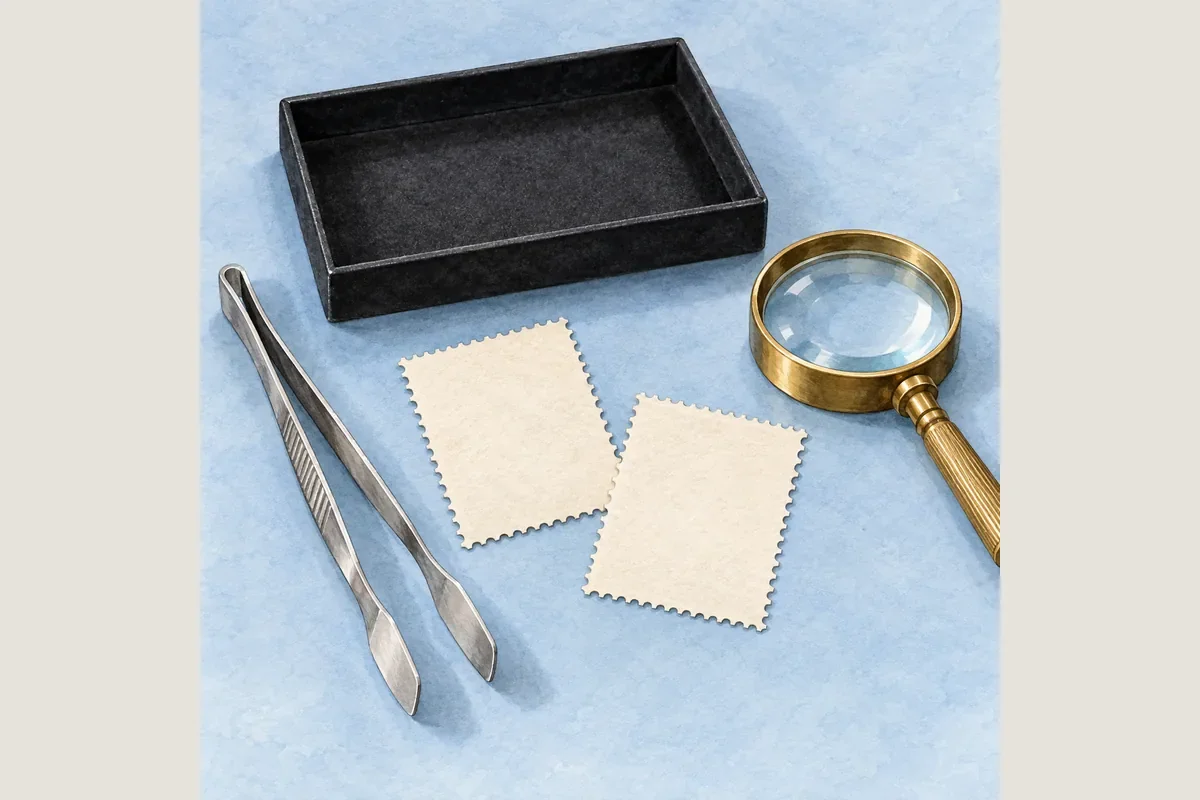
Begin with safe dry observation of a loose stamp's reverse. Use stamp tongs and a clean surface. Do not rub the gum, fold the paper or soak an unused stamp to reveal the pattern. If the item is attached to a cover or stuck to a page, keep it attached and write that the watermark could not be inspected. The watermark guide gives a preservation-first inspection sequence.
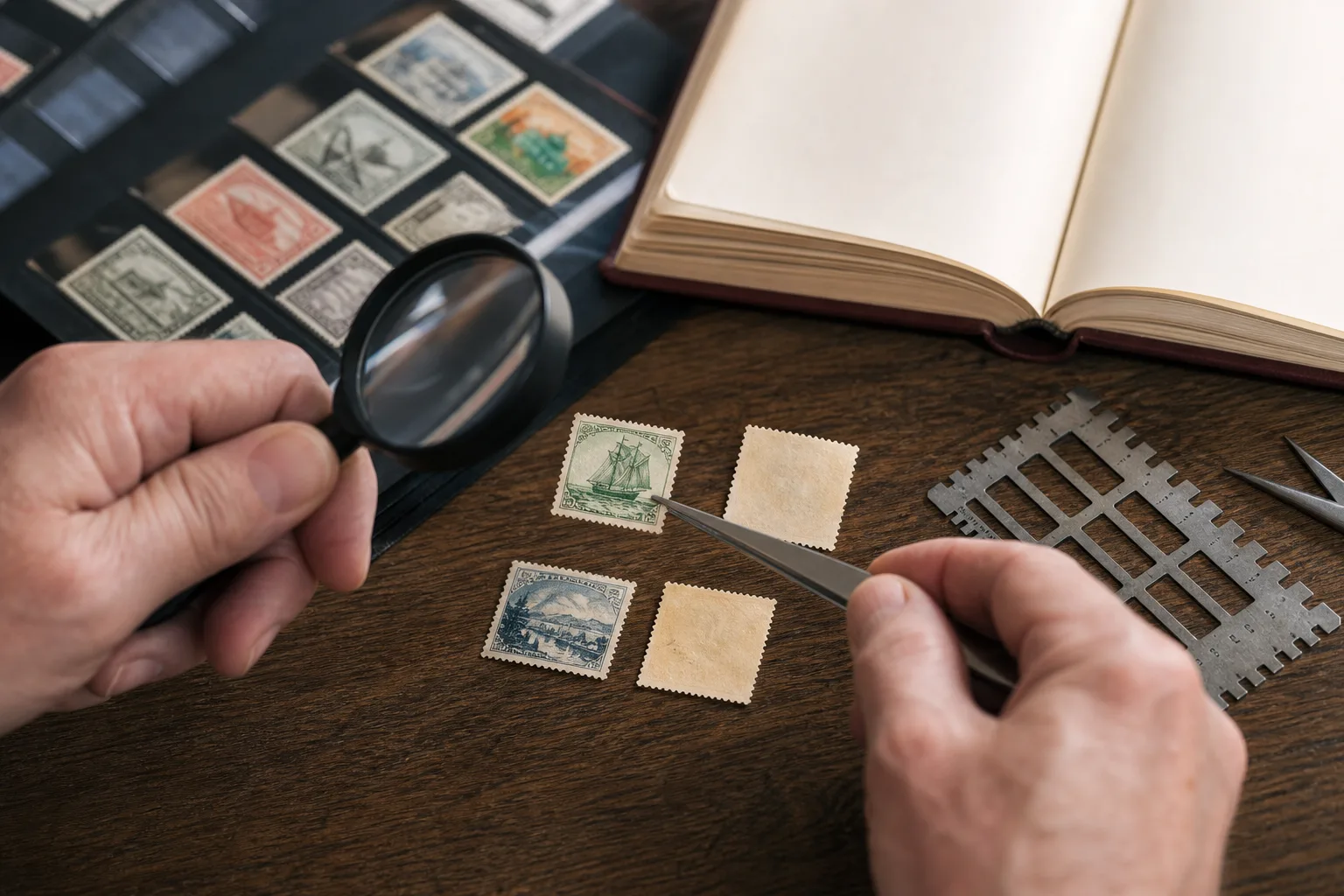
Distinguish no watermark from watermark not visible. A faint pattern, a hinge remnant or a poorly lit photograph may prevent a confident reading. Record the viewing direction and the visible portion of the pattern. The illustration here shows an inspection arrangement with blank paper, not the appearance of a genuine Germania watermark. It should not be used as a catalog diagram or evidence for your stamp's identity.
Peace and war printings require more than an attractive shade
The specialist reference separates the 1905 peace group from the 1915 war group using printing, paper and gum, not a new central subject. It lists suffixes within the peace-printing entries, including colors and other distinctions. This guide does not assign those suffixes or quote prices for them. The USD 3.25 offer documents one dealer-described pre-war 2-pfennig single, not a price for all watermarked Germania varieties.[9][2]
Photograph color under neutral light and compare the physical stamp with a relevant reference. A phone's white balance, yellow album paper and a faded print can make an ordinary color look different. Do not match an enlarged online image by saturation alone. If you have no checked comparison example, describe the visible color without turning it into a catalog shade. The absence of a suffix is an honest identification limit.
Ask which physical feature would establish the proposed printing or suffix. If it requires specialist examination, submit the original and ensure any opinion refers to that stamp. The five ordinary offers provide no price evidence for an exceptional variety.
Separate small pfennig stamps from large mark values
The portrait-type pfennig stamps are not a complete description of everything dealers call Germania. GermanStamps.net separately catalogs the large-denomination 1902 mark issues, with DEUTSCHES REICH and no watermark.[10] Its reference distinguishes a 2-mark issue with Gothic lettering from a following issue.[10] A large horizontal design therefore needs its own catalog comparison rather than the small pfennig table in this guide.[10]
Copy the currency unit as well as the number. A 30-pfennig stamp is not a 30-mark stamp, and its original postage denomination is not a current collector price. If an overprint adds a new value, record the underlying value and the added value separately. This avoids treating a currency conversion or surcharge as a newly discovered high face value. None of the five quoted offers prices a large mark-value stamp.
Our catalog-number guide explains why publisher names and suffixes matter. In the price table, Scott 58 is attached to dealer code 5GE00058. The 1900 issue table uses Michel 53 to 62. Their overlapping numerals do not mean the systems are interchangeable. Keep the source's system intact instead of silently changing an American dealer's reference into a Michel number.[1][5][7]
Read the whole overprint before comparing prices
Germania also appears with added inscriptions and denominations. GermanStamps.net documents 1900 REICHSPOST overprints for German post offices in Turkey.[11] Its reference separates overprint fonts and describes some later types that were not issued for postal use.[11] This is enough to show why an added inscription needs separate research; it is not permission to call any dark mark on Germania a rare postal overprint.[11]
Copy every letter and numeral that crosses the underlying design. Record the position and direction of the added text, and photograph the complete stamp at useful resolution. A cancellation passes over the design too, so distinguish an added printed inscription from postal ink. Do not erase, scrape or clean a mark to make the overprint clearer. Uncertainty belongs in the description until the original can be examined.
The checked prices concern unoverprinted German issues only. They do not price a Turkey overprint, an occupation issue, a forgery or an unissued item. A seller's identification can also be wrong, even if its price looks precise. For a valuable proposed overprint, compare the typography and issuing area in specialist literature and ask whether recognized expertization is warranted before treating its apparent premium as money you can realize.
Describe gum, faults and postal context separately
An unused Germania stamp is not automatically never hinged. NH concerns gum and hinge history, while LH describes a different condition. Inspect the back without touching the gum. Note hinge remnants, thins, creases, stains, missing teeth and repairs as observations rather than assigning an invented numerical grade. Our condition guide helps you keep issue identification separate from condition wording.
For used stamps, retain readable cancellation details and do not confuse a postmark date with an issue date. A heavy cancellation may obscure the inscription needed for identification. A light cancellation does not prove a rare use. Photograph an intact cover before considering any removal, since route, date, total franking and postal markings belong to that object. The illustration uses blank placeholders and does not depict a priced Germania cover.
Keep connected stamps, margins and booklet material together while researching them. A pair is not simply two loose singles if its arrangement supplies information, and a damaged stamp does not become a variety because part of the frame is missing. In the table, the 30-pfennig short tooth remains a fault in the description. We have not calculated a discount percentage for that damage or priced a fault-free replacement.[5]

Compare the same object before deciding to sell
Match issue, paper, denomination, quantity and condition before using any amount. The USD 7.70 ten-stamp used set is not a price for one 80-pfennig stamp, nor should it be divided into ten supposed single-stamp values. The four unused single-stamp offers have separate gum descriptions and stock codes. A box of duplicates is another format and needs its own sale evidence.[4][5][3]
Save the asking price, original currency, exact URL, stock code and observation date with your comparison. If you find an auction result later, also record the sale date and whether the figure includes a buyer's premium. Do not merge a retail ask, a catalog value and an auction estimate into a single price range. Those figures answer different questions, especially when you want to know what a dealer might pay.
For the items in this guide, the defensible result is a set of dated offers with identified differences. No realized sale or guaranteed resale amount was verified. If your stamp does not match an offer, use it as context only and keep looking for a closer comparison. A dealer's current buying needs, sale costs and your stamp's actual condition remain unknown until the transaction is discussed.[1]
Use the free checker to organize the visible clues
Photograph one stamp straight on with all perforations in the frame. Add a separate reverse image where safe, and include the whole cover when the stamp is attached. Copy REICHSPOST or DEUTSCHES REICH into your notes, together with the value and any overprint. Tell the checker which features are physically checked and which are only suggested by a front-image match.
The existing free checker can help narrow the issue and supply preliminary collector context. Compare its suggestion with the group table before adopting a number. Stamp Value Identifier & Scan also supports saved scan history and follow-up questions on iPhone and Android. These functions can help keep similar stamps and unresolved paper notes together. The app does not authenticate gum, certify an overprint or provide an official appraisal.
Drop a stamp photo here
Show the full stamp, every perforation, and as much front detail as possible in even light.
Keep similar Germania issues with their paper notes
Stamp Value Identifier & Scan has a free tier on iPhone and Android. Save scans and follow-up questions while you verify inscriptions, watermarks and condition. Identification suggestions are not authentication or official appraisal.
Finish with a record another collector can check
For each Germania item, keep a front photograph, a safe reverse photograph, the inscription, denomination, paper result, condition notes and complete catalog reference. Preserve any cover or connected format. Store the five prices as observations dated 7 October 2026, not as a permanent price list for the family. The dealer may change an amount or sell the particular item after that date.
Resolve the missing fact next. Inspect uncertain paper safely, show a difficult overprint to a specialist, or compare equivalent condition and quantity for an identified ordinary issue. Age and an expensive unrelated listing cannot replace those checks.
Frequently asked questions
Are all Germania stamps valuable?
No single value applies. The checked offers include a ten-stamp used set at USD 7.70 and individual unused stamps with different prices and conditions. An age, color or family name is not a rarity identification.
What is the difference between REICHSPOST and DEUTSCHES REICH?
The first pfennig Germania group of 1900 reads REICHSPOST. The 1902 group changes to DEUTSCHES REICH and remains unwatermarked. Later watermarked printings retain the latter inscription, so it does not by itself establish 1902.[7][8][9]
Does a lozenge watermark prove the 1905 peace printing?
No. GermanStamps.net explains that the 1915 war printings share the face values and watermark. Printing, paper and gum require further comparison. A front photograph cannot settle all of those features.[9]
Can I price an overprinted Germania from the ordinary offers?
No. Read the whole overprint and identify its issuing area, value and type. The documented Turkey overprints belong to separate entries. This guide verifies no price or realized sale for an overprinted Germania.[11]
Is the USD 7.70 set a value for each of its ten stamps?
No. It is the dealer asking price for the whole used 1902 set, code 6GE00065C-74u. Dividing it into single-stamp amounts would not establish individual market values, and it does not describe your stamp's condition.[4]
Sources and further reading
Primary references and specialist resources used to prepare this guide.
- [1] Allstamp.net: Scott catalog numbering and valuation limits; checked 7 October 2026
- [2] Allstamp.net: 8GE00080, 1905 2-pfennig single offer; checked 7 October 2026
- [3] Allstamp.net: 5GE00059, 1900 40-pfennig single offer; checked 7 October 2026
- [4] Allstamp.net: 6GE00065C-74u, ten-stamp used set offer; checked 7 October 2026
- [5] Allstamp.net: 5GE00058, 1900 30-pfennig single with fault; checked 7 October 2026
- [6] Allstamp.net: 6GE00066, 1902 3-pfennig single offer; checked 7 October 2026
- [7] GermanStamps.net: 1900 REICHSPOST pfennig issues; checked 7 October 2026
- [8] GermanStamps.net: 1902 DEUTSCHES REICH unwatermarked issues; checked 7 October 2026
- [9] GermanStamps.net: 1905 lozenge watermark and peace printing; checked 7 October 2026
- [10] GermanStamps.net: 1902 large mark-value issues; checked 7 October 2026
- [11] GermanStamps.net: German post offices in Turkey, Germania overprints; checked 7 October 2026