Quick answer
George Washington 2-cent stamp value depends on the exact issue, printing and condition. Common used examples can be offered for cents, while a different variety can cost much more. Read the denomination layout, separate the design families and measure perforations before applying a catalog number or price to your stamp.
Real prices for identified Washington stamps
George Washington appears on many US two-cent stamps. A red portrait stamp from one series is not interchangeable with a similar red portrait from another. The dealer examples below show how the reference and condition change the price even before specialist varieties enter the comparison. Kenmore displayed these offers when checked on 2 October 2026.
The mint labels are the dealer’s own categories. Before comparing an unused copy, inspect its gum and ask how the offered example is described. The used prices concern particular catalog entries, not every red Washington. Read our old stamps price list for a larger reference set once you have the right identity.
| Scott entry | Used offer | Mint offer |
|---|---|---|
| 406, carmine Type I, perf 12 | $0.30 | $11.00 |
| 554, carmine, perf 11 | $0.30 | $3.75 |
| 220a, cap on left 2 | $12.00 | $240.00 |
Read the frame and denomination first
Look at the entire design, not just Washington’s profile. Transcribe the wording at the top and bottom, the position of the numerals and any visible ornament in the corners. The Smithsonian distinguishes Washington-Franklin designs with the written denomination Two Cents from the later layout commonly described as 2 Cents 2.
The portrait remained familiar while other details changed. That makes the value panel a practical first sorting feature. A stamp with numerals and a written denomination should be compared with that design, rather than a photograph chosen only because the portrait and red ink look similar.
If you are sorting a group, arrange it by frame and wording before looking for a year. Postmark dates can help describe use, but do not automatically identify the issue. Keep an album’s pencil reference as a clue to check, not as a replacement for the visible features.
Choose the issue family before the variety
The two-cent Washington theme spans earlier nineteenth-century issues, the Washington-Franklin period and later definitive designs. The Smithsonian documents multiple forms of the Washington-Franklin two-cent design, differentiated by paper, coils, watermarks and perforations. The same portrait could therefore serve several catalog entries.
Scott 554 is the carmine, perforation-11 Washington in Kenmore’s 1922–1925 definitive group. Scott 406 is a Type I carmine, perforation-12 entry from the earlier Washington-Franklin series. These are useful ordinary-price anchors, but the design family and measurements must agree before you use either reference.
For collectors with green one-cent stamps alongside their red Washingtons, our Benjamin Franklin one-cent guide explains another frequently confused family. Keep the denominations separate: a matching portrait does not establish a matching issue.
Measure perforation, format and watermark
A perforation gauge measures how many holes fit into a length of two centimeters; it is not a count of all teeth on one side. Read the top and side separately, since a compound perforation can give different measurements. Use the perforation workflow to take repeatable readings.
Next describe the format: fully perforated single, two opposite straight edges, booklet material, attached pair or block. A straight edge may be part of the original production format, or it may result from later cutting. Look for a consistent format before calling an edge an error.
Watermarks can distinguish otherwise similar issues. Record a visible watermark and its orientation, or leave the field unresolved until examined. A photo of the front alone will not supply this observation. Our watermark guide covers the inspection sequence, and the catalog should agree with the design, format and measured perforation together.
What deserves closer variety research
Once the basic family is established, check the specific feature that separates its varieties. Scott 220a has the cap on the left 2 described by Kenmore. That is a precise design feature on the appropriate earlier issue, not a name to apply to every irregular red numeral.
The Washington-Franklin material also includes types and printing methods. Use a reference illustrated for that particular design when comparing engraved details. A heavy cancellation, blurred image or damaged paper can hide a line; a missing line in a photograph is not automatically a different type.
Record the suspected feature, a close image and the ordinary alternative alongside it. For a printing-method question, the relevant catalog measurements and specialist comparison are more useful than the overall paper width. If several possible catalog numbers remain, keep the possibilities visible rather than selecting the one with the largest listed value.
Why a red Washington is not automatically rare
These stamps served ordinary postage needs, and their designs remained in use through numerous printings. The Smithsonian’s history explains why the two-cent denomination was a postal workhorse. Age and an old cancellation make a stamp interesting to study, but do not by themselves distinguish a scarce issue.
Value comparisons become meaningful when the ordinary explanation has been tested. A well-centered unused stamp, a specialist variety and a damaged used single each require their own comparables. For a cover, include the destination, markings and complete envelope rather than pricing the stamp separately.
When a marketplace title uses rare without identifying its evidence, return to your measurements. Build a short description that another collector can check: denomination wording, design family, perforations, format, watermark status and condition. That description is a stronger starting point for price research than either an optimistic listing or a famous auction headline.
Compare a like-for-like price
Use the catalog identity, format and condition together when looking for a comparable. A single, pair, booklet pane and complete cover belong in different searches. A catalog number without its suffix can leave out the very feature that explains the price. Keep the catalog publisher and edition in your notes so another collector can reproduce the identification.
Our old stamps price list gives a broader set of dealer offers to compare after identification. Make two lists: currently offered examples and completed sales. In the first, record the asking price and whether postage is extra; in the second, record the date, currency, lot contents and any buyer’s premium. Keep the original currency until you have made the comparison.
An expensive listing can be an optimistic seller, a different variety or a much better specimen. Read the description and examine the photographs before adding it to your comparison. If three apparent matches disagree widely, investigate their differences rather than averaging their prices. A small bundle of ordinary stamps also needs a bundle comparison, because selling costs can exceed the value of a single.
Inspect the front, back and edges
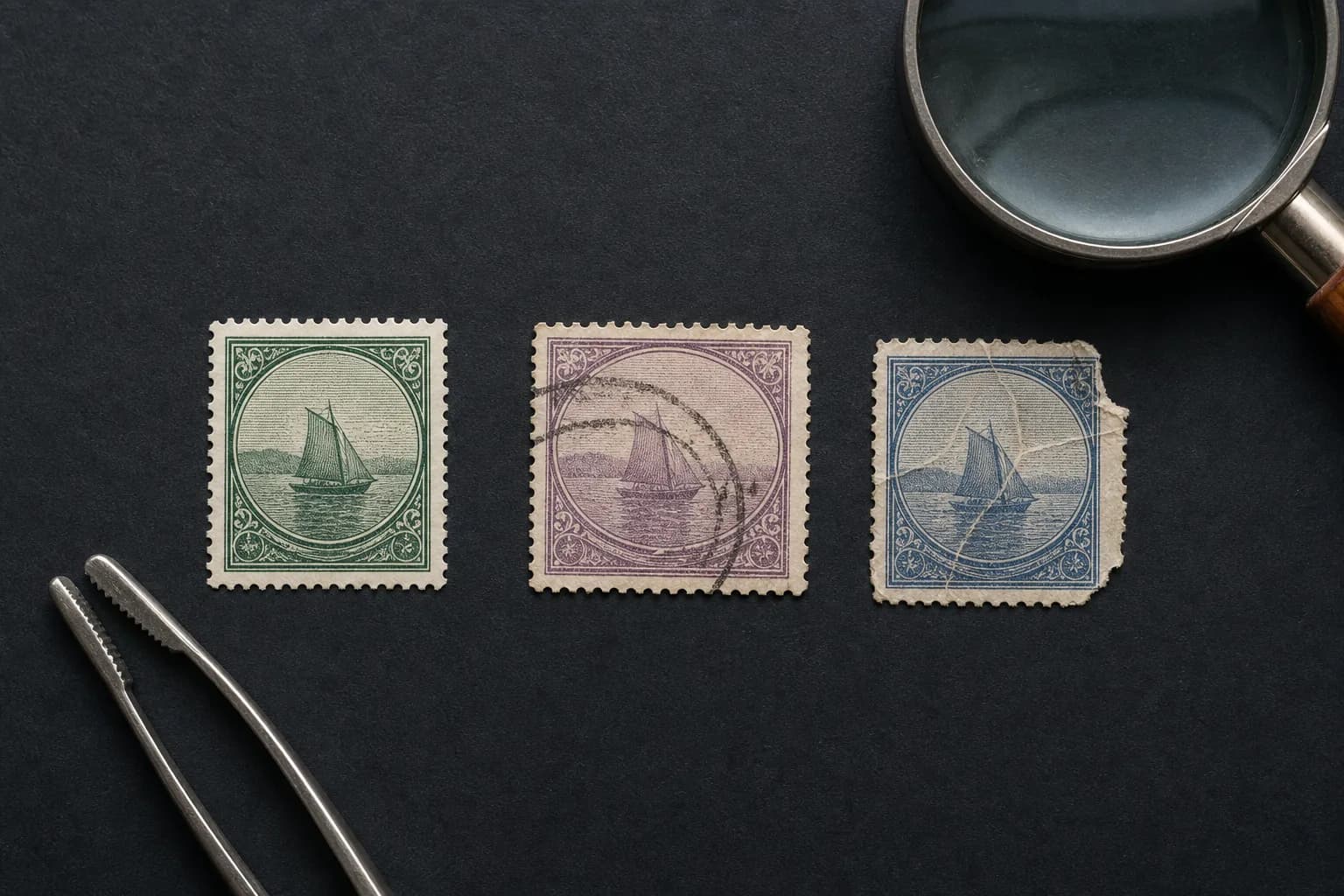
Begin with the item as you found it. Photograph the front and reverse under neutral light and keep every edge visible. Look for tears, thin spots, creases, missing perforation teeth, staining and repairs. Describe a fault by its location, such as a short tooth at the upper right, so it can be checked against the image.
For an unused stamp, record whether gum is present and whether a hinge mark or residue remains. For a cancelled stamp, note how much of the design is covered and whether a place or date can be read. The stamp condition guide explains the vocabulary for a useful description. Do this before comparing a sharp, centered dealer example with your own copy.
Keep a stamp on its complete envelope or card while researching it. The address, date, rate and other postal markings can explain how it was used. A loose-stamp price will not describe that combination. Avoid cleaning the paper, tracing a faint mark or trimming an edge to make the item look tidier; each would change evidence you are trying to read.
Check your stamp from a photo
Place one stamp on a plain background and photograph it straight on. Include the full outline and focus on the printed design, not the album page behind it. Use the free checker below for a first identification and value estimate, then compare its suggested issue with the specific features in this guide.
Add collector notes with observations that the picture does not show clearly: a measured perforation, a legible inscription, original gum, an attached envelope or a catalog reference already written in the album. Write observations rather than the rare variety you hope to find. Save the original photograph so you can compare it with a later close-up.
See the photo identification workflow for lighting and focus. If several stamps are attached as a pair or block, keep them connected and describe that format in your notes. For a whole album, take individual photographs of representative issues before working through duplicates.
Drop a stamp photo here
Show the full stamp, every perforation, and as much front detail as possible in even light.
Keep your Washington stamp research together
Install Stamp Value Identifier & Scan for free on iOS or Android. Scan your stamps one by one, save their results together and return to the issues you want to research next.
Build a useful collection record
Assign the item a simple reference and keep its photographs, candidate catalog number, measurements, condition notes and price comparisons together. Separate what you have observed from what still needs checking. For example, a visible numeral is an observation; a catalog identity that depends on a watermark is a candidate until that watermark is established.
When asking a specialist for help, send the full front and back, a close-up of the disputed feature, the measurements you took and the reference you used. Ask one concrete question: which issue fits these features, is the plate reading correct, or does this format match the catalog description? That makes a response easier to assess than a photograph accompanied only by a large price.
If you have several similar stamps, keep the ordinary examples for comparison. Differences are easier to see when the specimens are side by side under the same light. Store each securely without adhesive touching its surface, and keep any certificate with the corresponding item. Revisit the record when you obtain better evidence rather than giving every duplicate the most expensive identity.
Frequently asked questions
How much is a common used two-cent Washington worth?
Kenmore offered used Scott 406 and 554 for $0.30 each on 2 October 2026. Confirm the exact entry and condition before using either as a comparison.
Does a red Washington mean a rare stamp?
No. Several ordinary issues share a red Washington portrait. Design, perforation, watermark, format and any specific variety feature must be checked.
What does Two Cents versus 2 Cents 2 mean?
These names describe different denomination layouts within the Washington-Franklin designs. The wording helps select the correct issue family.
Should I count the teeth to find the perforation?
Use a gauge reading over two centimeters on both directions. Counting the total teeth around a stamp is not a perforation-gauge measurement.
Is an old postmark the issue date?
It records a use date when legible. The stamp’s design and physical features are needed to identify the issue itself.
Sources and further reading
Primary references and specialist resources used to prepare this guide.