Quick answer
Curtiss Jenny stamp value starts with the denomination and aircraft orientation. The ordinary 1918 issues are 6c orange Scott C1, 16c green C2 and 24c carmine rose and blue C3. Mystic's used-single asking prices were USD 45, USD 50 and USD 85 respectively on 5 October 2026. These are dealer offers, not realized sales or prices for the Inverted Jenny.[1][2][3]
First separate the three ordinary denominations
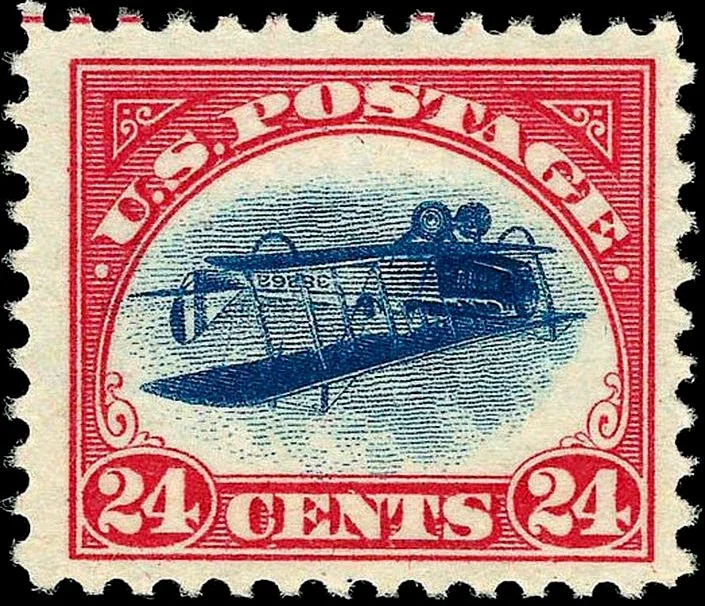
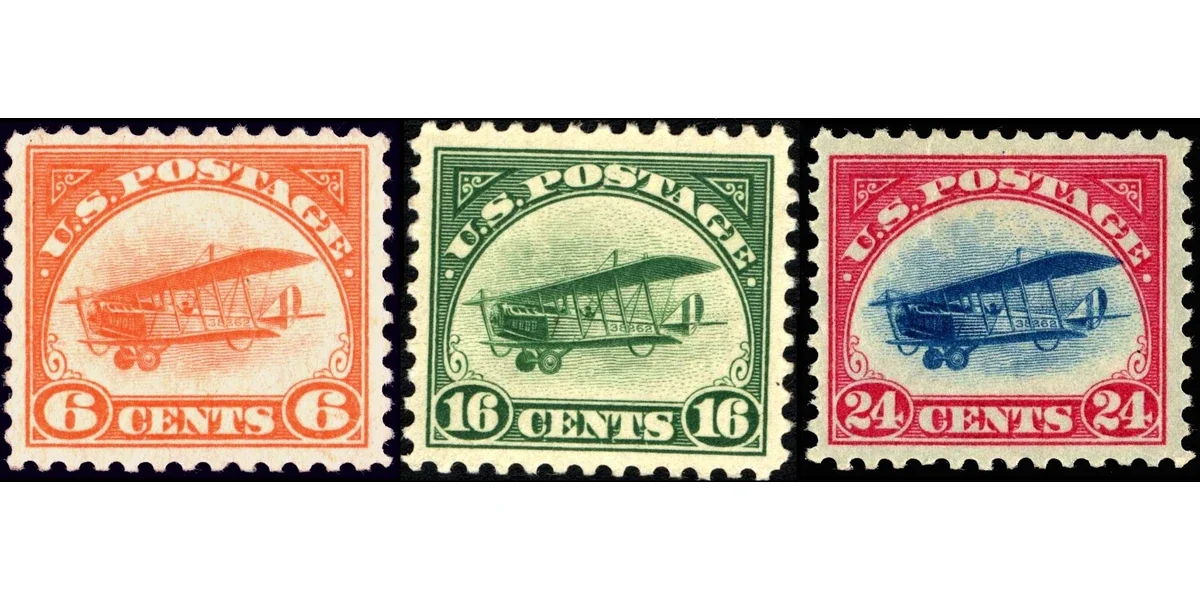
A Curtiss Jenny stamp is not automatically an Inverted Jenny. Begin by reading the two lower denomination panels with the country wording upright. The original family contains an orange 6-cent stamp, a green 16-cent stamp and a 24-cent stamp with a carmine-rose frame and blue aircraft. Mystic identifies these as Scott C1, C2 and C3. The aircraft stands normally above its landing wheels in all three ordinary designs.[1][2][3]
This guide answers the album-sorting question for those ordinary 1918 airmails. It does not assign a famous error's price to every stamp showing a biplane. A stamp with an upside-down plane, an outer dollar denomination or reproduction wording needs a different identification before any price comparison. Keep that item separate rather than choosing the largest number associated with the name Jenny.
Compare the complete frame, denomination and aircraft with the genuine reference scan below. It is not a photograph of Mystic's offered stock and supplies no grade for your stamp. Record the catalog publisher with the number using the catalog-number guide. An album label saying only C3 is a useful lead, not a substitute for checking the stamp itself.
| Scott reference | Denomination and color | Issue date |
|---|---|---|
| C1 | 6 cents, orange | 10 December 1918 [1] |
| C2 | 16 cents, green | 11 July 1918 [2][5] |
| C3 | 24 cents, carmine rose and blue | 13 May 1918 [3][4] |
Why C3 appeared before C1
Catalog order can mislead a collector dating a Jenny. The United States Reference Manual explains that Scott groups the three stamps as a set and orders them by denomination. The 24-cent C3 appeared first, on 13 May 1918, before the regular route opened on 15 May. The lower-denomination stamps followed as the airmail charge fell. C1 therefore does not mean the first Jenny issued.[4]
For the 16-cent stamp, Stamps Forever records an issue date of 11 July 1918 and a rate change effective 15 July. The manual gives 15 December as the later 6-cent rate's effective date; Mystic records the orange stamp's issue date as 10 December. These dates describe different events. A rate starting on a Monday need not mean that its stamp first went on sale that day.[1][4][5]
Keep the issue date distinct from a dated postmark. A July cancellation is not enough to identify a green Jenny if the denomination is hidden, and a later cancellation need not identify a later stamp. For an intact envelope, write down both the stamp issue and the postal date. Those two observations help avoid an incorrect first-day description when you research the whole cover.
Seven retail comparisons for ordinary stamps
The table records Mystic's stock options visible on 5 October 2026. Each amount is in US dollars and applies to one ordinary stamp in the stated category. A stock-option identifier makes the offer traceable, but it is not a certificate number or proof of a uniquely photographed specimen. The used single categories and the explicitly graded never-hinged categories should not be merged.[1][2][3]
These are dealer asking prices. They are neither auction hammer prices nor totals including a buyer's premium. No sale date or premium applies to these observations because no completed transaction is claimed. Shipping and tax are not included in the quoted item amount. Do not turn the lowest and highest rows into a universal Jenny valuation band.
For a cancelled green 16-cent stamp, begin with the C2 used-single option, not the blue-and-red C3 never-hinged option. For an uncancelled stamp whose back is hidden, leave its gum classification open. The old stamps price list helps interpret retail observations, but a dealer's offer is not the amount another dealer will pay to buy your stamp.
| Issue and stock option | Dealer's condition category | Dealer asking price |
|---|---|---|
| C1, 273601 [1] | Used single; grade not specified | USD 45.00 |
| C1, 273595 [1] | Mint, Very Fine, never hinged | USD 195.00 |
| C2, 274334 [2] | Used single; grade not specified | USD 50.00 |
| C2, 274328 [2] | Mint, Very Fine, never hinged | USD 290.00 |
| C3, 274537 [3] | Used single; grade not specified | USD 85.00 |
| C3, 274529 [3] | Mint, Very Fine, never hinged | USD 350.00 |
| C3, 274522 [3] | Used; small flaws, grade not specified | USD 49.00 |
Upright, inverted and reproduced are different identities
Hold the country inscription and the word CENTS in their normal reading position. Then inspect the aircraft relative to the frame. Rotating the entire stamp or its photograph does not create a printing error. The relevant question is whether the aircraft is inverted while the frame remains upright. A plane that sits normally on its wheels belongs in the ordinary-design comparison, subject to confirming the issue.
The famous invert concerns the bicolored 24-cent design. The manual connects it with the separate printing of that stamp and treats the invert in a different specialist discussion.[4] Do not search for a comparable by the word Jenny alone. An orange or green normal stamp is not made equivalent to that error by an old album's handwritten claim or by a dramatic online headline.
A later postal issue, a commemorative image and a private reproduction may all repeat the aircraft. Read the actual outer denomination and any reverse wording before assigning a 1918 catalog reference. A dollar-denominated outer stamp cannot match the cent denominations in this table. If an apparent inverted 24-cent item lacks established provenance, preserve it and seek expert examination. Our error-identification guide explains why a visual surprise is only the start of an identification.
Perforation 11 is a measurement, not a tooth count
Mystic records flat-plate printing and perforation 11 for each ordinary denomination.[1][2][3] That gauge describes perforations over a standard measured distance. It does not mean that the stamp has eleven teeth along each side. Use an actual gauge and compare intact horizontal and vertical edges; a magnified phone image with no scale cannot supply the physical measurement.
For the green 16-cent issue, Stamps Forever records unwatermarked paper. It also describes sheets of 100 with the right and bottom margin selvage removed before sale.[5] That documented sheet treatment matters when you meet a straight outside edge. It is not a reason to call the item a booklet stamp, an imperforate error or a trimmed specimen without further examination.
Keep missing teeth separate from a naturally straight sheet edge. Write down which edge is straight and whether the design or paper looks cut, but do not repair or trim it to make the outline more regular. The perforation-measurement guide gives the practical alignment method. If an edge makes the catalog match uncertain, keep the uncertainty in the record rather than inventing a variety.
For mint Jennys, the reverse determines the comparison
No cancellation does not establish never-hinged gum. Examine the reverse only when the stamp is loose and safe to move with tongs. Record an obvious hinge trace, remnant, gum disturbance, missing gum or suspect paper loss separately. If a mount hides the back, write gum unexamined. Choosing a never-hinged price because the face looks fresh skips the evidence that defines that category.
The table deliberately uses Mystic's Very Fine, never-hinged categories for all three mint comparisons.[1][2][3] That keeps the terminology consistent, but it does not prove that your stamp meets the dealer's category. Keep dealer descriptions as quoted classifications in your notes. Original gum, regumming and subtle repairs can require in-hand specialist assessment, not a brighter photograph.
Do not moisten, rub or press the gum to test it. An attached old hinge is a handling question before it is a pricing question. Read the hinges and mounts guide before removing an item from an old album. Preserve the back's evidence, even if leaving the stamp in place postpones a final comparison.
Centering and faults matter within one denomination
On a Jenny, judge centering against the entire printed frame, not the aircraft alone. Photograph all edges and check how close the country inscription, ornamental border and denomination panels sit to the perforations. A well-positioned aircraft within an off-center frame does not make the whole stamp well centered. Keep shortened teeth and missing corners in a separate fault description.
Mystic's ordinary C3 used-single offer is USD 85, while its option described as used with small flaws is USD 49.[3] These two retail categories show why condition belongs beside a price. They do not establish a fixed percentage deduction for a crease or thin, and the phrase small flaws does not tell you which fault your stamp has. Inspect the actual object rather than applying a discount formula.
A cancellation can obscure the plane and wording without changing the stamp's denomination. Take a complete front image before deciding that a heavily cancelled example matches a clean retail illustration. The condition-grading guide helps describe centering, paper and faults without assigning an unsupported numerical grade. Keep what you can see distinct from what a seller claims.
Do not price a cover or joined block as a loose single
The reference manual illustrates early airmail covers and the first-trip markings connected with the 1918 route.[4] A stamp still attached to a complete envelope is a different collecting object from the single-stamp stock options above. Preserve the envelope, address, postmarks and any accompanying stamps. A familiar Jenny on the front is not permission to soak it off for easier comparison.
For a joined block, photograph every stamp and the back of the whole unit. Record the number of attached stamps, remaining sheet margin and any visible printing in the margin. Do not split the block to make it fit a single-stamp retail row. Likewise, do not multiply the single price by the number of stamps and call the result an established block value.
If a cover carries a supposed first-flight date, check its entire route and markings before using that description. The issue date, departure marking and historical flight date are separate evidence. Our first-day cover guide explains how to distinguish an issue-day claim from other commemorative or postal-history material. A later souvenir can retain the same aircraft subject without being a 1918 flown cover.
Submit the denomination with your photograph
Photograph one stamp straight on with the complete frame and every edge visible. In the notes, transcribe 6, 16 or 24 cents, describe the colors and state whether the aircraft appears upright relative to the wording. Add cancellation, gum visibility and faults you actually observed. A note saying possible C2, reverse unexamined is more useful than rare Jenny worth thousands.
For a cover or block, first retain a full-object photograph in your records. Explain that format in the checker notes instead of presenting a cropped single as the complete object. The checker can suggest an issue and collector context, but it cannot authenticate an invert, establish original gum or prove whether an edge was altered from an ordinary front photograph.
Drop a stamp photo here
Show the full stamp, every perforation, and as much front detail as possible in even light.
Keep your orange, green and bicolored Jennys separate
Install Stamp Value Identifier & Scan for free on iOS or Android. Scan stamps individually, save results and organize your collection while you compare denominations, backs and unresolved condition questions.
Choose the next step from the unresolved feature
If denomination and normal orientation match, select the corresponding ordinary issue and inspect its condition. If the gum is hidden, obtain a safe reverse view before choosing a mint category. If the edge is uncertain, measure what remains and ask for specialist advice. If a plane is inverted relative to the frame, leave the error claim open until expert examination and provenance support it.
Keep the source URL, stock-option identifier, denomination, condition category, currency and observation date together. A later completed sale can add stronger transaction evidence, but it must still match your stamp's identity and format. Record the actual sale date and distinguish hammer from a total including fees. No such auction amount is asserted in this guide, and none of the ordinary retail observations should be substituted for an authenticated-error result.
Frequently asked questions
Are all 24-cent Jenny stamps the famous invert?
No. C3 is the ordinary 1918 stamp with its aircraft upright relative to the frame. Check the plane while the country wording is upright. A rotated photo, reproduction or later postal issue does not establish the original printing error.
Why is Scott C3 older than C1?
Scott orders this three-stamp set by denomination, not issue date[4]. C3 appeared on 13 May 1918, C2 on 11 July and C1 on 10 December. The rate changes followed their own effective dates.[1][2][3]
What can I compare an ordinary used 16-cent Jenny with?
Mystic's C2 used-single stock option 274334 was offered at USD 50 on 5 October 2026. Its grade is not specified. That is a dealer asking price for the described category, not a completed sale or an offer to buy your stamp.[2]
Does a straight edge mean the green Jenny is imperforate?
No. Stamps Forever describes right and bottom sheet selvage being removed for the 16-cent issue. A straight outside edge alone does not prove an imperforate error. Preserve the item and check the remaining edges and format.[5]
Can I use the never-hinged price if there is no postmark?
Not without examining the gum. An uncancelled front does not prove a never-hinged back. Record hinge traces, missing or disturbed gum and paper faults. Leave the gum classification unresolved when a mount prevents safe inspection.
Sources and further reading
Primary references and specialist resources used to prepare this guide.
- [1] Mystic: C1 issue and stock options, checked 5 October 2026
- [2] Mystic: C2 issue and stock options, checked 5 October 2026
- [3] Mystic: C3 issue and stock options, checked 5 October 2026
- [4] The United States Reference Manual: first airmail issue, published 20 October 2000
- [5] USPS Stamps Forever: 16-cent issue, checked 5 October 2026