Quick answer
Netherlands Wilhelmina fur-collar stamp value depends on denomination, printing, format and condition. On 11 October 2026, Theo Peters asked EUR 2.25 for a green 3-cent postfris single and EUR 4.50 for a 5-cent postfris single. These are separate dealer offers, not used-stamp values or sales. Check the portrait and edges first.[23][25]
Identify the fur collar before reading a price
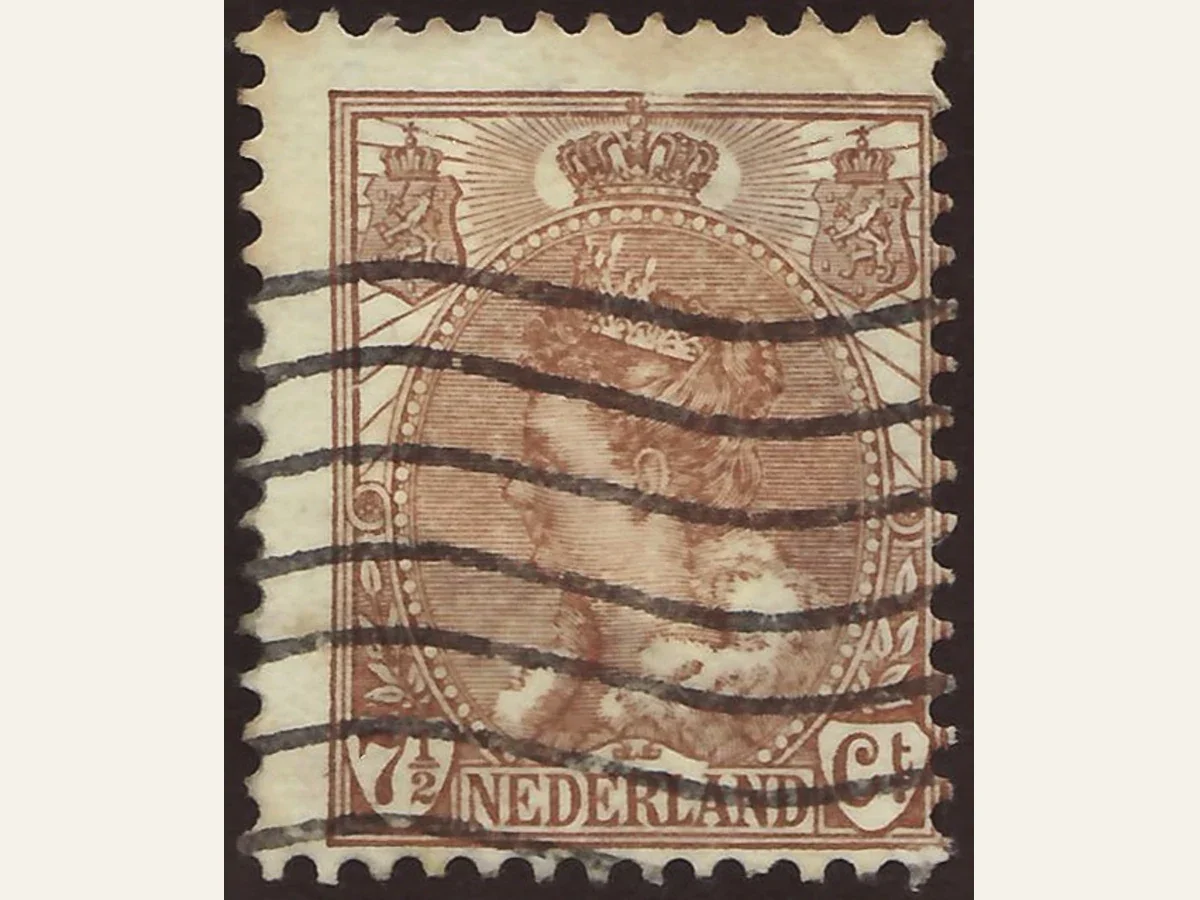
The Netherlands Wilhelmina fur-collar family is recognizable by the young queen's left-facing profile, tiara and pale textured collar within an oval. The genuine brown 7½-cent scan in this guide shows those features, the word NEDERLAND and a heavy barred cancellation.[20] Use that combination rather than the queen's name alone. Wilhelmina appears on several different Dutch designs, and a portrait identified as hers does not settle which issue you own.
The cent-value issue began on 1 August 1899 in Stampi's reference. Its designer is Louis-Eugène Mouchon, and the printer is Joh. Enschedé & Zonen.[1] Later additions and reprints explain why a dealer may group the material under 1899-1921.[22][23] An album heading of 1899 is a family label, not proof that every stamp below it was printed in that year. A cancellation date records a use, not necessarily an issue date.
Start by transcribing the country, face value, visible color arrangement and any added words. Photograph the whole object before making a portrait close-up. Keep a joined pair or a stamp on a letter together. The foreign-stamp identification method helps with inscriptions, but this family needs the collar, denomination and frame checked together. Do not give an unclear fraction the value suggested by an empty album space.
Sort cent values and color arrangements
Stampi's initial cent-value group includes 3, 5, 7½, 10, 12½, 15, 20, 22½, 25 and 50 cents.[1] The same reference separately records the olive-green 3-cent and violet 17½-cent additions in 1901-1906. Later pages cover more colors and denominations, including 30, 40 and 60 cents.[1][16] These lists organize candidates. They do not imply that every shade or printing is covered here.
A number at bottom left and Ct at bottom right identify the printed cent value on the illustrated small-format design.[20] Keep that old face value separate from a modern EUR dealer price. Read 7½ and 12½ as fractions, not 75 or 125. A bicolored stamp has a frame color and a portrait-area color, both of which belong in the record. A dark cancellation can hide either color, so inspect uncovered areas before naming a shade.
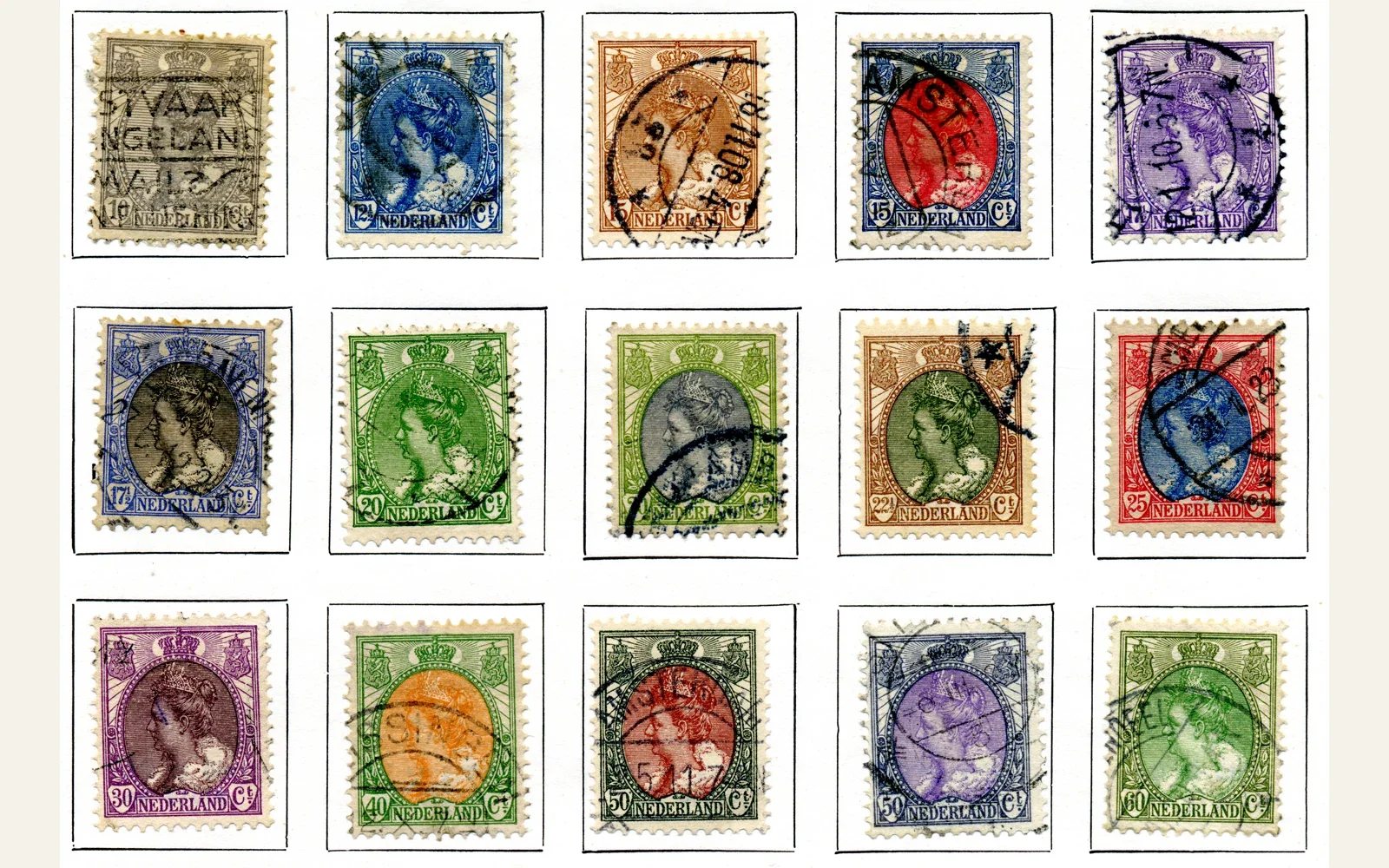
The genuine hero collage shows fifteen collected examples between 10 and 60 cents, including repeated denominations with different color arrangements.[21] It is not a complete set inventory, a dealer lot or a chart of rarity. Its handwritten-style album boundaries and cancellations are part of the source image. Do not count its fifteen stamps as the quantity supplied by any price listing below.
Keep the guilder portraits in a separate comparison
The larger guilder designs need a separate catalog comparison. Stampi groups 1, 2½, 5 and 10 guilders under 1899-1905, with their own design credits and perforation descriptions.[1] A 10-guilder stamp is not a 10-cent stamp enlarged in a photograph. The currency word, frame and whole format matter before any price can be useful.
The 1-guilder design is a particular trap. Stampi dates the inauguration issue to 6 September 1898 and explains that the later 1-guilder issue has its denomination farther from the edge and thinner GULDEN lettering.[1] NetPha places the coronation guilder at the beginning of the broader fur-coat design history.[11] These statements use different boundaries, not contradictory dates for one identical cent stamp. This guide's ordinary price examples concern the small cent-value family.
Record GULDEN exactly when it appears, and compare the whole frame rather than the face alone. Do not transfer the asks in our cent-value table to a guilder portrait, an inauguration issue or a different portrait family. A large printed number can also be partly covered by a postmark. If the unit cannot be read, keep the identification unresolved instead of choosing the more expensive possibility.
Measure the perforations, but do not make one gauge universal
Stampi describes comb perforation 12½ for the main 1899 cent portrait group.[1] This is a useful starting point, not a statement that every denomination and printing has one gauge. In the same section, its 22½-cent and 25-cent bicolors include entries with 11½ by 11 and 11½. The later 50-cent grey/violet group also includes an 11½ by 11 entry.[1][16]
Measure both directions on the actual stamp with a gauge. Use the perforation measurement guide if you are unfamiliar with compound measurements. Write the horizontal reading first and the vertical reading second. Do not count visible teeth in a phone crop or use the image's pixel width as a physical scale. Missing teeth and a trimmed edge need separate condition notes.
The guilder entries have their own combinations, including 11, 11½ by 11, 11 by 11½ and 11½ in Stampi's listings.[1] Reversing the order of a compound gauge changes the comparison. No measured gauge in this article establishes a price premium by itself. We have not priced specialist perforation varieties or certified a gauge from the genuine scans. The conceptual desk illustration is not a usable gauge chart.

Separate later hatching and the Veth portrait
Stampi records a 1921-1923 10-cent grey Mouchon portrait distinguished by wider hatching in the medallion.[17] Therefore a grey 10-cent portrait should not be assigned to the original 1899 printing from color alone. Compare the medallion lines with a specialist reference and keep a photograph sharp enough to show them. A blurred phone image or a cancellation across the face can leave that distinction unresolved.
The 4-cent reddish-purple and purple entries also occur in Stampi's 1921-1923 group.[17] Their presence explains why an omnibus dealer category can contain later additions beside older denominations. Record the observed value first, then investigate the period. Do not force a 4-cent stamp into the initial denomination list just because the album page begins with 1899.
Stampi gives the later 1924 Wilhelmina portrait design to Jan Veth, engraved by H. Seegers, and describes comb perforation 12½.[18] That shared gauge does not make it a Mouchon fur-collar stamp. The whole portrait and frame must agree. This article supplies no Veth price, no complete catalog-number crosswalk and no hidden-paper diagnosis. A family name is the beginning of the attribution, not its end.
Treat imperforates and improvised holes as specialist questions
Stampi lists official imperforate 5-cent and 10-cent Wilhelmina stamps in January 1923.[17] René Hillesum's NetPha article explains that a strike at Joh. Enschedé left stamps unfinished and that some post offices subsequently added their own perforation or piercing.[11] The later NetPha article discusses a 10-cent example and the differences among local improvised edges.[5] These are historical reports, not authentication of an item in your album.
An edge without teeth can result from cutting an ordinary perforated stamp. Irregular holes can be later damage or alteration rather than a documented post-office treatment. Keep all margins, the cancellation and any attached envelope or piece intact. A wide margin or unusual edge is a reason for a specialist comparison, not permission to declare an imperforate rarity from one front image.
The 2023 NetPha text says all stamps since the first 1852 issue had been perforated.[11] That sweeping historical sentence is not used here. The useful evidence is its focused account of the 1923 issue and local piercing. Likewise, auction-lot references in those articles do not provide a verified realized price. A 2024 auction preview is not evidence of a 2026 sale result or a rarity premium for an unidentified loose single.
Compare the exact dealer offer and photographed format
Theo Peters supplied five live product pages checked on 11 October 2026. Their structured offers explicitly state EUR, and each page names a postfris item, meaning the seller's mint never-hinged category.[8][22][23] Each photograph shows one stamp. Retain the NVPH seller label and stock identifiers rather than treating a photograph as independent catalog certification. The observations are retail asking prices, not completed sales or purchase offers to you.
The two 3-cent offers illustrate why a face value is insufficient. The orange photographed single, seller NVPH 56, was EUR 45.00; the green photographed single, NVPH 57, was EUR 2.25.[22][23] These are separate products with separate colors and identities. They are not endpoints of a universal 3-cent value range. Neither page proves that your uncancelled stamp has original undisturbed gum or the same condition.
The 4-cent photographed single, seller NVPH 58, was EUR 2.25. The 5-cent single, NVPH 60, was EUR 4.50. The blue 12½-cent single, NVPH 63, was EUR 14.00.[24][25][8] These are displayed item prices, not verified delivered totals. Shipping, final checkout total and the exact specimen supplied require the seller's confirmation. This guide includes no verified retail asking price for an ordinary used single. The mint never-hinged offers should not be used to value one.
| Seller NVPH and source | Stock and item number | Photographed value and color | Format and condition | Ask |
|---|---|---|---|---|
| 56 [22] | TPC104467 / 18166 | 3c orange | 1 stamp; postfris, seller label | EUR 45.00 |
| 57 [23] | TPC104466 / 18167 | 3c green | 1 stamp; postfris, seller label | EUR 2.25 |
| 58 [24] | TPC104464 / 18168 | 4c reddish purple | 1 stamp; postfris, seller label | EUR 2.25 |
| 60 [25] | TPC104462 / 18170 | 5c rose/red | 1 stamp; postfris, seller label | EUR 4.50 |
| 63 [8] | TPC104459 / 18173 | 12½c blue | 1 stamp; postfris, seller label | EUR 14.00 |
Inspect the reverse and preserve cancellation evidence
A postfris listing cannot value a used stamp with a heavy cancellation. The genuine 7½-cent scan here shows bars across the portrait and lower lettering.[20] They help explain the visible object, but neither the image nor its rights metadata assigns a condition grade. Inspect centering, corners, tears, stains and thinning separately. A clean-looking face does not establish gum status on the back.
When safe, photograph the reverse without peeling a stuck hinge or lifting an adhered stamp. Distinguish never hinged, hinged, unused without gum and used when describing your own item. The condition grading guide gives a practical inspection sequence. Do not improve the apparent condition by washing, trimming or erasing marks before identification. Such interventions can remove the evidence a specialist needs.
A readable cancellation or cover can justify a postal-history question different from the loose stamp's retail comparison. Keep the place, date and whole envelope in the record. The cancellation guide helps describe the mark without assigning an unsupported premium. The references in this guide do not establish an exceptional cancellation value or a sale price for an intact cover. Those questions require their own matched evidence.
Build a record another collector can check
Write down the exact denomination, country inscription, portrait family, color arrangement, measured gauge and whole-object format. Add front and safe reverse photographs, then identify the catalog publisher when recording a number. NVPH 57 in a seller title is not the dealer's stock number TPC104466.[23] The catalog-number guide explains why those identifiers should occupy different fields.
If you want to sell, compare transactions for the same attributed issue, format and condition. Retain the sale date and whether an auction amount includes a buyer's premium. Do not divide a set price by its stamp count and call the result an observed single price. This guide's table contains singles only. It offers no complete-set price, no valuation of an inherited album and no dealer buy-in estimate.
Use the old stamps price list for broader examples after identification. It separates retail asks from other evidence. Your useful next action is to resolve whichever attribute prevents a match. That may be the fraction, guilder unit, medallion hatching, edge treatment or gum. If several are unresolved, retain the fur-collar family as a candidate rather than entering an exact catalog number and price prematurely.
Use an individual scan to organize the next check
Photograph one object straight on in diffuse light with all edges visible. If it is a joined pair or cover, photograph the complete object before the close-up. State the denomination you can actually read and tell the checker whether the back is safely accessible. For a grey 10-cent candidate, ask which physical comparison could separate the original group from the wider-hatched later printing.
Stamp Value Identifier & Scan offers photo identification, follow-up questions and saved collection records. Its current iOS listing is free with in-app purchases, and Google Play provides installation with in-app purchases.[12][13] Free installation does not mean every scan or feature is unlimited. Save individual scan records while you compare country, denomination and visible design with a reference. The product description supports saved history and collection organization, not invisible specimen authentication.
The checker can suggest a family and estimated collector context, but it cannot establish original gum, a hidden paper feature or an authentic post-office emergency perforation from the front. The app is not an official grading, certification or appraisal service. Keep uncertain details in the saved record as questions. A scan should help you decide what to inspect next, not turn a plausible portrait match into a guaranteed sale price.
Drop a stamp photo here
Show the full stamp, every perforation, and as much front detail as possible in even light.
Keep bontkraag identification questions with each saved scan
Install Stamp Value Identifier & Scan for free on iOS or Android. Save individual scans in your collection and compare denomination, medallion hatching and edge treatment. In-app purchases apply; scans do not authenticate gum or rare perforations.
Frequently asked questions
How much is a Netherlands Wilhelmina fur-collar stamp worth?
On 11 October 2026, Theo Peters asked EUR 2.25 for the green 3-cent postfris single, seller NVPH 57, and EUR 4.50 for the 5-cent postfris single, NVPH 60. These are separate retail offers, not a used-stamp range or realized sales.[23][25]
Does 1899 on an album page prove the printing year?
No. Stampi dates the initial cent-value issue to 1 August 1899 but also records later additions, a wider-hatched 10-cent group in 1921-1923 and 1923 imperforates. Compare the stamp itself rather than treating an album label as proof.[1][17]
Is every fur-collar stamp perforated 12½?
No. Stampi gives 12½ for the main cent group but records other gauges for selected bicolors and separate combinations for guilder designs. Measure both directions and match the denomination and catalog description.[1][16]
Is a smooth edge proof of the 1923 imperforate issue?
No. Official imperforate 5-cent and 10-cent issues are documented, but cut-down perforated stamps and altered edges need exclusion. Preserve margins and postal context. NetPha's accounts do not authenticate your specimen.[17][11]
Can the app certify never-hinged gum or emergency perforations?
No. A scan can organize a likely design match and saved questions. Gum and unusual edge treatment require physical evidence and, when necessary, specialist examination. Free installation on iOS or Android does not include official authentication.[12][13]
Sources and further reading
Primary references and specialist resources used to prepare this guide.
- [1] Stampi: 1899 cent group, guilder designs and earlier portraits
- [5] NetPha: imperforate Wilhelmina and local piercing
- [8] Theo Peters: NVPH 63, TPC104459
- [11] René Hillesum, NetPha: The un-perforated Queen
- [12] Apple App Store: current product listing
- [13] Google Play: current product listing
- [16] Stampi: later cent values and color groups
- [17] Stampi: 1921-1923 hatching and January 1923 imperforates
- [18] Stampi: 1924 Veth portrait and reversed pairs
- [20] Wikimedia Commons: genuine brown 7½-cent scan and rights
- [21] Wikimedia Commons: genuine 10-60 cent collage and rights
- [22] Theo Peters: NVPH 56, TPC104467
- [23] Theo Peters: NVPH 57, TPC104466
- [24] Theo Peters: NVPH 58, TPC104464
- [25] Theo Peters: NVPH 60, TPC104462