Quick answer
US special delivery stamp value depends on the issue and condition, not the 10-cent inscription alone. On 7 October 2026, Northland listed one used Scott E1 at USD 42 and one hinged E6 bicycle stamp at USD 89. These are dealer asks, not sales. Check wording, perforations, watermark and gum before choosing a comparable.[1]
Identify a special delivery stamp before looking up ten cents
Look for SPECIAL DELIVERY and TEN CENTS, then inspect the scene. Early American examples show a running messenger. Later stamps show a messenger on a bicycle, and the 1922 design changes to motorcycle delivery. A blue ordinary postage stamp with a 10-cent denomination belongs to a different search unless it also matches this service and design. Stamp Smarter separates these designs in its special delivery checklist.[6]
This guide covers loose US 10-cent messenger stamps, chiefly the running and bicycle issues, with motorcycle comparisons to prevent misidentification. It does not price every special delivery denomination, territorial overprint, plate-number multiple or envelope. The green Helmet of Mercury stamp is a separate design within the service, not a green bicycle variety.[6] Read any extra printing before treating an example as the ordinary US issue.
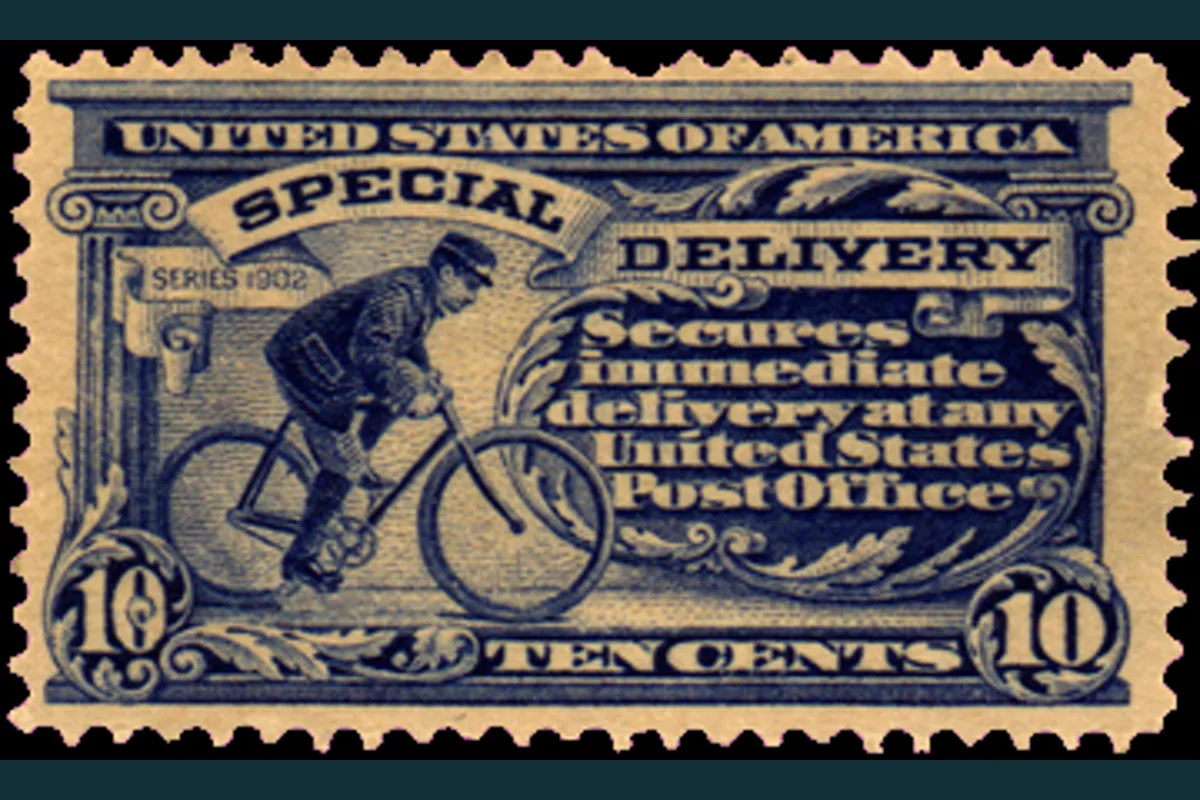
The genuine reference scan below shows the 1902 bicycle design, with the rider at left and delivery-service wording at right.[9] It is not a photograph of a dealer's priced specimen. Color, a rider and a wide rectangular format establish useful design clues, but a front scan cannot establish the watermark or the state of the gum. Keep those observations separate in your notes.
The ten cents paid for a service, not ordinary postage
Special delivery began on 1 October 1885. The United States Stamp Society explains that the first stamp promised delivery at a special delivery office; service expanded to all post offices in 1886, and a revised stamp followed in 1888.[7] Those inscriptions matter because collectors are identifying different issues, not simply different shades of a blue stamp.
The National Postal Museum's page, preserved in a 10 July 2025 archive snapshot, explains that the special stamp paid an additional fee alongside lawful postage. It did not guarantee delivery by a particular day.[10] An envelope bearing ordinary postage and a messenger stamp therefore need not contain redundant postage. The two stamps paid for different things. Avoid describing this historical service as a modern guaranteed overnight product.
The printed 10 cents is the historical face value. It is not today's collector price, and it does not identify an auction result. A readable cancellation date records use rather than automatically dating the printing. On an intact envelope, retain the ordinary postage, destination and any delivery markings together. Those details belong to the postal-history object, which needs its own comparison rather than a loose-stamp price.
Sort the running messenger by wording and paper
For the first blue design, transcribe the lower inscription. The Stamp Society distinguishes delivery at a special delivery office from delivery at any post office. It also records the orange change in 1893 and the Bureau's added line under TEN CENTS in 1894.[7] Do not use that Bureau line as a shortcut for separating the original E1 from E2. The wording is the first design check.
The 1894 and 1895 Bureau running designs require a paper check. The specialist identifier separates unwatermarked E4 from double-line-watermarked E5.[5] A postmark from the 1890s or an album label saying Bureau does not settle that distinction. Record a visible watermark positively; if you have not examined the back, record watermark unexamined instead of assigning the scarcer entry.
| Scott reference | Issue year and visible clue | Paper check |
|---|---|---|
| E1 | 1885; blue; a special delivery office wording | Unwatermarked |
| E2 | 1888; blue; any post office wording | Unwatermarked |
| E3 | 1893; orange running messenger | Unwatermarked |
| E4 | 1894; blue Bureau design; line under TEN CENTS | Unwatermarked |
| E5 | 1895; blue Bureau design | Double-line watermark |
A bicycle image can belong to several issues
The bicycle design arrived in 1902 and returned after the intervening Helmet of Mercury issue. The Stamp Society describes successive double-line, single-line and unwatermarked printings.[7] That history explains why a visual match to a bicycle image is not an exact catalog identification. You must combine design with measured perforations and the paper's actual watermark status.
For each candidate, write the catalog publisher beside the number. Scott E6 is a reference, while a dealer's inventory number identifies an offered object. Neither replaces the other. The catalog-number guide explains how to keep the system and variety together. Leave the suffix open when a claimed shade or transfer variety has not been established physically.
| Scott reference and design | Perforations | Watermark or printing clue |
|---|---|---|
| E6; bicycle | 12 | Double-line watermark |
| E8; bicycle | 12 | Single-line watermark |
| E9; bicycle | 10 | Single-line watermark |
| E10; bicycle | 10 | Unwatermarked |
| E11; bicycle | 11 | Unwatermarked |
| E12; 1922 motorcycle | 11 | Flat-plate printing |
| E15; 1927 motorcycle | 11 × 10½ | Rotary-press printing |
Documented ordinary dealer asking prices in US dollars
These offers were read directly on 7 October 2026. Each row is one loose stamp, not a set or cover. Northland prints no separate stock ID for these entries; its reference and exact condition description locate the offer. Falmouth prints inventory numbers. The currency is USD, and these are retail asking prices, not realized sales or bids for your stamp.[1][2]
Falmouth's live page states a last update of 27 January 2025. Its prices remained displayed when checked, but neither dealer's page independently confirms present stock. Ask before ordering. For Northland's used E1, USD 42 is the ask; the adjacent Scott USD 80 is a catalog figure. Do not copy a catalog column into the asking-price column.[1][2]
Falmouth's E11 and E15 amounts are in Cat. $, with empty Price cells, so they are excluded from this asking-price table.[2]
| Dealer, catalog and stock ID | Seller's stated condition | Asking price |
|---|---|---|
| Northland; Scott E1; stock ID absent | Used; VF | USD 42.00 |
| Northland; Scott E1; stock ID absent | Unused; regummed, unhinged; described as sound | USD 99.00 |
| Northland; Scott E6; stock ID absent | Original gum; hinged; F/VF | USD 89.00 |
| Northland; Scott E12; stock ID absent | Original gum; never hinged; VF+ | USD 49.00 |
| Falmouth; Scott E1; inventory 87572 | Mint; original gum; hinged; no finer grade stated | USD 425.00 |
| Falmouth; Scott E6; inventory 87587 | Mint; original gum; never hinged; no finer grade stated | USD 425.00 |
Compare condition before using an offered price
The table does not establish one value for all ten-cent special deliveries. A motorcycle E12 is a different issue from E1, and a used stamp differs from an unused one. Choose a row only after the issue, quantity and condition match. The old-stamp price list explains why a dealer's selling price and a buying offer answer different questions.
Original gum describes the back's adhesive. Hinged means a mounting hinge has affected it; never hinged describes a different gum state. Northland's regummed E1 is explicitly not an original-gum comparison, even though it is unhinged.[1] A clean front and an uncancelled design cannot demonstrate original gum. If the stamp remains mounted, keep its reverse condition unresolved.
Inspect shortened teeth, tears, creases, thins and stains independently of centering. A dealer's VF or F/VF label is the seller's description, not a grade assigned here. Use the condition guide to record visible faults. Do not invent a percentage discount for a missing tooth or infer a market premium from the difference between two unrelated offers.
Measure the horizontal and vertical perforations
Use a perforation gauge on two sound edges, one horizontal and one vertical. The number describes spacing over a standard distance, not the total teeth on a long rectangular stamp. Bicycle entries include gauges 12, 10 and 11; the later E15 motorcycle entry has compound perforations 11 × 10½.[6] Counting teeth without a gauge can send the price search to the wrong entry.
Follow the perforation-measurement workflow before assigning a number. Keep the stamp flat and handle it with tongs. A damaged edge cannot prove an imperforate variety, and trimming an edge destroys evidence. For an uncertain measurement, save a photograph beside the gauge and write the uncertainty rather than rounding to the most valuable possible result.
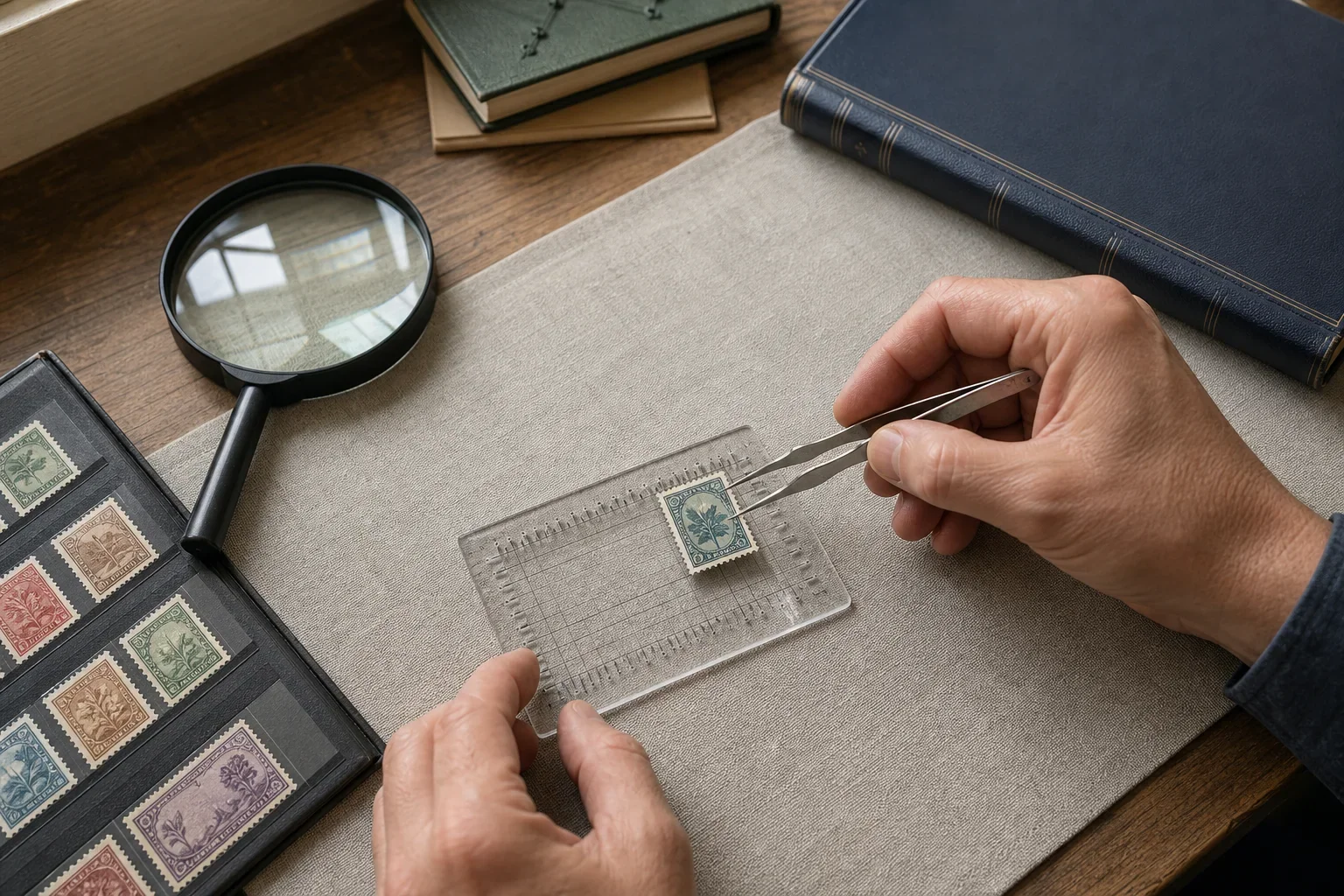
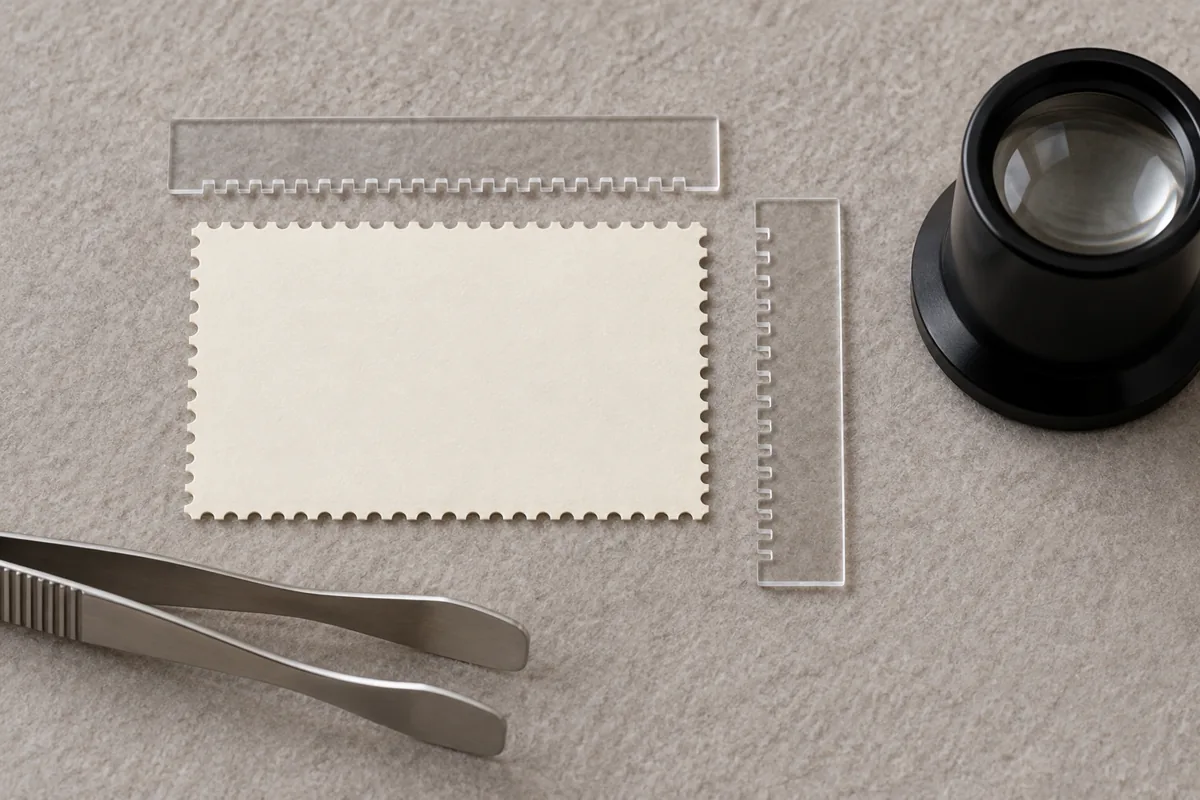
The illustration shows which directions need attention, not a usable calibrated scale. Its blank paper is not an E6 or E15 specimen. Compare your physical stamp against a real gauge, then consult the family table. If a joined pair or sheet margin survives, measure without separating it; the attached paper may answer a later format or printing question.
Leave the watermark unresolved until you inspect the paper
For a perf-12 bicycle, the relevant ordinary comparison is double-line E6 versus single-line E8. For a perf-10 bicycle, it is single-line E9 versus unwatermarked E10.[5] A front scan alone cannot answer these paper questions. A watermark can be partial, so absence of an obvious complete letter in one view does not justify an immediate unwatermarked identification.
Begin with a safe dry inspection of an already loose stamp. Consult the watermark guide for inspection choices and material precautions. Do not peel a mounted stamp, wet its gum or use household solvents to force a result. If you cannot inspect it safely, report the design and measured gauge while leaving the watermark pending.
A proposed high-priced entry deserves evidence for the feature that separates it from the alternative. Ask for a clear reverse image and an explanation of the paper check. An app suggestion, an old album annotation or a confident seller title does not substitute for that examination. Seek specialist help when the unresolved paper or gum claim would determine a substantial purchase.
Keep envelopes, multiples and extra printing out of single comparisons
A cover is an envelope or other complete mailed object, not simply a cancelled stamp. Preserve it intact with its address, ordinary postage, arrival marks and any special delivery notation. Do not soak off the messenger stamp to match a convenient loose-single price. No cover price is established by this article's six offers, and an interesting date alone does not establish a premium.
Pairs, blocks and plate-number pieces also need their own comparables. Do not multiply the single price by the number of stamps and call it a multiple's value. The Stamp Society's account documents plate-number and overprint collecting within this service.[7] This guide stops at ordinary design and paper sorting; it does not authenticate a scarce plate position or price an overprinted territorial issue.
Read the full denomination on motorcycle stamps. The checklist includes 10, 13, 15 and 17-cent motorcycle issues.[6] A seller's grouped E13-18 offer cannot price an individual E15 without a separate described single. Keep quantity, attached material and extra printing in the record so a broad motor-delivery resemblance does not become a false exact match.
Photograph the missing clue, then check a matching issue
Take a straight-on front image with all edges visible. For a runner, add a close-up of the office wording and TEN CENTS. For a bicycle, include a gauge reading and record watermark examined or pending. Keep a separate reverse photograph if the stamp is loose, and an overall photograph if it remains on an envelope. Do not crop away evidence to make the stamp look tidier.
Use the checker as an initial identification aid. State the visible design, denomination, used or unused appearance and the checks you actually made. It can suggest collector context, but a front photo cannot authenticate original gum, regumming or a watermark distinction. Install Stamp Value Identifier & Scan for free on iOS or Android if you want to save scans and organize those unresolved questions with the collection.
Drop a stamp photo here
Show the full stamp, every perforation, and as much front detail as possible in even light.
Check your ten-cent messenger's visible clues
Upload one complete front photo. Note running, bicycle or motorcycle design and any measured perforations. Treat the result as a starting identification, not certification, grading or an appraisal.
Frequently asked questions
Is every blue US 10-cent stamp a special delivery stamp?
No. Look for the special delivery inscription and the messenger design. Ordinary postage belongs to another family. The same service also used a Helmet of Mercury design, which is not a bicycle stamp.[6]
How do I separate the first running-messenger E1 and E2?
Read the delivery-office wording. E1 promises delivery at a special delivery office; E2 changes it to any post office. The added line under TEN CENTS belongs to the later Bureau design, so it is not the first E1-versus-E2 test.[7]
Why can two bicycle messenger stamps have different numbers?
The design continued across different papers and perforations. E6 and E8 are perf 12 with different watermarks; E9 and E10 are perf 10 but differ in watermark status. Measure the gauge and inspect the paper before choosing the entry.[5][6]
What is a used 1885 special delivery stamp offered for?
Northland displayed USD 42 for one used Scott E1 described as VF on 7 October 2026. No separate stock ID was shown. This is a dealer asking price with availability unconfirmed, not a realized sale or an appraisal of every used E1.[1]
Does unhinged mean original gum on an E1?
No. Northland's USD 99 E1 is explicitly described as regummed and unhinged. Unhinged alone does not establish original gum. Keep that offer separate from an original-gum, never-hinged stamp.[1]
Should I remove a messenger stamp from an envelope to price it?
No. Preserve the envelope, other postage and delivery markings. Loose-single offers do not value the complete postal-history item. Photograph the intact object and seek a comparable for its actual format.
Sources and further reading
Primary references and specialist resources used to prepare this guide.
- [1] Northland International Trading, special delivery net price list, checked 7 October 2026
- [2] Falmouth Stamp & Coin, special delivery inventory, checked 7 October 2026; page last update 27 January 2025
- [5] 1847us, special delivery issue identification
- [6] Stamp Smarter, special delivery perforation checklist
- [7] United States Stamp Society, chapter 44, The Special Deliveries
- [9] Wikimedia Commons, genuine 1902 bicycle-design scan and public-domain metadata
- [10] National Postal Museum, Special Delivery Issues, archived 10 July 2025