Quick answer
1934 National Parks stamp value depends on format and condition. On 8 October 2026, Minnesota Stamp Co asked USD 6.50 for a used ten-stamp Scott 740-749 set and USD 12.50 for a mint never-hinged set. These are dealer asks, not sales. Farley imperforates and souvenir sheets need separate identification.[3][4][5]
Sort the park scene before looking at prices
A 1934 National Parks stamp value search should start with the park name, denomination and edges. Minnesota Stamp Co displayed a USD 6.50 ask for a used set of ten Scott 740-749 and USD 12.50 for a mint never-hinged set on 8 October 2026. These are whole-set retail offers, not prices for one loose stamp.[3][4][5] The same scenery also appears on imperforate material. A smooth edge or a gumless back does not automatically identify a rare issue.
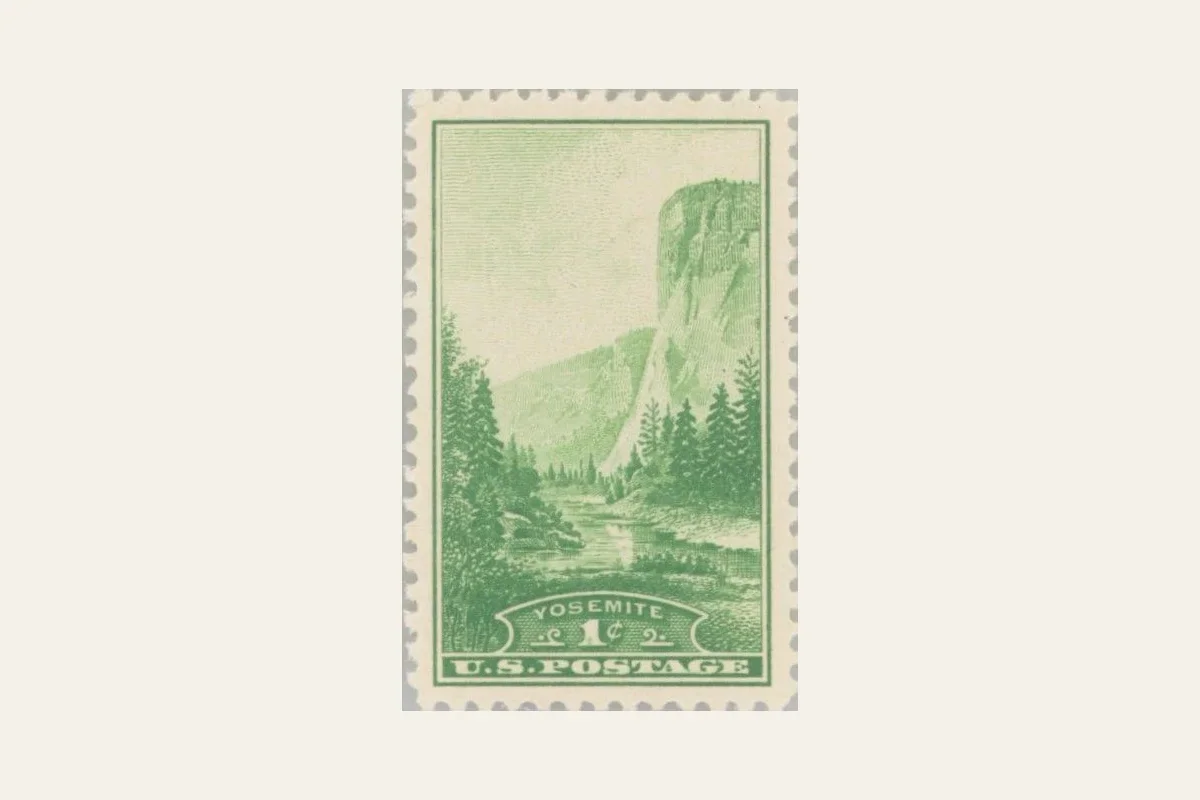
The National Park Service records ten designs with denominations from one through ten US cents. Yosemite, Yellowstone, Zion and Great Smoky Mountains use vertical designs; the other six are horizontal.[1] Match the actual inscription and value before relying on an album label. The one-cent Yosemite shows El Capitan, not Old Faithful. The five-cent Yellowstone shows Old Faithful, not a mountain portrait. A black seven-cent Acadia and a gray-black ten-cent Great Smoky Mountains are separate designs.
Keep a note of what you own: one loose stamp, a set, joined material or an envelope. If an album contains only four park scenes, it is not the ten-stamp set priced below. Leave an uncertain item in the family rather than choosing the catalog entry with the largest advertised value.
Use the ten designs as an identification checklist
The table names the subjects and denominations, not every specialist variety. The ordinary perforated group is Scott 740-749. The matching ten Farley special-printing designs are Scott 756-765.[2][3][4] Keep Scott's name with the numbers. A seller's inventory code and a catalog number identify different things.
Issue dates are not a simple denomination sequence. NPS dates the one-cent Yosemite to 16 July 1934, six-cent Crater Lake to 5 September and ten-cent Great Smoky Mountains to 8 October.[1] The last design was released on this guide's calendar anniversary, but that fact does not create a price premium. Avoid dating all ten from the first stamp's release or treating an album's 1934 heading as proof that every imperforate item is an original.
Use the catalog-number guide when a handwritten number has no publisher name. Record the old attribution separately from your current observations. The park inscription, denomination and format should agree with the reference before you transfer its number to your collection record.
| US cents and park | Subject | Scott ordinary / Farley |
|---|---|---|
| 1c; Yosemite | El Capitan | 740 / 756 |
| 2c; Grand Canyon | Grand Canyon | 741 / 757 |
| 3c; Mount Rainier | Mount Rainier | 742 / 758 |
| 4c; Mesa Verde | Cliff Palace | 743 / 759 |
| 5c; Yellowstone | Old Faithful | 744 / 760 |
| 6c; Crater Lake | Crater Lake and Wizard Island | 745 / 761 |
| 7c; Acadia | Great Head | 746 / 762 |
| 8c; Zion | Great White Throne | 747 / 763 |
| 9c; Glacier | Mount Rockwell and Two Medicine Lake | 748 / 764 |
| 10c; Great Smoky Mountains | Mount Le Conte | 749 / 765 |
Separate perforated stamps from Farley imperforates
The 1935 Farley reprints were sold without gum from 15 March through 15 June 1935. Their National Parks group is Scott 756-765; the broader Farley group includes other designs.[2] Do not describe every Farley stamp as a National Parks stamp. For the park family, compare the actual edge and format rather than assuming that a shared picture proves the same issue.
An imperforate item has no separating perforation holes between the relevant impressions. Joined stamps with an intact intervening gutter or margin can preserve better evidence than a closely cut single. Keep pairs and blocks together. A trimmed perforated stamp can also have straight-looking edges. A small single with little surrounding paper should remain unresolved until its measurements and margins support an attribution.
Measure toothed edges with a gauge, recording horizontal and vertical results separately. The perforation guide explains the method. This article does not supply a complete specialist gauge or paper crosswalk. Do not count the number of teeth in an enlarged phone photo and turn that count into a catalog identification. Photograph all edges before considering any unusual-format claim.
Gum does not prove which printing you have
1847us records that the Post Office Department offered to gum full sheets in 1940, including Scott 756-765, 769 and 770. Some Farley sheets therefore acquired gum through a later official service.[2] An imperforate park stamp with gum is not automatically a forgery, but it is also not automatically a scarce official-gummed example. The history explains a possible category; it does not authenticate your stamp.
A gumless back is equally inconclusive. Gum can be removed from an ordinary stamp by soaking, and used material may have no remaining gum.[2] Keep issue identification and gum description in separate fields. Describe what you can see, such as an accessible unused back, a hinge mark or an unexamined reverse. Do not use never hinged as a synonym for verified original gum.
For a proposed officially gummed Farley, retain the complete item, its margins and any supporting document. Ask a specialist what evidence distinguishes that attribution from later private regumming. No qualified current official-gummed price is supplied here. Do not borrow a multiple from an old editorial article or apply a certified specimen's asking price to an unidentified single.
Souvenir sheets need a separate catalog search
Yosemite and Mount Rainier also appear in souvenir-sheet listings. 1847us associates Yosemite with Scott 740, 751, 756 and 769, and Mount Rainier with 742, 750, 758 and 770.[2] Those numbers do not describe four interchangeable loose singles. The surviving sheet, pane, margins and printing context matter.
Photograph the whole object before taking a close-up of a stamp. If a mount contains a larger imperforate rectangle, do not cut away blank paper to make it fit a single-stamp space. A sheet inscription or preserved margin may answer the identification question that the central scene cannot. Record dimensions and the number of impressions without separating them.
This guide supplies no price observation for a souvenir sheet or an extracted souvenir-sheet single. The ordinary used and mint set offers below cannot price that format. An old album number can still be a useful lead, but confirm the reference's full format description. A landscape picture that matches Yosemite does not settle whether the item belongs to a regular issue, a souvenir sheet or a special printing.
Dealer asking prices checked on 8 October 2026
Minnesota Stamp Co's ordering page explicitly states that website prices are in U.S. Dollars.[5] The USD labels below come from those terms, not an assumption about a dollar sign or the dealer's address. The product pages identify the ten-stamp set, condition and item code.[3][4] No completed sale is claimed.
The used and mint never-hinged offers refer to separate whole sets. F-VF is the dealer's Fine to Very Fine description. It does not certify every stamp in your album. The individual supplied specimens and exact stock counts were not established by the product text read for this guide. A visible Add to Cart control records an offered item, not a promise that stock will remain available.
The dealer also states a USD 20 minimum order.[5] Each displayed item price is below that minimum on its own. Keep this purchasing condition beside your comparison rather than treating USD 6.50 as a complete delivered transaction. Shipping, taxes and any order discount are not added to these item asks. None of those adjustments changes the fact that the quantity is ten stamps.
| Dealer and stock code | Identity, quantity and condition | USD item ask and purchasing context |
|---|---|---|
| Minnesota Stamp Co; yc34npused [4] | Scott 740-749; ten stamps; used, F-VF | USD 6.50; exact stock count unconfirmed; USD 20 minimum order [5] |
| Minnesota Stamp Co; ycnpnh [3] | Scott 740-749; ten stamps; mint never hinged, F-VF | USD 12.50; exact stock count unconfirmed; USD 20 minimum order [5] |
Compare condition and quantity before using an ask
The two offers show why a family-wide price range would mislead. One is a used set; the other is mint never hinged.[3][4] Do not label USD 6.50-12.50 as the value of a National Parks single. Dividing either set ask by ten would produce arithmetic, not evidence of an individually offered stamp. A missing ten-cent design also means your partial set does not match either listing.
Inspect centering, all teeth, cancellation, creases and staining. On a safely accessible back, record hinge remnants, thinning and disturbed gum. Follow the condition-grading guide to separate those observations. Do not peel hinges or flatten paper to improve the comparison. A clean-looking front can hide a reverse fault.
A retail ask records what the dealer requests. It does not show what a buyer paid or what a dealer would pay you. If you plan to sell, seek completed transactions for the same issue, format and condition. Keep their actual sale date and premium basis. No auction result, rare-variety range or universal resale estimate is established by this packet.
The genuine Mesa Verde photograph explains the design
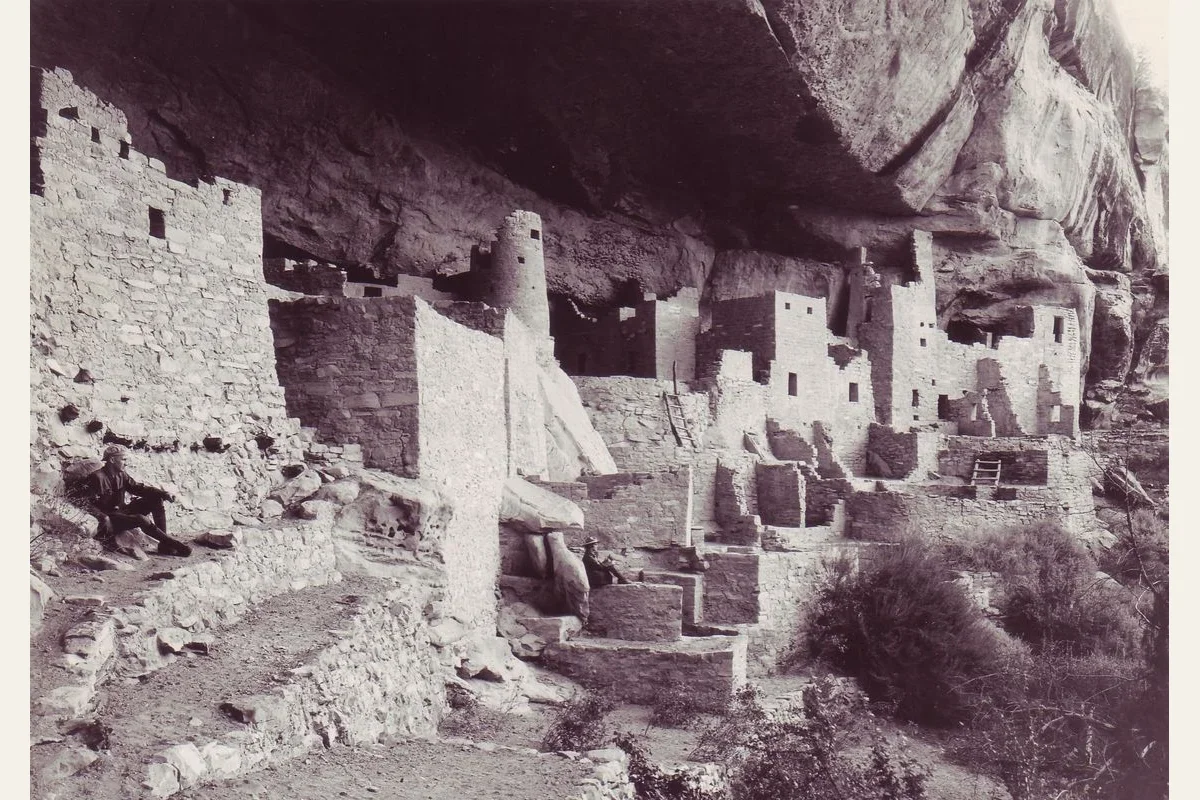
NPS identifies the source photograph for the four-cent Mesa Verde design as George A. Grant's view of Cliff Palace. The stamp shows the ruins, while the original photograph includes rangers.[1] Comparing the real photograph and the printed subject helps you recognize the design without inventing a specimen or treating a generated picture as evidence.
The images in this guide have different purposes. The hero is an original illustration of a collecting desk and park scenery. The Yosemite scan is a genuine NPS reference image. The Mesa Verde image is a historical photograph, not a four-cent stamp for sale. None depicts the exact set offered by Minnesota Stamp Co. Color and condition observations belong to your physical stamp, not to an editorial illustration.
Record the wording on your own copy even when the reference scene looks familiar. The printed park name and face value are stronger first checks than a broad resemblance to a canyon, lake or forest. A photograph can suggest the design, but it cannot settle gum history or establish an imperforate printing from a tightly cropped front.
Preserve a cover or block before asking about value
If your park stamp remains on an envelope, keep the postmark, other postage and complete cover together. Photograph both sides and then the stamp. Do not soak it off to match a loose-set listing. A cover has its own identification task, and this guide's set asks contain no postal-history comparison.
For a block, record the number of joined stamps, surviving sheet margins and any plate inscription. Leave those parts attached. A specialist may need the spacing or margin to assess the format. Do not assume a block is worth the loose-single price multiplied by its count. The price evidence here concerns sets of separate designs, not joined blocks of one design.
A useful inquiry states the park, denomination, edge type, quantity, visible condition and unresolved questions. Attach the whole-item photograph alongside a close-up. If you suspect later official gumming, ask that precise question and state which evidence is missing. This gives the reviewer an object to examine rather than a requested rarity to confirm.
Use a scan to organize the next physical check
Upload one straight-on front photograph with all edges visible. In the notes, give the park inscription, denomination and whether you have a single, set, block or cover. Say whether the back is accessible. An unresolved imperforate or gum attribution should remain a question, not a fact entered to steer the result.
The existing checker can suggest a design-family match and a useful research direction. A front photograph cannot establish the 1940 gumming history or authenticate an unusual format. Compare the suggested catalog candidate with the physical evidence before attaching a price. If two candidates remain possible, save both and record what measurement or document would separate them.
Stamp Value Identifier & Scan has a free tier on iPhone and Android, photo-based identification and saved collection records. Use individual scans to keep your perforated parks separate from imperforate candidates while you record physical checks. Do not use a saved result as certification or multiply estimated context across an album. The practical goal is a record that preserves the uncertainty until you resolve it.
Drop a stamp photo here
Show the full stamp, every perforation, and as much front detail as possible in even light.
Keep perforated parks and Farley candidates separate
Try Stamp Value Identifier & Scan for free on iOS or Android. Scan each park stamp individually, save the result and organize your collection while you record edges, format and gum questions.
Frequently asked questions
What are ordinary 1934 National Parks stamps worth?
The checked offers were USD 6.50 for a used ten-stamp Scott 740-749 set and USD 12.50 for a mint never-hinged set on 8 October 2026. They are dealer asking prices for complete sets, not a valuation of every single.[3][4][5]
Does no gum prove a Farley special printing?
No. 1847us notes that gum can be soaked off ordinary stamps. Separate edge and format identification from the gum description. A missing gum layer alone cannot establish Scott 756-765.[2]
Can a Farley imperforate have gum?
Yes. 1847us records a 1940 official service for gumming full sheets including Scott 756-765, 769 and 770. That history does not authenticate gum on an individual stamp or establish its current value.[2]
Are Yosemite and Mount Rainier souvenir sheets priced here?
No. These designs also have souvenir-sheet references. Preserve the complete sheet and margins. The two ordinary-set offers do not price souvenir sheets or singles cut from them.[2][3][4]
Should I remove a park stamp from an envelope?
No. Photograph the complete cover, its back and postal markings before the stamp close-up. Keep the item intact. A loose-set asking price cannot establish the value of your postal-history object.
Sources and further reading
Primary references and specialist resources used to prepare this guide.
- [1] NPS: ten national park designs, issue history and source photographs
- [2] 1847us: Farley references, original gumless sale and later official gumming
- [3] Minnesota Stamp Co: mint never-hinged set, item ycnpnh
- [4] Minnesota Stamp Co: used set, item yc34npused
- [5] Minnesota Stamp Co: explicit U.S. Dollars and minimum order
- [8] NPS: government-work public-domain and rights policy