Quick answer
Italy Leoni stamp value starts with the green 5c, red 10c and grey 15c. On 11 October 2026, iBolli asked EUR 0.40 for three separate used stamps as one set, stock 28823. That is not a single-stamp value or a sale result. Check quantity, surcharges and condition before comparing.[19]
Start with the three ordinary Leoni denominations
The ordinary Italy Leoni family in this guide is the green 5c, red 10c and grey 15c with Victor Emmanuel III facing left. Tony Clayton dates the first two to 1906 and the grey 15c to 1919. The Italian reference iBolli gives October 1906 and November 1919 respectively.[1][5] A 15c under an album heading of 1906 is not automatically a 1906 issue. The design family continued beyond its first release.
Read both bottom value ovals and the word CENTESIMI before choosing a reference. The c means the historical centesimi denomination. It is not a current euro price. The ruler is Victor Emmanuel III, not Victor Emmanuel II. A general search for an Italian king's portrait can bring together different reigns, designers and postal services. Keep the printed inscription and denomination with the photograph rather than relying on an inherited album label.
Sort the whole object before sorting the design. A loose single, three separate stamps sold as a set, a joined block and a stamp still on an envelope need separate records. Our ordinary used-price observation covers three separate stamps offered together. It does not describe a joined strip or give a separate asking price for each denomination.[19][21] Leave margins and covers intact while identifying them.
Match the dates and catalog names without mixing systems
The denomination table records iBolli's ordinary Italian entries. Its three values share comb perforation 14, a crown watermark and typography. It lists dimensions of 20 by 24 mm for each.[5] These shared properties support a family identification, but they do not distinguish a particular shade, printing flaw or gum state. Do not turn a correct denomination match into a specialist variety attribution.
Name the catalog whenever writing a number. The grey 15c illustrates why this matters. iBolli gives Unificato 109 and Sassone 108 for the same ordinary stamp. Its Scott reference is 96.[5] A dealer's sequence of 81, 82, 109 therefore cannot silently be copied into a Sassone field. The seller at stock 28823 does not name the catalog in that field, so retain the exact seller sequence and keep the separately sourced cross-reference beside it.[19]
The catalog-number guide explains how to store publisher, edition and seller stock code separately. Stock 28823 is a sales-inventory identifier. It is not an international catalog number, a certificate or evidence that your own stamp has the listed condition. If you cannot read a denomination, leave the number unresolved until the stamp and the reference agree.
| Value and color | First issue | Catalog references | Shared physical description |
|---|---|---|---|
| 5c green | October 1906 | Unificato 81; Sassone 81; Scott 94 | comb perf 14; crown watermark; typography; listed 20 x 24 mm |
| 10c red | October 1906 | Unificato 82; Sassone 82; Scott 95 | comb perf 14; crown watermark; typography; listed 20 x 24 mm |
| 15c grey | November 1919 | Unificato 109; Sassone 108; Scott 96 | comb perf 14; crown watermark; typography; listed 20 x 24 mm |
Use perforation and size measurements for the right question
iBolli describes the ordinary 5c, 10c and 15c as comb-perforated 14.[5] Measure the horizontal and vertical edges with a physical gauge. The perforation guide gives a repeatable method. Counted teeth in a phone image are not a reliable substitute for a gauge reading, especially when the image has been resized. Record uncertain readings as uncertain rather than forcing them into the ordinary description.
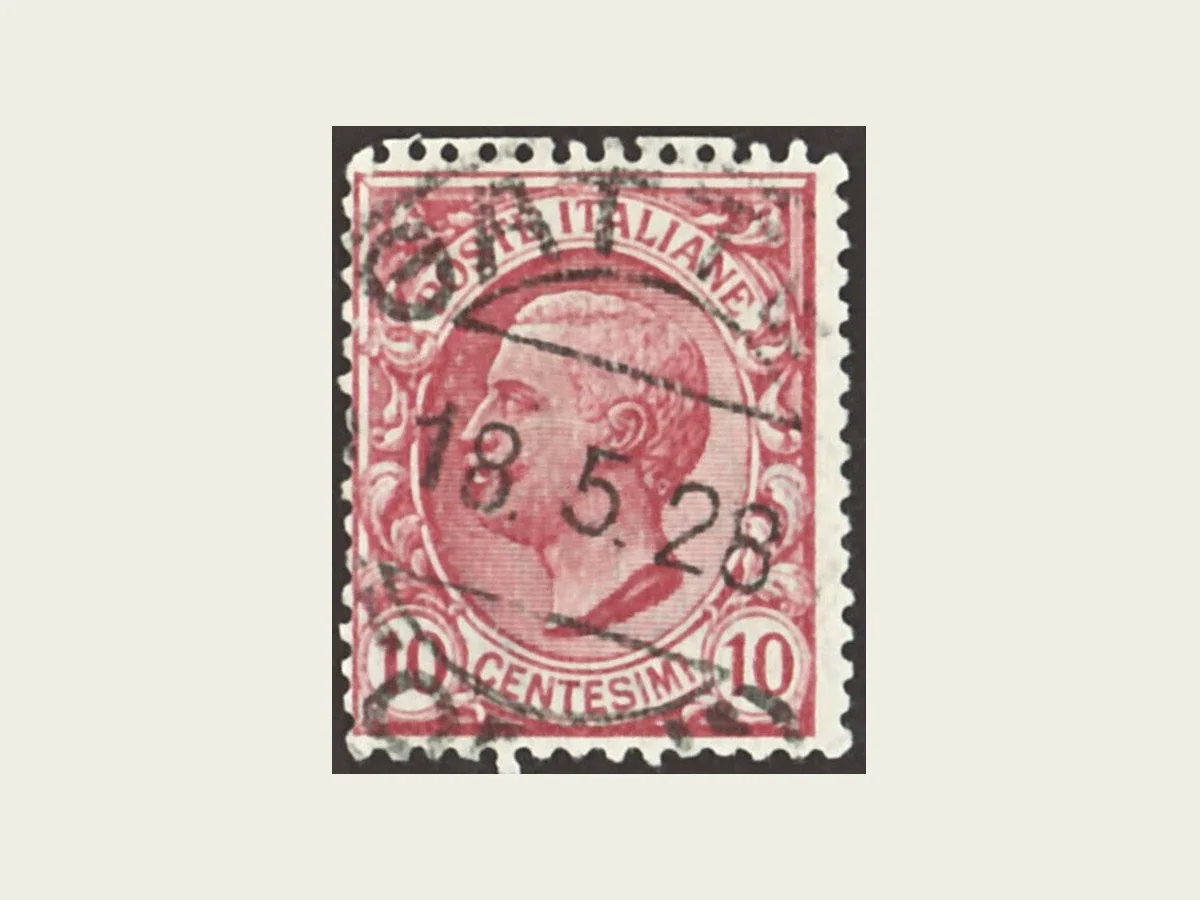
Dimensions need a stated measurement basis. iBolli lists 20 by 24 mm without defining the measurement basis in its description. The Commons description for our genuine 10c scan specifically gives the printed area as 18.0 by 22.5 mm.[5][18] These figures should not be treated as contradictory measurements of the same boundary. Nor do they establish two different Leoni varieties. Measure the printed area and the whole piece separately and label each result.
A useful size distinction concerns service stamps. iBolli lists the 1908 30c express stamp and the 1913 10c pneumatic stamp at 40 by 24 mm, rather than the ordinary family's 20 by 24 mm.[5] The wide format and service inscription are reasons to change the reference group. They are not reasons to apply an ordinary 10c price to a wider stamp with the same king.
Separate ordinary postage from service stamps and overprints
The ordinary portrait family is narrower than everything called tipo Leoni. iBolli's broader page includes express, pneumatic, colonial and foreign-office uses.[5] For the 1908 express issue it records a 30c blue-and-red stamp with the service wording also given in French, including exprés. For the 1913 pneumatic issue it records a brown 10c in the wider 40 by 24 mm format.[5] These are reference boundaries, not extra ordinary denominations.
Read any added word or changed value before looking at price. iBolli also records a grey 15c ordinary base overprinted 10c in May 1925.[5] A visible 10 on a grey stamp can therefore concern a surcharge, not a faded version of the red 1906 10c. Preserve the original value, the added value and the exact added inscription in your notes. An unclear surcharge should remain a candidate for further checking.
The related Michetti material on iBolli's page includes a 15c portrait facing right, described with different dimensions and perforation.[5] Portrait direction is a useful first sorting clue. It does not authenticate a difficult item. Colonial names, foreign currency overprints and altered service stamps fall outside our ordinary price comparison. Keep these intact and seek the appropriate catalog section instead of treating every similar head as the same Italian issue.
Read the ordinary price evidence with its exact quantity
On 11 October 2026, iBolli stock 28823 displayed EUR 0.40 for a complete used Leoni set. The seller listed 81, 82, 109 and warned that cancellations might differ from those in its photograph.[19] We inspected the photograph. It shows three separate stamps, green 5c, red 10c and grey 15c, not a joined strip.[21] This is an ordinary dealer asking price for one set, not a realized sale or a valuation of any unidentified single.
The seller's purchase terms, updated 27 April 2026, require a EUR 10 minimum order excluding packing and shipping. Overseas shipping costs vary by destination.[20] The EUR 0.40 figure is therefore not the delivered cost of ordering this set alone. Keep the merchandise ask separate from the minimum basket and delivery charges. Neither a low advertised amount nor a minimum order determines what a dealer would pay you.
A second retailer, LaVecchiaScatola, displayed EUR 3.50 for stock IT6161, its 1906 Sassone 81/82 MNH/** set. Its page said the item was no longer in stock.[8] We preserve the displayed price as an unavailable listing, not a current purchasable offer. The two-stamp identity follows the named 81/82 set, not a three-value family set. It is not a comparison for the used 1919 15c.
The old stamps price list gives broader examples with their evidence types. Do not divide a set price and call the result an observed single-stamp price. We found no completed-sale evidence for these exact sets, no current used-single ask for each of the three denominations and no established market-wide range. The available ordinary set is useful evidence precisely because those limits stay visible.
| Stock and source | Identity and seller condition | Object quantity | Displayed ask and availability |
|---|---|---|---|
| 28823 [19] | 1906/19 Leoni; used; seller codes 81, 82, 109; cancellations may differ | 1 set; 3 separate stamps, 5c + 10c + 15c | EUR 0.40; offered; EUR 10 minimum order, packing/shipping excluded [20] |
| IT6161 [8] | 1906 Sassone 81/82; MNH/** | 1 two-stamp set; 5c + 10c | EUR 3.50; no longer in stock; not a purchasable offer |
Record condition before comparing a cleaner example
The used set seller provides a condition category and a photograph, not an independent grade for each delivered stamp.[19] Its cancellation warning matters if you want a particular town or a lightly struck portrait. A photographed cancellation is not a promise about the example supplied. Ask for an exact specimen photograph when the postmark or centering drives your purchase, and record whether the seller supplies generic or individual stock.
Check teeth, corners, centering, staining and creases without changing the stamp. When the back is safely accessible, record hinge remnants, disturbed gum and thinning separately. The condition guide helps describe these observations. Do not wash, press or peel a stamp merely to make it resemble a mint listing. A portrait that looks clean from the front does not establish mint never-hinged condition.
LaVecchiaScatola's MNH/** token remains the seller's description for its unavailable 1906 set.[8] It does not certify another stamp and does not create a universal mint premium. The used three-value set and the unavailable two-value mint set differ in quantity, issue coverage and condition. Comparing their two figures as the bottom and top of a value range would hide all three differences.
Keep a checkable record for a sale or collection decision
Record denomination, inscription, portrait direction, measured gauge, measurement basis, watermark finding and the complete object format. Add front and back observations in separate fields. For the grey 15c, preserve the 1919 ordinary issue lead while checking any surcharge. For a wide service stamp, preserve the full wording rather than reducing it to 10c or 30c. These notes let another collector see exactly what remains unresolved.
Attach the stock ID, source URL, EUR currency, observation date, quantity and seller condition when saving a price comparison. For stock 28823, retain the cancellation warning and the minimum-order terms. For IT6161, retain unavailable status. The old-stamp valuation guide distinguishes a dealer ask from completed-sale evidence. Neither listing is a cash offer to buy your collection.
Keep a stamp on its envelope until you have considered the postal object. A visible date can help describe use, but it is not automatically the issue date. The genuine red scan used here carries a 1928 cancellation while its source identifies the 1906 design.[18] Record the issue lead and the postmark separately. Do not remove a stamp to fit a loose-single price comparison.
Use a scan to plan the next physical check
Photograph one entire object straight on with all edges visible. For a single, include the bottom value ovals and the full inscription. For a set, save the denominations separately as well as a whole-set image. State whether a 15c is grey and unsurcharged or has added wording. A focused question is more useful than asking for a value before the format and issue are identified.
The checker can suggest a visible design-family lead and estimated collector context. It cannot establish the crown watermark from the front alone, guarantee hidden gum or certify a surcharge. Keep those questions open for physical inspection. Our generated desk and tool illustrations contain blank paper, not Leoni specimens or watermark diagrams. Only the genuine red 10c image supplies a reference face design.
Stamp Value Identifier & Scan supports individual photo scans, follow-up questions and saved collection records. The current iOS and Android stores identify the app; iOS lists it as free with in-app purchases, and Google Play lists in-app purchases.[10][11] Installation is free, not a promise of unlimited free scans. Save each Leoni scan with your observations while checking the stamp itself. The app is not an official authentication, grading or appraisal service.
Drop a stamp photo here
Show the full stamp, every perforation, and as much front detail as possible in even light.
Organize your Italy Leoni collection
Install Stamp Value Identifier & Scan free on iOS or Android. Scan each Leoni stamp individually and save its collection record with the denomination and your observations. Keep uncertain issue, surcharge and postal-service identifications open, and ask follow-up questions before checking the stamp itself. Free installation does not mean unlimited free scans.
Frequently asked questions
How much are ordinary used Italy Leoni stamps worth?
On 11 October 2026, iBolli stock 28823 was offered at EUR 0.40 for a complete used set of three separate 5c, 10c and 15c stamps. Cancellations could differ from the photo. This is a set ask, not a single-stamp value or completed sale. The EUR 10 minimum order excludes packing and shipping.[19][20][21]
Was the grey 15c Leoni issued in 1906?
iBolli dates the ordinary grey 15c to November 1919; the green 5c and red 10c are October 1906. Tony Clayton corroborates the two issue years. An album's family heading does not establish each stamp's release date.[1][5]
Why is a 15c listed as both 108 and 109?
iBolli lists Sassone 108 and Unificato 109 for the ordinary grey 15c, with Scott 96. These are different catalog systems. Seller stock 28823 gives 81, 82, 109 without naming the catalog; preserve that wording rather than calling it Sassone.[5][19]
Is every 10c king portrait a Leoni ordinary stamp?
No. iBolli lists a brown 1913 pneumatic 10c at 40 x 24 mm and a grey 15c surcharged 10c in May 1925. Read service wording, added values and format before using the ordinary red 10c comparison.[5]
Does a clipped edge prove an imperforate Leoni variety?
No. Tony Clayton illustrates imperforate pairs and other specialized varieties, but a clipped or unclear edge does not establish a match. Keep connected material intact and obtain a specialist comparison. No variety premium is priced here.[1]
Sources and further reading
Primary references and specialist resources used to prepare this guide.
- [1] Source: Tony Clayton: Leoni definitive issues
- [2] Source: iBolli: ordinary 10c technical record
- [5] Source: iBolli: Leoni issue family and service boundaries
- [7] Source: Collezioni Hobby: green/red shades and overprints
- [8] Source: LaVecchiaScatola: unavailable IT6161 set
- [10] Source: Apple App Store: app identity and free installation
- [11] Source: Google Play: app identity and in-app purchases
- [18] Source: Commons: genuine 10c scan description and public-domain rights
- [19] Source: iBolli: offered used set, stock 28823
- [20] Source: iBolli: 27 April 2026 purchase terms
- [21] Source: iBolli: stock 28823 product photograph