Quick answer
Merson stamp value depends on denomination, issue and condition. On 7 October 2026, dealers asked EUR 0.30 for a used 40c and EUR 32.00 for a used violet-and-yellow 2f. A separately described never-hinged 2f was offered at EUR 1,290.00. These are retail asking prices, not realized sales or an appraisal of your stamp.[1][2][3]
Recognize the horizontal Merson design
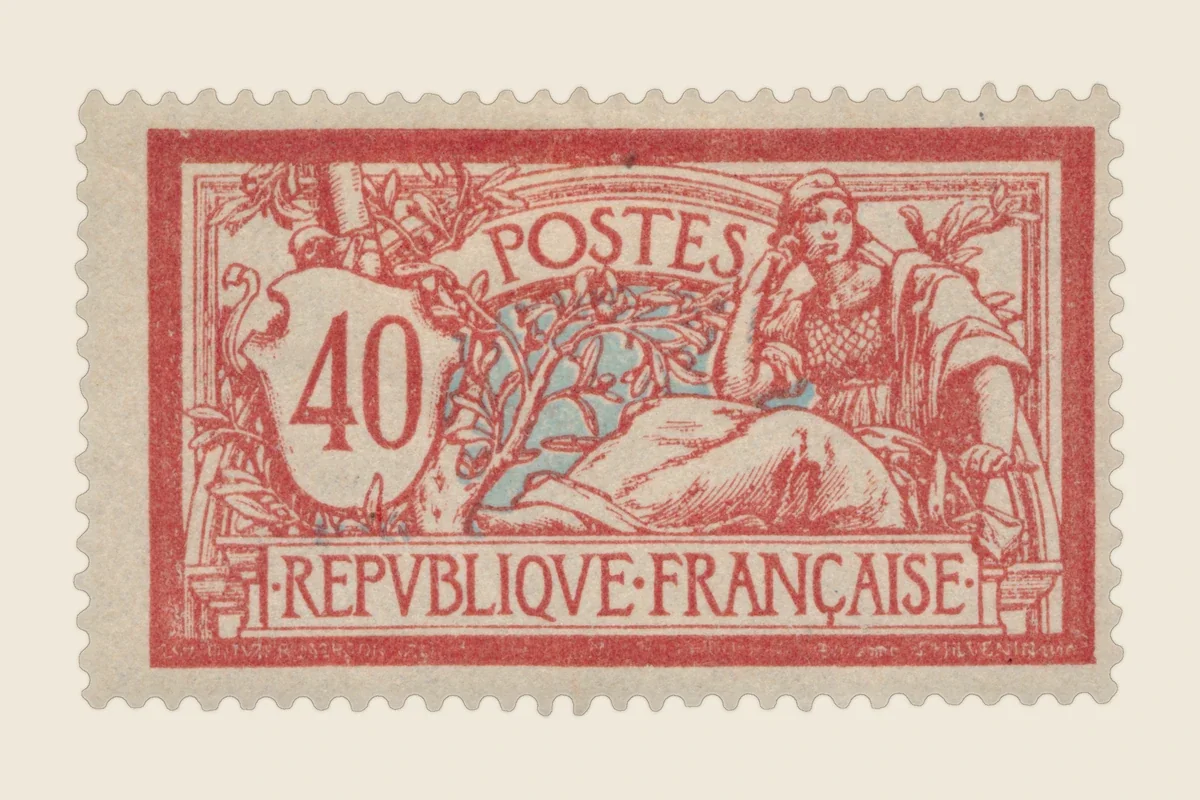
Start with the complete stamp, not the word FRANCE in an album. The original Merson design is a broad horizontal composition with a seated allegorical Republic, a denomination at the left and the inscriptions POSTES and REPVBLIQVE FRANÇAISE. The genuine 40c scan below shows that arrangement. It has red printing with blue in the background and no visible overprint. The numeral alone does not establish every catalog detail.[6]
Behr identifies Luc-Olivier Merson as the designer and Auguste Thévenin as the engraver, and explains that the format and multicolor printing suited the higher denominations in the new French definitive program of 1900.[4] Higher face value is a historical postal category. It is not a promise that every surviving example is expensive. The original printed francs are not the euros used in today's dealer offers.
Record the exact face value before looking for prices. A 40c, a 1f and a 2f belong in different searches even when the seated figure looks identical. Photograph the full frame and all perforated edges. If the country is uncertain, use the foreign-stamp identification guide first. A resemblance to the picture is a family-level lead, not an authentication.
Separate Merson from Sower and other French designs
Do not use a Sower price for a Merson. The Sower, or Semeuse, shows a standing figure walking and sowing. Merson has the seated figure and wide two-color composition described above. The Sower value guide covers that separate family. Read the figure's posture before choosing a guide, even when the country inscription and denomination look familiar.
A seated Republic is not sufficient by itself. Behr's comparison also describes the Mouchon design, whose seated figure holds a tablet bearing the Rights of Man. It places Blanc, Mouchon and Merson in different denomination groups within the 1900 program.[4] Compare the frame, pose and inscriptions together instead of choosing a family from the French republican theme alone.
Keep a doubtful stamp in an unresolved group until the entire design can be read. A heavy cancellation may hide the posture; an album caption may be wrong. Do not fill an uncertain gap with the most valuable search result. Once the design is established, the denomination, additional wording and reverse condition provide the next useful checks.
| Candidate | Visible clue | Research decision |
|---|---|---|
| Merson | Wide seated-Republic composition, left denomination, bicolor design | Continue with exact denomination and any overprint |
| Sower / Semeuse | Standing figure walking and sowing | Use the separate Sower family guide |
| Mouchon | Seated figure with Rights of Man tablet | Do not borrow a Merson price |
| Unresolved design | Pose or inscription hidden | Save a complete photograph; leave the family open |
Dated dealer asking prices in euros
The following pages were read on 7 October 2026. Each offer concerns one stamp, not a complete series, block or cover. Philatélie 91 explicitly identifies the currency as EUR in its product metadata. Its titles give numbers 119 and 122 but do not name the catalog system, so this table preserves them as seller numbers. Both pages use the generic reference #oblitéré, not a unique specimen stock ID.[1][2]
Philatélie72 explicitly names Yvert et Tellier 122 and the stock reference FR-PO122-Lot2 **. Its ** quality explanation means unused with original gum and no hinge trace. The description also reports a small original white spot on the gum at the top and a Roumet signature. The offer is a single removed from a block of four, not a four-stamp lot. These details remain part of the comparison.[3]
The same page prints a catalog figure of EUR 3,200.00 separately from its EUR 1,290.00 selling price.[3] Do not put the catalog figure in the asking-price column or assume the signature independently proves authenticity. None of these observations establishes what a dealer would pay you. The old-stamp price-list guide explains why retail listings and seller proceeds answer different questions.
| Offer identity and reference | Seller's stated condition and quantity | Retail asking price |
|---|---|---|
| Philatélie 91 product 25879; seller n°119; catalog system not stated; generic SKU #oblitéré, no unique specimen ID | 40c red and blue; used; 1 single; individual faults not described | EUR 0.30 |
| Philatélie 91 product 25882; seller n°122; catalog system not stated; generic SKU #oblitéré, no unique specimen ID | 2f violet and yellow; used; 1 single; individual faults not described | EUR 32.00 |
| Philatélie72 product 14133; Yvert et Tellier 122; FR-PO122-Lot2 ** | 2f violet and yellow; original gum without hinge trace stated; small original white gum spot; Roumet-signed; 1 single from a block of 4 | EUR 1,290.00 |
Why the 2f color and denomination matter
A search for Merson 2 francs still needs the colors. The issue chronology distinguishes the violet-and-yellow 2f associated with the 1900 series from a later orange-and-green 2f.[8] The EUR 32.00 and EUR 1,290.00 observations in this article both concern violet and yellow. Neither is a price for every 2f Merson, and neither supplies a comparison for an orange-and-green example.
Transcribe the denomination as printed and describe both colors independently. Use neutral daylight and retain the unedited photograph. A yellowed mount, a colored lamp or an automatic phone filter can change the apparent background. Do not adjust saturation until the stamp resembles the expensive listing. If the colors remain uncertain, record that uncertainty rather than assigning a scarce shade.
The two 2f offers also differ in stated condition, documentation and individual description. They are not a controlled experiment measuring the value of gum. Do not divide one price by the other to create a universal mint premium. Find a comparable for your exact issue and condition, then examine what its description actually includes.
Examine original gum without changing it
An uncancelled front does not establish mint never-hinged condition. Look at the reverse for original gum, hinge traces, missing gum, disturbance, stains and paper damage. If a mount hides the back, write gum unexamined. Do not move straight from no visible postmark to the EUR 1,290.00 row. That row includes a dealer's specific gum statement and a stated spot.[3]
Describe what you can see without trying to improve it. Do not wet, wash, polish or re-gum a stamp to obtain a cleaner photograph. Tongs and a stable dry work surface let you photograph both sides without touching the gum. If the item is stuck down or fragile, seek handling advice before attempting removal. A better-looking surface created by intervention is not new evidence of original condition.
Check the front and back for thins, creases, shortened teeth, tears and repairs. Record the fault's location alongside the photograph. The condition-grading guide helps distinguish gum state from paper condition. Never-hinged terminology does not erase a described fault, and a seller's grading symbol is not a substitute for reading the full description.
Read overprints and changed country wording
Merson designs also appear outside metropolitan France. The family history distinguishes stamps overprinted with a territory name from modified designs with another issuing place named in the country panel. It also notes Levant issues with piastre surcharges and no added country name.[8] That is why the absence of a territory word in black does not establish an ordinary French definitive.
Transcribe every added word, numeral and currency unit before selecting the catalog section. Keep a country-panel inscription separate from a later overprint. A surcharge can change denomination without changing the underlying printed numeral. Do not value a territorial or foreign-office issue using the metropolitan 40c offer merely because its seated figure is familiar.
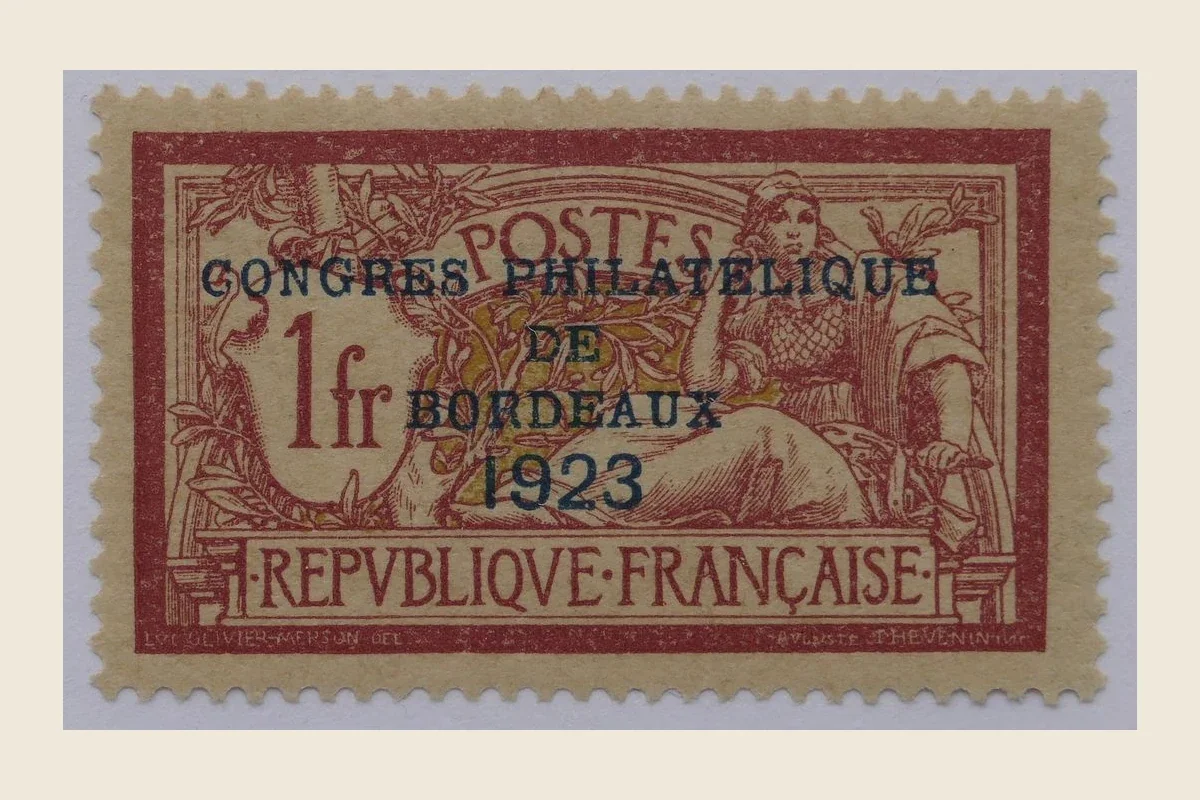
Exhibition and airmail overprints need their own checks too. The genuine reference scan below visibly reads CONGRES PHILATELIQUE DE BORDEAUX 1923 over a 1f design.[7] It is a design reference, not a certified specimen and not a dealer comparable. An unusual overprint deserves an exact listing and, when its claimed value justifies it, specialist examination rather than an automatic rarity label.
Do not confuse originals with later reproductions
An old design reproduced on a later stamp, souvenir product or printed album page is not the original postal issue. A recognizable Merson image is only the first clue. Inspect the entire object for a modern date, extra border, revised denomination, label, surrounding sheet or a backing that was excluded from the listing photograph. Do not crop away the detail that tells you what the object actually is.
The prices here apply only to the identities and conditions named in the table. They do not price modern reissues, reproductions, essays, proofs or souvenir sheets. No modern-reissue catalog number has been verified for this guide, so none is assigned. If your item has extra wording or a different format, keep the identification open until a catalog entry matches the complete object.
Likewise, an imperforate edge or two-color displacement is not enough to claim a valuable error. A cut-down perforated stamp can lose its teeth, and a photograph may conceal what happened at an edge. Do not invent a plate flaw name or rarity from a visual impression. Keep measurements and visible differences in your notes, then research that specific claim.
Use catalog references without inventing a crosswalk
Write the publisher beside the number and retain every suffix. The Philatélie72 offer explicitly gives Yvert et Tellier 122, while the Philatélie 91 pages provide only their seller numbers.[1][2][3] A dealer's numbered title can be a useful search lead, but this guide does not silently relabel an unspecified system as Yvert, Scott or Michel. Product IDs and catalog numbers serve different purposes.
A product ID identifies the page you read. A unique stock reference identifies a particular dealer object, when provided. A catalog reference identifies an issue or variety within a named system. Philatélie 91's repeated #oblitéré reference cannot distinguish two individual specimens. Save the URL and observation date, and ask for front-and-back images if the dealer page does not document the actual stamp.
No Scott or Michel cross-reference is verified here, and no edition-specific catalog value is supplied as a universal valuation. Philatélie72 lists perforation 13½ × 14 for its 2f entry; measure your own stamp rather than inferring that gauge from a front photograph.[3] Use the catalog-number guide to organize a lookup. If a suffix depends on paper, perforations or another unseen feature, leave it unresolved until you have the required physical evidence.
Keep covers, multiples and singles separate
Photograph a Merson on an envelope with the full envelope before concentrating on the stamp. The addressee, route, markings and other postage can explain the postal object. Do not detach the stamp to make it look like a single in the price table. This article has no matched cover sale and gives no cover valuation.
For a block, record the number of stamps, margins, shared gum condition and any separating perforations. A single described as originating in a block is still one single. The Philatélie72 wording about a block of four must not become four stamps for EUR 1,290.00.[3] Conversely, a real block listing should not be divided mechanically into an equivalent loose-stamp price.
Before selling, group ordinary singles separately from documented overprints, covers and multiples. Request a specialist review of promising items instead of treating the highest retail offer as the value of the entire page. Keep provenance, existing certificates and old purchase records with their matching objects. A loose note saying rare is not an issue identification.
Check your Merson and save the remaining questions
Use a clear front image with every edge visible, then save a separate reverse image. Start the record with denomination, both colors, country wording, added text, cancellation and gum status. If the stamp is on a cover, retain the full-object image too. An unresolved field is useful because it tells you what still needs checking.
Stamp Value Identifier & Scan can suggest a likely identity and estimated collector context from a photo, answer follow-up questions and save scans. Ask whether the candidate is a metropolitan definitive, an overprinted issue or another object. Check the proposed catalog reference against a named source before using it to choose a price row. The app is not an authentication, grading or appraisal service.
The hero image is a generated collector-workspace illustration, not evidence of a historical stamp or its condition. The two inline scans provide visible design references only. Finish your record with the exact comparable, original currency and observation date. If the match remains uncertain, say so rather than turning an attractive price into a conclusion.
Drop a stamp photo here
Show the full stamp, every perforation, and as much front detail as possible in even light.
Save a Merson identification before comparing prices
Scan the full stamp with Stamp Value Identifier & Scan, keep the likely issue and your gum notes together, and ask follow-up questions. Confirm scarce varieties and valuable overprints with a specialist. Photo-based estimates are research leads, not certification or appraisal.
Frequently asked questions
Are all Merson stamps valuable?
No. A used 40c was offered at EUR 0.30 on 7 October 2026. A separately described never-hinged violet-and-yellow 2f was offered at EUR 1,290.00. Different denominations and conditions cannot be combined into one Merson value range.[1][3]
Is the 2f violet-and-yellow stamp the same as orange and green?
No. The chronology distinguishes those color combinations. Both 2f price observations here concern violet and yellow; neither prices an orange-and-green example. Match the issue and condition before comparing.[2][3][8]
Does no postmark mean my Merson is never hinged?
No. The reverse must be examined. An uncancelled stamp may have hinge traces, disturbed gum or no gum. If the back is hidden, record gum unexamined instead of using a never-hinged offer as a comparable.
Can I use French Merson prices for colonial overprints?
Not without an exact match. Added country wording, a changed country panel or a currency surcharge can lead to a different catalog section. Read all wording and identify the issuing authority before choosing a price.[8]
Is the EUR 1,290.00 listing a block of four?
No. FR-PO122-Lot2 ** is one 2f single described as coming from a block of four. The seller reports an original white gum spot and a Roumet signature. The page's EUR 3,200.00 catalog figure is separate from the asking price.[3]
Sources and further reading
Primary references and specialist resources used to prepare this guide.
- [1] Philatélie 91: used 40c, product 25879, read 7 October 2026
- [2] Philatélie 91: used violet-and-yellow 2f, product 25882, read 7 October 2026
- [3] Philatélie72: Yvert et Tellier 122, FR-PO122-Lot2 **, read 7 October 2026
- [4] Behr Philatélie: Blanc, Mouchon and Merson in 1900
- [6] Wikimedia Commons: public-domain 1900 40c Merson design scan
- [7] Wikimedia Commons: 1f Bordeaux 1923 overprint scan and rights record
- [8] Wikipédia: Type Merson, issue chronology and use outside metropolitan France