Quick answer
Portugal Ceres stamp value depends on the exact paper, perforations and condition. On 10 October 2026, four single-stamp dealer asks were EUR 4.00, EUR 29.00, EUR 17.00 and EUR 159.00 for different specified examples. They are not sold prices or a family-wide range. Identify mainland issues separately from colonial and island material.[5][6][7][8]
Start with the stamp, not the largest price
A Portugal Ceres stamp value search can return several prices for stamps that look almost identical. The four offers below concern only one stamp each. The two 4-centavo examples differ in used versus mint never-hinged condition. The two 50-centavo examples share a hinged original-gum description but differ in perforation.[5][6][7][8] Neither comparison prices every stamp with a standing Ceres figure.
First record the wording, face value, paper description if known, horizontal and vertical perforations, and condition of the back. Keep unknown fields blank. An album label saying 1912 is a starting point, not proof that the stamp matches a particular paper or catalog suffix. The dealer's year labels identify listing groups; they do not establish the precise printing date of your specimen.
Also record the object you own. A loose single, joined pair, complete series and stamp on an envelope are different comparison units. Do not remove a stamp from a cover or divide a set price to manufacture a single-stamp value. This guide uses four identified single-stamp offers because their quantity is explicit.
Recognize mainland Ceres and its face values
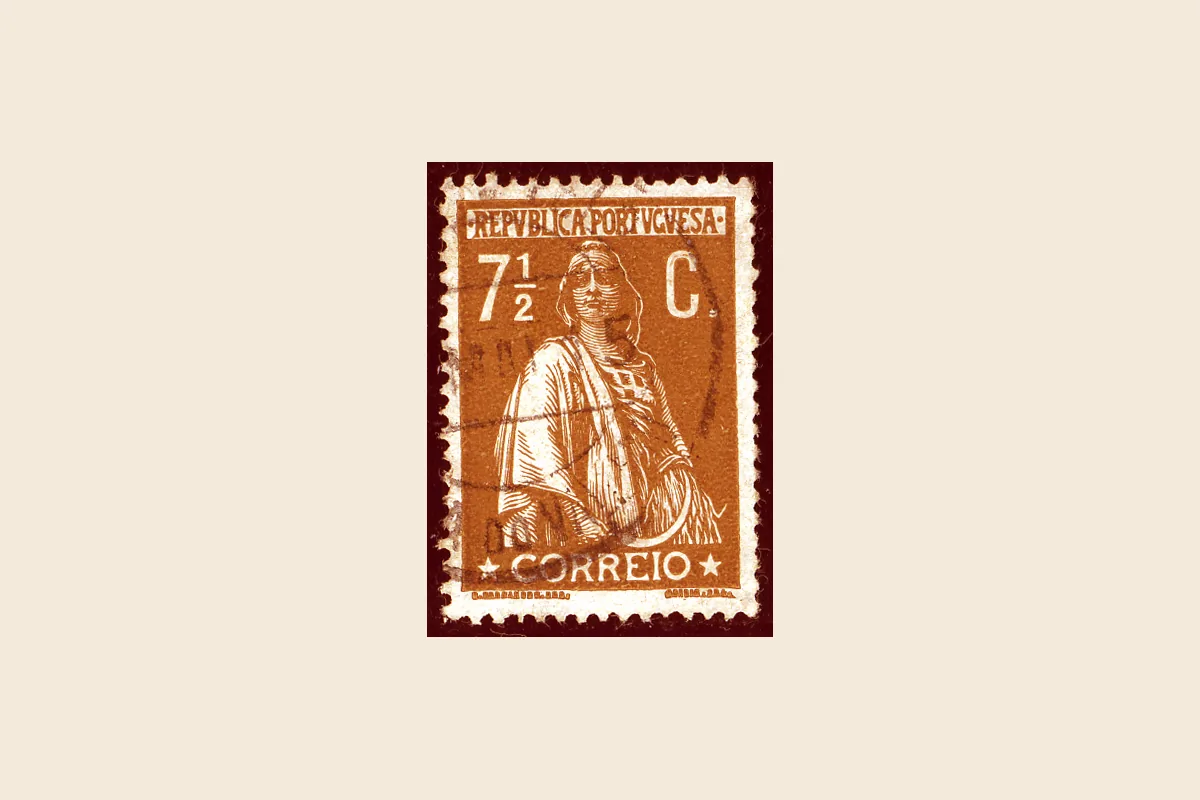
The original mainland design shows a standing Ceres with grain and a billhook, with REPUBLICA PORTUGUESA and CORREIO inscriptions. The specialist CNF album groups the original issue under 1912. Its denomination list includes fractional centavos, whole centavos and one escudo.[11] Wikipedia gives 16 February 1912 as the first issue date; that exact day has only this one supporting source in the packet.[3] The design and denomination are more useful for your initial sorting than an assumed release day.
Read a fraction carefully. A face value of 1/2 centavo is not a damaged 1-centavo numeral, and 1 1/2 is not 15. The original list includes 1/4, 1/2, 1, 1 1/2, 2, 2 1/2, 5, 7 1/2, 8, 10, 15, 20, 30 and 50 centavos, plus 1 escudo.[11] Record the complete printed value before searching a catalog.
These are historical postage denominations, not euro prices. On later mainland listings, 10$00 is Portuguese escudo notation, not a US-dollar dealer ask.[15] Keep your note of the printed denomination separate from any modern selling currency. A similar central figure with a colonial name or island overprint belongs in another issuing-territory search.[3]
Separate the original, London and retouched branches
Do not put every mainland Ceres stamp into the original 1912 group. CNF's 1917/1920 group includes a light-green 4-centavo value.[17] The checked 4-centavo dealer offers carry a 1917 label and Afinsa 226f, with CARTOLINA thick paper and 15x14 perforation.[5][6] A green stamp and the numeral 4 alone do not confirm that paper classification.
The London branch is dated 1926 in CNF and Wikipedia. CNF records 13 1/2x14 perforation and values extending to 10$00; Wikipedia notes that the authors' names are absent on this branch.[3][15] Inspect a clear, complete image for the relevant small inscriptions, then measure the actual stamp. Do not decide London printing from a cropped image that hides the lower design.
CNF dates the retouched mainland branch to 1930, describes Casa da Moeda printing and gives 12x11 1/2 perforation.[16] That gauge is not unique to the retouched branch. The earlier dealer-labelled 1912 Afinsa 219c also has 12x11 1/2.[8] Use gauge with design and paper evidence, not as a one-step dating rule.
| Branch | Documented clue | What still needs checking |
|---|---|---|
| Original group, 1912 | Standing Ceres; centavos and 1 escudo [11] | Paper, gauge and exact denomination |
| 1917/1920 group | Light-green 4 centavos in CNF [17] | Paper and condition of the individual stamp |
| London, 1926 | 13 1/2x14; authors' names absent [3][15] | Design details and measured gauge together |
| Retouched, 1930 | Casa da Moeda; 12x11 1/2 [16] | Retouched design, not gauge alone |
| New-value and revalidation overprints | 1928/1929 new values; REVALIDADO in 1929 [3][12] | Exact added text, base issue and authenticity |
Measure both perforation directions
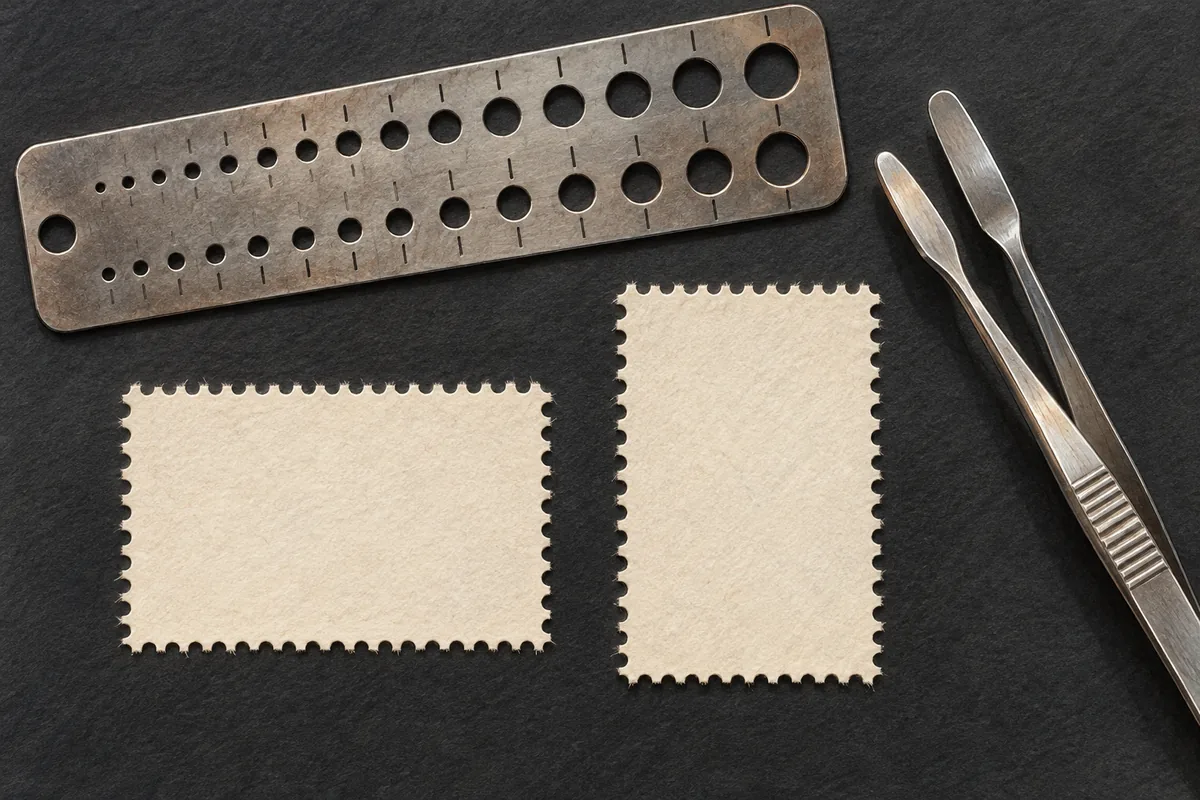
The notation 15x14 records two directions. Write the horizontal gauge first and vertical gauge second. The 50-centavo listings make the practical consequence visible. Afinsa 219 is described as 15x14, while Afinsa 219c is described as 12x11 1/2.[7][8] Count neither the total teeth around the stamp nor the holes in an enlarged photograph as a substitute for a gauge measurement.
Use a physical gauge and align a sound section of each edge without pressing the stamp. Repeat on the opposite edges when possible. A short, damaged edge can make a reading uncertain. Keep that uncertainty in your record rather than rounding to the variety you hope to find. The perforation measurement guide explains the method.
A phone image helps you notice missing teeth and plan which edge to measure. It cannot supply a trustworthy scale when the camera distance, angle or resizing is unknown. Preserve the whole edge in your photograph, and record the measured result separately. Never trim a rough edge to make it resemble a different format.
Paper and gum need their own evidence
The 4-centavo offers describe CARTOLINA as thick paper. The 50-centavo offers describe porcelana as chalky paper.[5][6][7][8] Those are the dealer's classifications, not independent examination by this guide. A front photo that resembles the offered color does not verify either paper. Keep the Portuguese paper name with its plain-language meaning when copying a listing into your notes.
Used, mint hinged and mint never hinged are different condition descriptions. The EUR 4.00 4-centavo is used. The EUR 29.00 example is described as mint never hinged with original gum.[5][6] Both 50-centavo examples are described as mint hinged with original gum.[7][8] Do not call a stamp never hinged merely because no hinge is visible in the front photograph.
Photograph an accessible back and note hinges, disturbed gum, thinning, creases or stains. Do not peel a hinge or attempt a paper test that could mark the stamp. The condition guide helps separate those observations. If your back remains hidden in a mount, say unexamined rather than assuming original gum.
Four dealer asks checked on 10 October 2026
Filatelia Maçãs displayed the following four offers with euro amounts and Add to cart controls on 10 October 2026. Each page describes one stamp and calls its condition good.[5][6][7][8] These are retail asking prices observed on that date, not transactions completed on that date. Remaining stock counts and actual sale dates were not established.
The 219c page has an internal naming inconsistency. Its Portuguese title retains the suffix c, while the English description drops it.[8] The table preserves Afinsa 219c and its stated 12x11 1/2 gauge instead of silently treating it as 219. The exact product identity helps you retrieve the same offer without confusing the dealer's inventory number with the Afinsa reference.
The archived CNF pages supply identification history, not these prices. They are historical copies from January 2008, read for this article on 10 October 2026.[11][15][16][17] Shipping, taxes and checkout charges for the dealer offers were not checked. No auction buyer's premium is added to a dealer ask, and no USD conversion is supplied.
| Dealer identity and catalog | Face value and condition | Paper and perforation | EUR ask |
|---|---|---|---|
| product_id 14679; dealer label 1917; Afinsa 226f [5] | One 4-centavo single; used | CARTOLINA thick paper; 15x14 | EUR 4.00 |
| product_id 14678; dealer label 1917; Afinsa 226f [6] | One 4-centavo single; mint never hinged, original gum | CARTOLINA thick paper; 15x14 | EUR 29.00 |
| product_id 14688; dealer label 1912; Afinsa 219 [7] | One 50-centavo single; mint hinged, original gum | Porcelana chalky paper; 15x14 | EUR 17.00 |
| product_id 16879; dealer label 1912; Afinsa 219c [8] | One 50-centavo single; mint hinged, original gum | Porcelana chalky paper; 12x11 1/2 | EUR 159.00 |
Use the offers as matched comparisons
The two 4-centavo asks show a condition distinction within the same dealer-described catalog variety.[5][6] They do not establish a fixed premium for gum on every Ceres stamp. Check that your stamp also matches the denomination, paper and perforation before considering either offer relevant. A hinged unused example matches neither of these two condition descriptions exactly.
The two 50-centavo asks instead show a gauge distinction within the same described paper and hinged original-gum condition.[7][8] EUR 159.00 is not a price for every 50-centavo stamp, nor evidence that any 12x11 1/2 Ceres belongs to Afinsa 219c. The design branch and catalog evidence still have to agree.
Do not turn EUR 4.00 and EUR 159.00 into a family value range. A dealer ask is also not the amount a dealer would pay you. For a selling decision, seek a comparable completed transaction with the same variety, quantity and condition. No qualified realized-sale amount is provided here. The separate used-set listing is excluded because its text did not explicitly establish the number of stamps.[9]
For broader comparisons, the old stamps price list keeps described retail asks separate from realized sales. Use an entry only when its issue, quantity and condition match your stamp.
Keep overprints and other territories separate
New-value overprints appear in 1928/1929, and REVALIDADO is a 1929 branch in the CNF index.[3][12] Transcribe every added word and numeral. The base design does not price the overprinted item. Keep an uncertain surcharge reading as a question, and preserve any old expert document rather than treating the overprint's appearance as authentication.
Ceres also appears in colonial material, where the colony's name may be part of the design, and on Azores material with the archipelago name overprinted.[3] This article's table excludes colonial, Azores and Madeira prices. Mainland centavo and escudo rules should not become a currency table for every territory that used the design.
Do not confuse a later commemorative object with an original definitive. Marklaro documents a Ceres maximum card with a Lisbon marking dated 1 October 2010.[10] Its Ceres subject does not make it a 1912 loose stamp. Keep the complete card or cover, record the actual dated marking and investigate that object in its own format.
Record a catalog candidate without losing uncertainty
For the offers in this article, keep Afinsa before the number and preserve suffixes such as 226f and 219c. A dealer stock identity such as product_id 16879 is not a catalog number.[8] The catalog-number workflow explains how to keep the reference system attached to an attribution instead of treating bare numbers as interchangeable.
A useful collection record includes both photographs, the printed value, complete inscription, overprint if present, measured horizontal and vertical gauge, observed back condition, and the reference consulted. Separate an inherited album attribution from your own checked evidence. If paper is unresolved, keep more than one candidate rather than copying the expensive suffix into the confirmed field.
Use a scan after the identification checks
Photograph one Ceres stamp straight on with all edges visible. Include a separate back image only when the stamp is loose and safe to handle. In your notes, state mainland Portugal as a candidate, quote the printed denomination and list the measured gauge. Ask which design branch needs comparison; do not tell the tool that an unverified paper variety is already proven.
Stamp Value Identifier & Scan supports photo-based identification, follow-up questions and saved collection records, with a free tier on iPhone and Android. Save the likely design match alongside the paper, gum and gauge questions still open. A front-photo result cannot certify CARTOLINA paper, original gum or an overprint. Use it to organize the next check, not to attach the EUR 159.00 ask to an unresolved stamp.
Drop a stamp photo here
Show the full stamp, every perforation, and as much front detail as possible in even light.
Keep your Ceres paper and gauge questions with the scan
Try Stamp Value Identifier & Scan on iPhone or Android. Save each Ceres candidate with its face value, measured perforations and back-condition notes before comparing a dealer offer.
Frequently asked questions
What is a Portugal Ceres stamp worth?
The four checked single-stamp offers were EUR 4.00, EUR 29.00, EUR 17.00 and EUR 159.00 on 10 October 2026. Each has a different specified condition or variety. They are dealer asks, not sold prices or a universal Ceres valuation.[5][6][7][8]
Why are the two 4-centavo prices different?
Both are dealer-described Afinsa 226f on CARTOLINA thick paper, 15x14. The EUR 4.00 stamp is used; the EUR 29.00 stamp is mint never hinged with original gum. That comparison does not establish a fixed condition multiplier.[5][6]
Does 12x11 1/2 identify a retouched Ceres stamp?
No. CNF gives that gauge for the 1930 retouched branch, but the dealer also lists the earlier Afinsa 219c 50-centavo at 12x11 1/2. Design, paper and denomination must agree with the catalog candidate.[8][16]
Does 10$00 mean the stamp costs ten US dollars?
No. In the London mainland issue's denomination list it is Portuguese escudo notation. Keep historical face value separate from a dealer's current selling currency. The four offers here are explicitly in EUR.[5][6][7][8][15]
Can I use these prices for an Azores or colonial Ceres?
No. Read the territory name and any overprint first. The four offers concern mainland stamps only. Colonial, Azores and Madeira items require their own exact issue and condition comparisons.[3][5][6][7][8]
Sources and further reading
Primary references and specialist resources used to prepare this guide.
- [3] Wikipedia: Ceres chronology and territories
- [5] Filatelia Maçãs: used 4 centavos, product 14679
- [6] Filatelia Maçãs: mint never-hinged 4 centavos, product 14678
- [7] Filatelia Maçãs: hinged 50 centavos, 15x14, product 14688
- [8] Filatelia Maçãs: hinged 50 centavos, 12x11 1/2, product 16879
- [9] Filatelia Maçãs: used series, excluded from price comparison
- [10] Marklaro: Ceres maximum card with Lisbon marking in 2010
- [11] CNF archived album: original mainland group, 1912
- [12] CNF archived index: overprint branches
- [15] CNF archived album: London group, 1926
- [16] CNF archived album: retouched group, 1930
- [17] CNF archived album: 1917/1920 group