Quick answer
Sower stamp value depends on the French Semeuse design, denomination, type and condition. On 6 October 2026, Philatelie72 asked EUR 3.50 for a never-hinged 15c green lined Sower and EUR 2.20 for a never-hinged 10c red cameo. These are dealer offers for singles, not sale results or values for every used Sower.[5][6]
Read the background before choosing a price
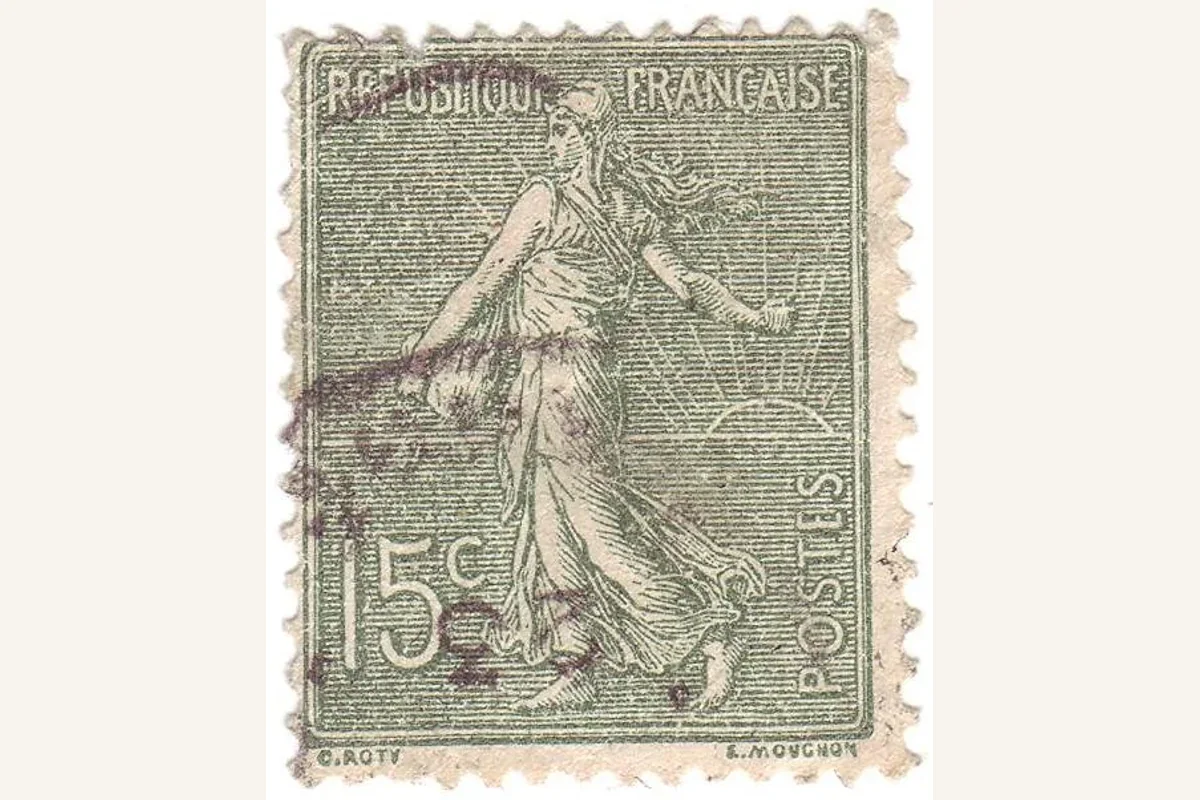
The Sower is a standing woman scattering seed, not a portrait of a named ruler. For France's Semeuse stamps, read REPUBLIQUE FRANÇAISE, the denomination and the small currency letter before searching by color. Then inspect the space around the figure. Closely spaced horizontal lines identify the lined design group, called Semeuse lignée. A solid background needs another check before you call it a cameo.[1][5][6]
This guide covers the early twentieth-century French postage family and useful denomination-level distinctions. It is not a price list for every booklet, colonial overprint, proof or later anniversary issue using the Sower. Keep any extra printed wording or surcharge in the identification record. A familiar figure does not establish the issuing authority, the original denomination or a specialist type.
Start with the whole design rather than a cropped face or skirt. In the genuine reference below, the green stamp has a visible 15c denomination and a lined background. Its cancellation and worn edges belong to that particular reference specimen. It is not the mint stock offered in our price table and does not demonstrate that your stamp has the same condition.
Lined, solid-ground and cameo are not interchangeable
The Cercle Philatélique Lexovien separates the 1903 lined issues, the 1906 solid-background designs and the cameo family beginning in 1907. The solid-background group includes the 10c with ground below the feet and the thin-lettered designs collectors call maigres. The later cameo has heavier lettering and clear light outlines around the figure. A plain background alone therefore does not identify Yvert 138.[1][4][6]
Inspect the feet, the lettering and the area above the waist together. The society describes a strong spot above the waist in the 1906 maigre family, absent from the later cameo. It also warns that a poorly impressed cameo can look thin-lettered. Do not classify the design from lettering weight alone when a cancellation or weak impression hides the other evidence.[1][4]
Use these groups to narrow the catalog search, not to assign a rare variety. A stamp whose ground is obscured needs a better front photograph or an in-hand comparison. Note the uncertainty instead of skipping straight to the most expensive similar image. The catalog-number guide explains why the publisher's name belongs beside any number you record.
Use denomination and color as a first sorting grid
Two green Sowers need not belong to the same group. The 15c green lined issue is Yvert et Tellier 130, while the society lists a 10c green cameo as 159. Red likewise appears in the 10c cameo family, but a red figure on a plain field still needs the 1906-versus-1907 checks. Denomination and background are more useful together than color alone.[1][5][6]
The compact table is a starting grid, not a complete French catalog. Its numbers are Yvert et Tellier references. Do not silently reuse them as Scott or another publisher's numbers. The c on these examples denotes centimes in the historical French denomination, whereas EUR in the price section is the present dealer currency. Those are different amounts with different purposes.
Other denominations also occur within the verified cameo overview, including 20c, 25c, 30c, 35c and 40c. Later lined issues also exist, so a lined background does not prove a printing date of 1903.[1] Keep later denominations in the Sower group while researching their own entries. The prices below do not cover every row of this identification grid.
| Design group and denomination | Yvert reference | Check next |
|---|---|---|
| Lined, 10c | 129 [1][2] | Horizontal background; specialist type still to check |
| Lined, 15c green | 130 [5] | 15c and lined background; 1903 issue |
| Solid background with ground, 10c | 134 [1] | Ground below the feet; 1906 group |
| Solid background, thin lettering, 10c red | 135 [1][4] | maigre family; lettering weight alone is insufficient |
| Cameo, 10c red, green or ultramarine | 138, 159, 279 [1][3][6] | Color plus combined type marks; 138 listed as 1907 |
Three dated offers, with quantity kept visible
These offers were checked on 6 October 2026. Philatelie72 showed stock references FR-PO130 ** and FR-PO138 **. Its condition explanation defines ** as mint with intact original gum and no hinge trace. The 15c green lined single was EUR 3.50; the 10c red solid-background, no-ground, thick-lettered single was EUR 2.20. Neither listing specifies the specialist subtype discussed later in this guide.[5][6]
Philantologie separately offered Yvert 129-133, a five-value 1903 lined set, for EUR 99.00 under reference FRASM 211. It describes original gum with a trace and gives the condition labels Neuf * and TB. Keep those seller labels in the record rather than translating TB into a certified numerical grade. This is five stamps sold as a set, not one exceptional single.[7]
All three figures are dealer asking prices, not completed sales. There is no auction date or buyer's-premium basis to report. Keep shipping and checkout charges separate from the quoted item amounts. Do not divide the set's ask into five supposed individual values or combine mint offers into a range for cancelled album duplicates. Our condition guide helps document the differences that matter before choosing a comparison.
| Offered item and stock reference | Quantity and dealer condition | Dealer asking price |
|---|---|---|
| Philatelie72, Yvert 130, FR-PO130 ** [5] | One 15c green lined single; intact original gum, no hinge trace | EUR 3.50 |
| Philatelie72, Yvert 138, FR-PO138 ** [6] | One 10c red cameo single; intact original gum, no hinge trace; subtype not specified | EUR 2.20 |
| Philantologie, Yvert 129-133, FRASM 211 [7] | Five-value 1903 lined set; original gum with trace; Neuf *, TB | EUR 99.00 |
For the 10c lined stamp, inspect the numeral and C
The society's study of Yvert 129 distinguishes three types. Its type I has a rounded foot to the numeral 1 and three lines inside the C. Type III has a square foot to the 1 and two lines inside the C. These are small design features, so take a sharply focused image of the denomination rather than relying on an enlarged, blurred album photograph.[2]
Type II requires a different combination. The society describes removal of the shading in the R of REPUBLIQUE and a hook-shaped retouch in the hanging belt fold. It notes that one position in type I lacks the usual R shading. That exception makes an unshaded R insufficient by itself. Compare the numeral, letter and belt details instead of promoting one missing mark into proof.[2]
This is an inspection task, not a priced rarity claim. We found no qualified current offer for a specific Yvert 129 subtype to publish here. Do not attach the price of the 15c green stamp to a 10c lined example. If the denomination detail is hidden by a postmark, record the broad issue and leave its type unresolved.
The 10c cameo needs more than the tail of Q
For the red and green 10c cameo, the society describes type IA with a level middle bar in the B of REPUBLIQUE and complete shading in the sowing hand. Type IC combines an inclined middle B bar with a shorter third shading line in that hand. The reference warns that one characteristic can occur without the other. Use the conjunction, not an isolated short line, for an IC candidate.[3]
The Q is a useful warning against shortcut identification. On some type IA impressions, its usual stroke shrinks to a small dot. That can mislead a collector toward another type. For the red type II, the reference instead describes a large Q dot together with a shorter fifth cheek shading line near the chin. A dot alone does not establish the specialist booklet type.[3]
For green and ultramarine examples, compare the C of centimes. The society gives type III a rounded back and a shorter lower arm; type IV has a longer lower arm. It also records type IV examples without the expected cut perforation teeth because sheets were sold at counters.[3] Do not use one straight edge as automatic proof of coil origin. None of these subtypes is priced by the unsuffixed FR-PO138 offer.
Mint, hinged and used describe different comparisons
A clear front does not establish never-hinged gum. The ** offers above define a reverse-side condition, while the five-value set is described with an original-gum trace.[5][6][7] For your own loose Sower, record any hinge remnant, gum disturbance, paper loss or stain. If the stamp remains fixed in an album, write reverse unexamined rather than pulling it free to complete a price search.
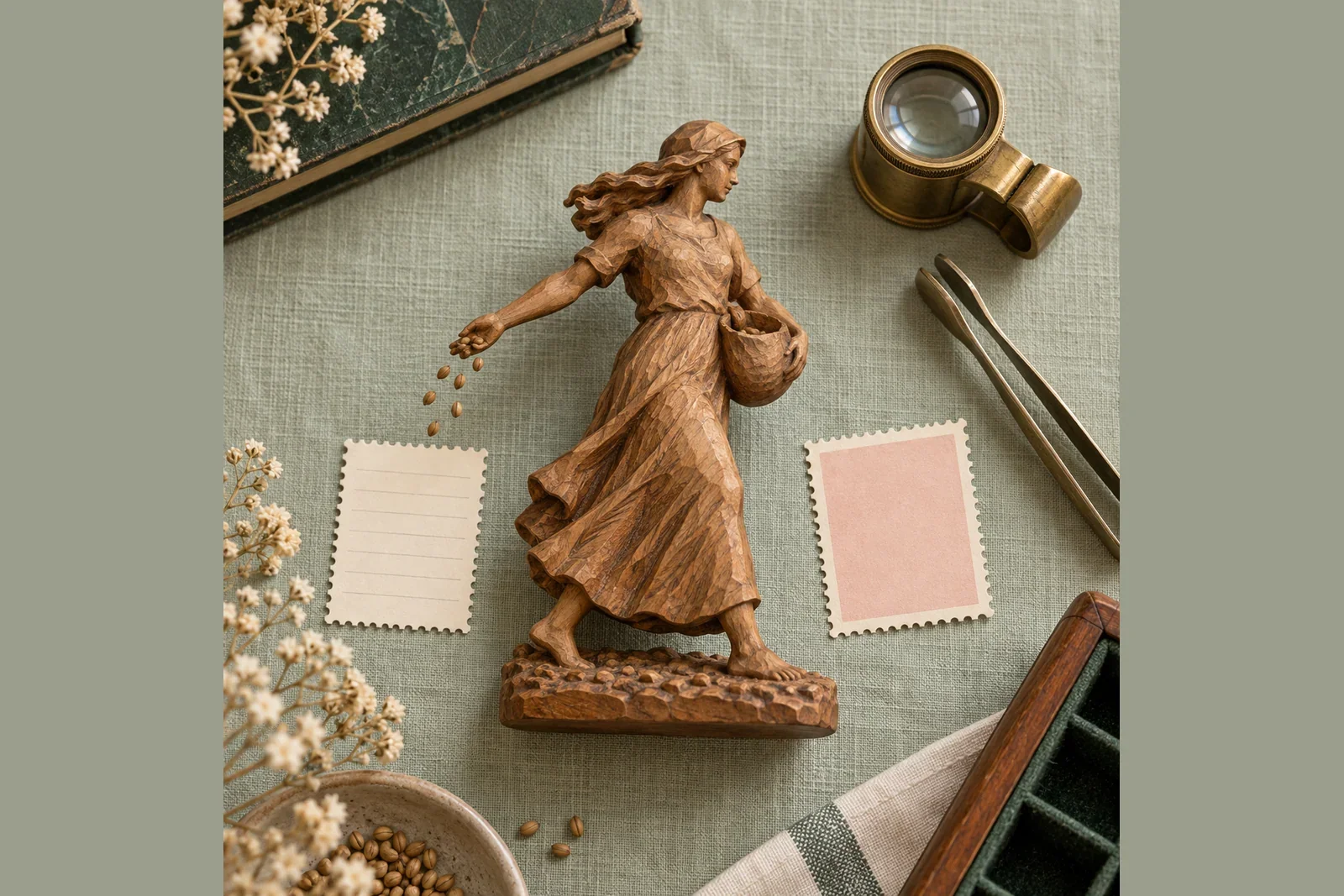
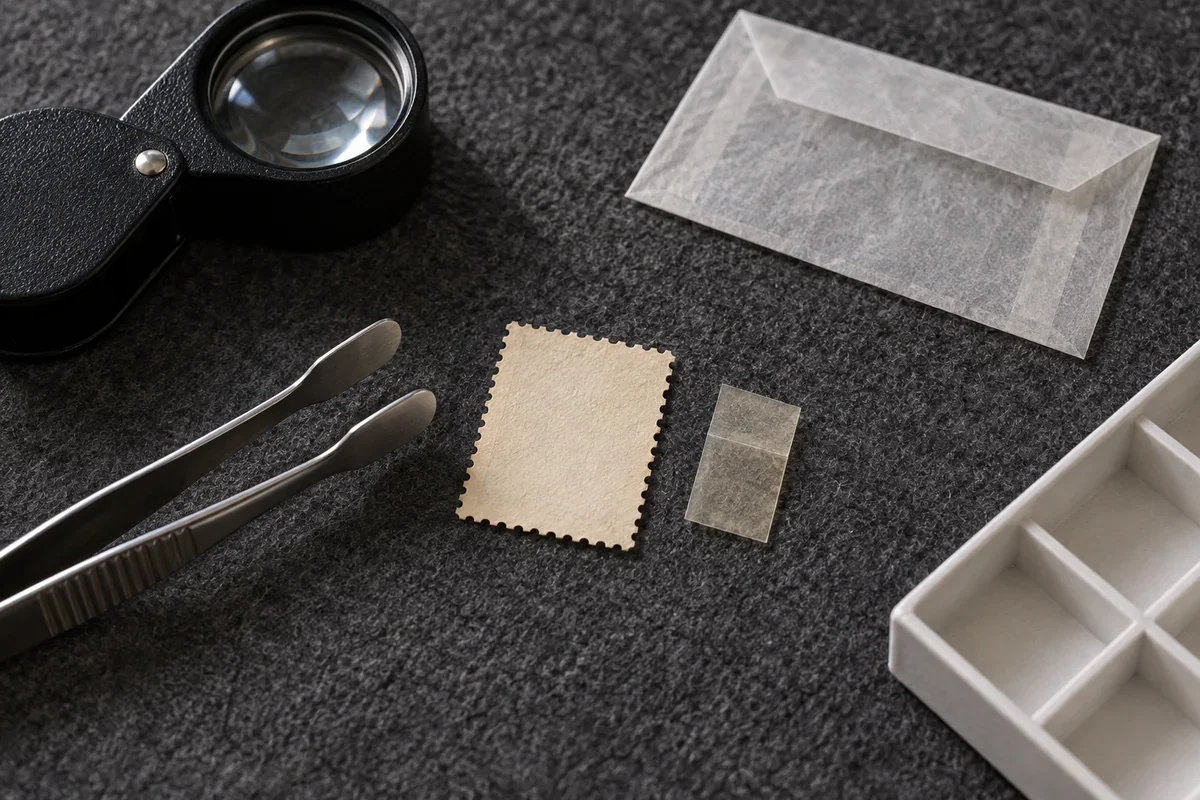
Do not moisten the back to see whether the gum is original. Do not erase a mark, peel an old hinge or flatten a crease as part of identification. Read the hinges and mounts guide before changing an old mounting. The blank-paper illustration below shows an inspection arrangement only. It cannot authenticate original gum, a repaired thin or a dealer's condition category.
For a used Sower, photograph the full cancellation and every tooth. Distinguish what the postmark actually shows from what an album caption says. A heavy mark may hide the B, Q or hand details needed for typing. A neat date does not make a cancelled stamp equivalent to the never-hinged comparison, and this packet contains no used-single offer from which to assign your stamp an exact retail price.
Preserve booklet, sheet-margin and cover context
The Sower reference connects several cameo types with sheet, booklet and coil production. Those associations help explain why a specialist asks to see attached paper and neighboring stamps.[1][3] Photograph a joined unit intact, including any margin printing, rather than detaching the most attractive single. A format claim should rest on its actual context and confirmed type, not on an edge that might have been cut.
For a stamp on an envelope, keep the whole envelope. Record the town, readable date and any other stamps before deciding what the object is. The cancellation guide helps separate stamp identity from postal markings. A cover, a joined strip and a loose single need their own comparisons; the three dealer offers here do not price postal-history material.
Separate extra wording and surcharges from ordinary postage examples. Do not ignore a new printed denomination simply because the woman and background look familiar. Likewise, a modern stamp reproducing an earlier Sower inside its design is not the earlier stamp itself. When extra printing changes the identity, stop using the ordinary single's offer and locate evidence for the complete item.
Photograph the details that resolve your uncertainty
Make one straight-on front image with all edges visible, then a close-up of the denomination and REPUBLIQUE. For a 10c cameo, add the sowing hand, cheek and letter C. For a 10c lined example, include the foot of 1 and hanging belt fold. These separate photographs are useful because the diagnostic marks occupy different parts of the design.[2][3]
Add a back image only when the stamp is already loose and safe to turn with tongs. Include the original album label in a separate photograph so its claim remains traceable without replacing the physical evidence. Keep color adjustments modest. A sharpened image that invents edges around the Q or hand can make a type comparison less reliable, not more decisive.
Use the checker to organize the visible country, denomination and design clues. Add notes such as 15c, horizontal background lines, used, or 10c red, solid background, gum unexamined. A photograph may suggest a broad match, but it cannot settle original gum or an unclear specialist subtype. Keep those questions open for a reference comparison or an in-hand examination.
Drop a stamp photo here
Show the full stamp, every perforation, and as much front detail as possible in even light.
Check the visible clues on your Sower
Upload one complete front photo and note the denomination, background, extra printing and known gum state. Use the result as a starting identification, then verify any small type marks against the cited specialist reference.
Keep one record for each unresolved Semeuse
Install the app for free on iOS or Android to scan stamps individually, save results and organize the collection. Keep the lined and cameo candidates in separate records, with the back's condition and any unresolved letters noted. Saving the uncertainty is more useful than labeling every similar green or red stamp with the same catalog number.
For the next comparison, record the confirmed denomination, background group, catalog publisher, type if established, format and condition. Copy the dealer's stock reference and observation date beside the amount. If one of those fields differs, explain the difference before treating the offer as relevant. The EUR 99.00 set and the two never-hinged singles remain separate evidence, not a formula for valuing an inherited album.[5][6][7]
Frequently asked questions
How can I tell a lined Sower from a cameo?
Look for horizontal background lines around the woman. A solid field needs another check: the 1906 ground and thin-lettered designs are not automatically the 1907 cameo. Compare the feet, lettering and spot above the waist using the society's overview.[1][4]
Is every green French Sower the same stamp?
No. The 15c green lined issue is Yvert 130, whereas the society lists a green 10c cameo as Yvert 159. Read the denomination and background together before selecting a reference or price.[1][5]
Does a dot under Q prove the rare 10c cameo type?
No. The society warns that type IA can have a reduced stroke that resembles a dot. Its red type II comparison uses a large dot together with a shorter fifth cheek line. Keep the type unresolved if either feature is hidden.[3]
Can I use EUR 3.50 for my cancelled 15c Sower?
Not as an exact comparison. That offer was for Philatelie72 stock FR-PO130 **, mint with intact original gum and no hinge trace, observed 6 October 2026. A cancelled or faulty stamp has a different condition. No used-single price was established here.[5]
Why is the five-stamp set priced above the singles?
Philantologie's EUR 99.00 offer covers Yvert 129-133, five different 1903 lined values, with original-gum trace and seller labels Neuf * and TB. It is not five copies of the EUR 3.50 stamp. Do not divide the set price into invented single values.[7]
Sources and further reading
Primary references and specialist resources used to prepare this guide.
- [1] Cercle Philatélique Lexovien, Semeuse overview
- [2] Cercle Philatélique Lexovien, 1903 lined 10c
- [3] Cercle Philatélique Lexovien, 10c cameo types
- [4] Cercle Philatélique Lexovien, 1906 maigre designs
- [5] Philatelie72, Yvert 130 and ** condition definition
- [6] Philatelie72, Yvert 138 and ** condition definition
- [7] Philantologie, Yvert 129-133 set, FRASM 211
- [8] Wikimedia Commons, genuine 15c reference and public-domain rights