Quick answer
Great Britain Seahorse stamp value depends on printing, denomination and condition. On 8 October 2026, British Stamps listed a used 1934 SG 450 single at £8.50 and an unmounted mint SG 450-452 set of three at £625. These are dealer asking prices. Check the portrait background before comparing your stamp with either offer.[5]
Read the denomination before searching prices
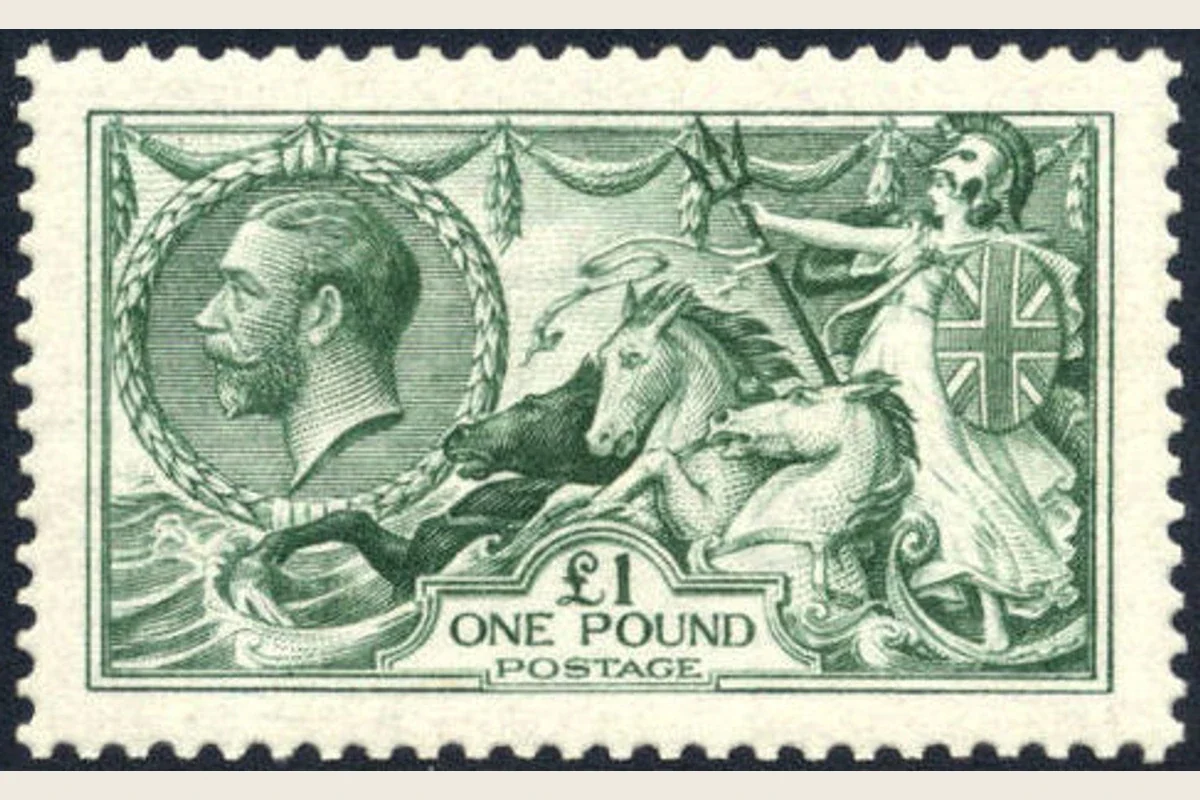
The Seahorse design puts George V's portrait at the left and Britannia with marine horses at the right. The genuine reference scan below shows the green £1 stamp of 1913.[8] Start by reading the entire value inscription. The small amount you see beside a dealer's offer is a selling price, not the denomination printed on your stamp.
The family includes 2/6, 5 shillings, 10 shillings and the £1 green. Roy Lingen's NSDA tutorial separates four printing groups but notes only one £1 green issue.[2] Do not assume that each denomination occurs in every group. In particular, a three-value re-engraved set is not missing a green pound stamp. The set and the early pound belong to different comparisons.
A 2/6 inscription means two shillings and sixpence in the old British currency, not £2.60. Keep the original notation in your inventory. This guide covers the unoverprinted British design family and explains how to sort its principal printings. It does not assign prices to every shade, retouch, overprint or cover. A George V portrait without the sea-chariot design needs a different identification.
The portrait background gives the clearest first split
Look inside the portrait oval, behind the King's head. The re-engraved Waterlow issue has crossed shading lines. Earlier printings have single-direction shading instead.[1][2] Enlarge that area from a sharp, straight-on image. Do not use the texture of Britannia's robe, the sea or the surrounding wreath as your test. Those are different parts of the design.
Cross-hatching narrows the search to the re-engraved group. It does not establish gum status, soundness or a particular dealer's grade. British Stamps identifies the three values as 1934 SG 450-452.[5] Keep that catalog attribution separate from the physical observation. A visible crossed background is your evidence; SG 450, 451 or 452 follows after the denomination also matches.
If a cancellation obscures the background, record it as unexamined rather than guessing. A dark scan can merge several thin lines into one patch. Try another photograph with diffuse light and no sharpening filter. When there is still no readable area, a specialist may need the actual stamp. A confident online caption cannot recover a design detail your own photograph does not reveal.
Measure the printed frame, not the paper
For earlier stamps, measure between the outer printed frame lines. The GB Overprints Society gives the first Waterlow and De La Rue designs as 22 mm high and 33½ mm wide. Its Bradbury Wilkinson group is 22¾-23 mm high and 34 mm wide.[1] These are printed-design dimensions, not measurements across the perforation tips or an album mount.
The difference is small enough for perspective to matter. A photograph taken at an angle, a browser image enlarged to an arbitrary size or an illustration in a web article is not a calibrated specimen. Use the physical stamp and a precise scale without pressing against its teeth. Record the measured height before selecting a catalog candidate. If a crease prevents a reliable reading, keep the printer unresolved.
Lingen also describes a dot near the top center as a positive clue to some Bradbury Wilkinson stamps. Its absence does not rule that printer out.[2] Inspect the correct spot without making a tiny mark your only test. A dirt speck, cancel dot or scan artifact needs a second photograph. Use the printed dimensions and the portrait shading together, rather than treating one attractive detail as authentication.
| Group | Useful observable clue | What the clue does not settle |
|---|---|---|
| First Waterlow | 22 mm printed height; normal or narrow top side tooth | Exact shade or gum condition |
| De La Rue | 22 mm height; broader top side tooth and smaller holes | Identity when edges are damaged |
| Bradbury Wilkinson | 22¾-23 mm height; some show a top-center dot | Absence of the dot is not exclusion |
| Re-engraved Waterlow | Cross-hatched portrait background | Condition, overprint or selling price |
The difficult comparison is Waterlow against De La Rue
Both earlier groups can have the same printed height, so size alone cannot separate them. GBOS points to broader top side teeth and smaller perforation holes in the De La Rue printing. The first Waterlow has a normal or narrow top side tooth.[1] Compare the upper corners and the adjacent edge with a verified reference. Do not confuse the top side tooth with an arbitrary tooth at the middle of the upper edge.
A missing corner removes evidence; it does not become a variety feature. Likewise, a torn hole or a badly separated tooth may distort the apparent pattern. Photograph all four edges and note the damage before reaching a printer decision. Your record can say early printing, Waterlow or De La Rue unresolved. That is a defensible stopping point when the surviving material does not support more.
Lingen says the principal issues share perforation 11 × 12 and the Crown and GvR watermark.[2] A gauge or watermark check can support family identification, but neither alone chooses among these printers. The perforation guide explains how to record both directions. Do not buy a detector expecting it to solve this particular printing comparison.
Dealer asking prices checked on 8 October 2026
These observations come from British Stamps, Rowan S. Baker's re-engraved Seahorse stock page. The page displays pound-denominated item prices and identifies the actual items. The numerical stock references below come from its image and basket identifiers, not from the letters appended to the descriptions.[5] We preserve the site's £ notation and do not convert the amounts into another currency.
Each row was visible with an add-to-basket control when checked. That is evidence of an advertised offer, not a completed sale or confirmed fulfillment. The dealer says order confirmation does not guarantee stock and gives a £20 minimum order.[12] The £8.50 item amount therefore is not a promise that you can purchase that stamp alone for that total. Postage and other order costs are not added here.
The set contains three mint singles, whereas the used offers concern one stamp each. Keep that quantity difference in your comparison. We did not average them into a family price or use the dealer's quoted catalog figures as realized values. Early printings and the green pound have no qualified current price observation in this table. Their absence is not a claim that they have no collector value.
| Issue and stock ID | Condition and quantity | Dealer asking price |
|---|---|---|
| 1934 SG 450, 2/6; 26004 | Fine used single; crisp circular date stamp | £8.50 |
| 1934 SG 451, 5/-; 26007 | Sound used single; double-ring circular date stamp | £25.00 |
| 1934 SG 452, 10/-; 24628 | Very fine used single; several light date-stamp strikes | £26.00 |
| 1934 SG 450-452; 25952 | Unmounted mint set of three; dealer reports no gum creases | £625.00 for the set |
Condition must survive the same close inspection
Separate the front's appearance from the reverse's state. A clean-looking uncancelled stamp is not automatically unmounted mint. Look for hinge traces, gum disturbance, thinning, creases and repairs without trying to improve the surface. The mint set offer specifically describes unmounted gum and no gum creases.[5] You need comparable reverse-side evidence before treating that offer as relevant to your stamps.
For a used Seahorse, record whether the cancellation obscures the portrait background or the top-center diagnostic area. The priced singles have different stated cancellation descriptions.[5] A circular date stamp can help you read place and date, but its presence alone supplies no fixed premium. The cancellation guide helps you describe the mark without substituting the mark for a condition assessment.
Inspect the frame and every corner for short teeth, cuts or tears. Check a dark patch from both sides rather than calling it an unusual shade. Store the stamp without flattening a crease or removing a hinge. Use the condition guide to separate observations from adjectives. When requesting a comparison, send the faults as well as the attractive front.
Overprints, shades and re-entries need another layer of evidence
Halberstam's specialist article discusses Seahorse overprints for Ireland, Nauru, Bechuanaland and British offices abroad.[11] The basic design can be familiar while the issuing authority has changed. Copy the overprint exactly, including a surcharge, and photograph its placement. Do not use the unoverprinted SG 450 price for an overprinted stamp merely because both have crossed portrait shading.
Shades also require more than a screen match. Different lighting, camera processing and paper condition can change the apparent tone. Start with the denomination and printing group, then compare the shade under the same light with an appropriate reference. A seller's color name is a claim to examine, not a fact you can inherit from a photograph that happens to look similar.
Halberstam warns that 2/6 re-entries are difficult to identify and that thicker or doubled lines can mislead.[11] Mark the exact area you suspect in a separate enlarged copy, leaving the original image unchanged. Seek a reference for that specific variety and, when the financial difference matters, specialist examination. Do not search the highest-priced re-entry first and work backward until an ordinary line appears to fit.
Build a comparison record that someone else can check
Write one record per physical item. Include denomination, portrait shading, printed dimensions, upper-corner evidence, cancellation, reverse condition and any overprint. Mark each unexamined feature explicitly. Attach the complete front and back images before detail crops. This lets a second collector challenge a printer attribution without losing the evidence you actually observed.
Then add a catalog candidate with its publisher name and any suffix. SG 450 is a Stanley Gibbons reference, not a dealer stock number. The British Stamps offer 26004 is a separate item identifier.[5] The catalog-number guide explains why those fields belong in different places. An inherited album's handwritten number should remain a prior attribution until you check it.
Save the comparable's date, quantity, condition and price type beside its URL. Return to the old-stamps price list for broader comparisons only after the Seahorse printing is reasonably secure. If you have a pair, block or complete envelope, keep it intact and search that format. A set ask cannot establish the worth of each component, and a loose-stamp price cannot establish an envelope's postal-history value.
Check a photo after recording the physical clues
Use the existing free checker below with a full front image and notes about the printed value, shading and measurements. Say whether the reverse remains unexamined. A useful note distinguishes what you measured from what the album label says. If an overprint is present, include its complete wording rather than only the British design name.
Treat the result as a starting point for this printing workflow. A photograph cannot confirm original gum or an unreadable watermark, and an apparent dot cannot certify a re-entry. Reconcile the suggested family with the physical clues before using the retail table. If a suggested catalog entry disagrees with your measured frame or visible background, keep the disagreement in your notes rather than deleting the awkward evidence.
Drop a stamp photo here
Show the full stamp, every perforation, and as much front detail as possible in even light.
Keep your Seahorse printing notes together
Install Stamp Value Identifier & Scan for free on iOS or Android. Scan stamps individually, save results and organize your collection while you revisit uncertain Seahorse printings. In-app purchases are available.[9][10]
Frequently asked questions
Is every George V Seahorse valuable?
There is no single family price. The observed £8.50 offer is a used SG 450 single; £625 concerns an unmounted mint three-value set.[5] Identify the printing, denomination, quantity and condition before choosing a comparison.
What is the easiest way to recognize re-engraved Seahorses?
Check the shading behind the King's head. Cross-hatching identifies the re-engraved group, whereas the earlier printings use single-direction lines.[1][2] A cancel that hides the background leaves this check unresolved.
Does no top-center dot exclude Bradbury Wilkinson?
No. Lingen says some Bradbury Wilkinson stamps lack the diagnostic dot.[2] Measure the printed frame and examine the other clues. A missing dot is not evidence for one of the earlier printers.
Can a watermark identify the Seahorse printer?
Not on its own. The NSDA tutorial gives the principal issues the same Crown and GvR watermark and perforation 11 × 12.[2] Portrait shading, printed size and edge details provide the relevant printer distinctions.
Should I split a mint set or remove a stamp from a cover?
Keep the format intact while researching it. The observed £625 price is for a complete three-value set.[5] A cover or joined multiple requires its own comparable. Separating it would discard evidence before you know which price question to ask.
Sources and further reading
Primary references and specialist resources used to prepare this guide.
- [1] GB Overprints Society: Seahorse printer distinctions
- [2] NSDA, Roy Lingen: Seahorse identification tutorial, April 2012
- [5] British Stamps: actual re-engraved Seahorse offers, checked 8 October 2026
- [8] Wikimedia Commons: 1913 £1 Seahorse scan and public-domain notice
- [9] Official App Store listing: free install and saved collection
- [10] Official Google Play listing: install and collection features
- [11] Aron R. Halberstam: overprints and re-entries, 19 October 2007
- [12] British Stamps: minimum order and stock-confirmation terms