Quick answer
Standing Helvetia stamp value depends on the exact printing, not the word HELVETIA alone. Marken-Meyer offered a used 40-rappen Zumstein 69A single at CHF 25 and a used 3-franc 72A at CHF 30 on 6 October 2026. These are dealer asking prices. Check perforations, paper and the reverse's control mark or watermark before choosing a comparable.[1][7]
Start with the figure, not an album label
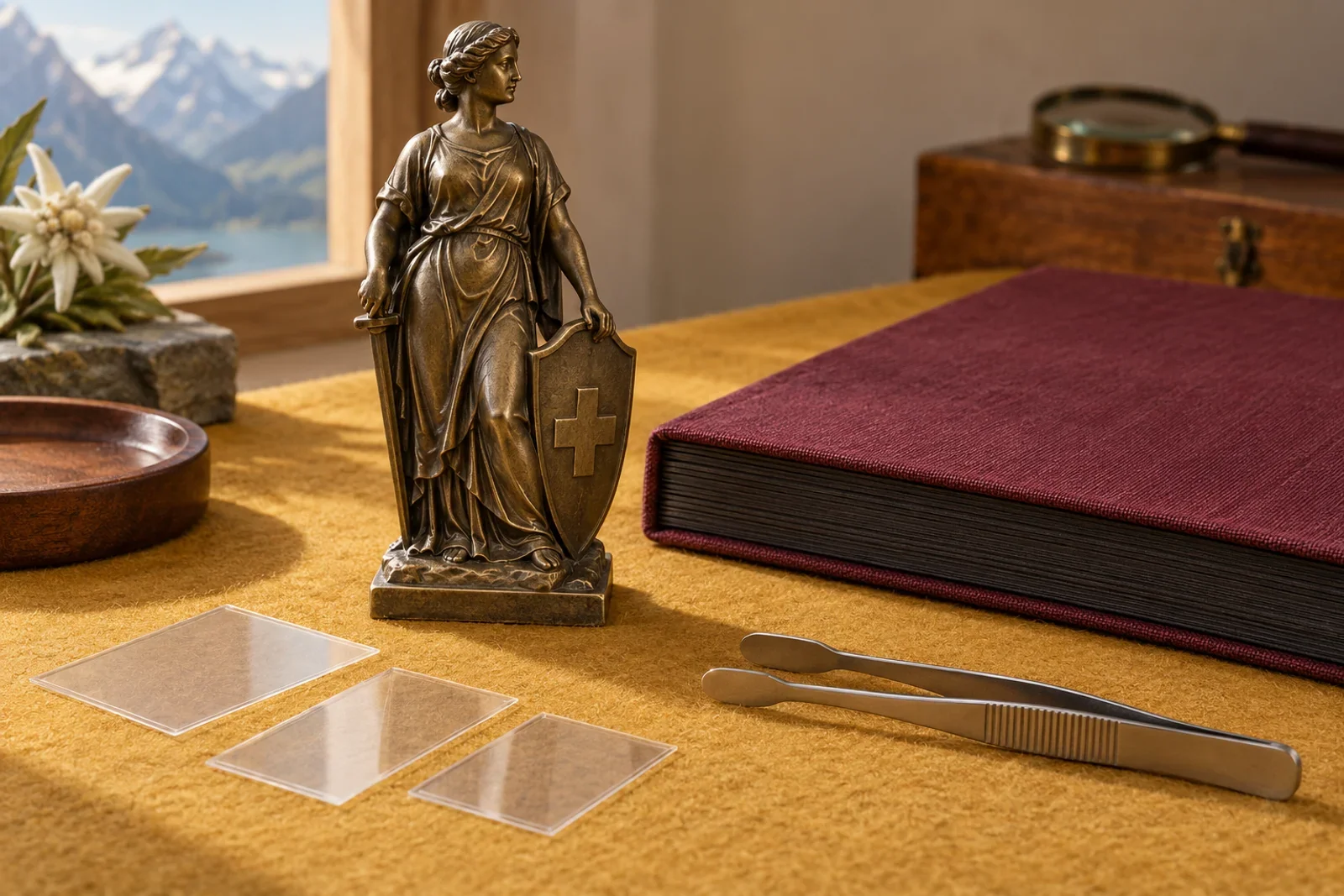
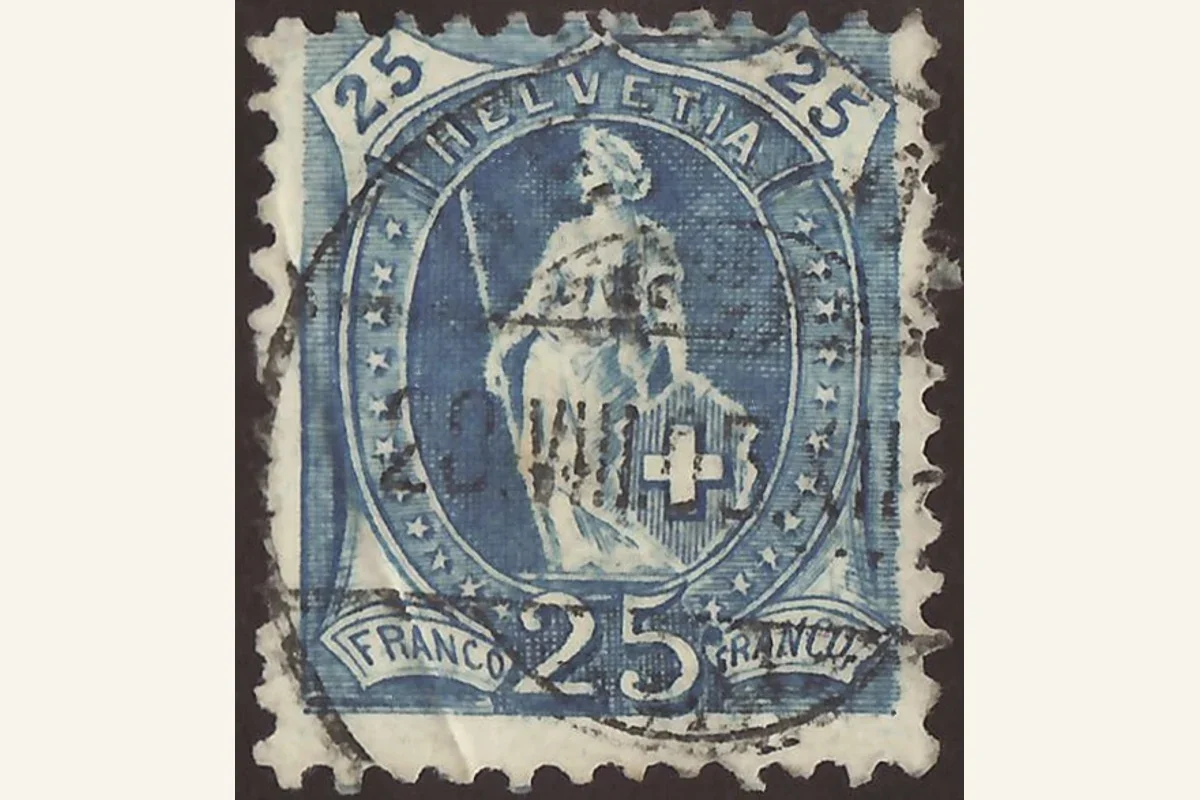
A Swiss stamp inscribed HELVETIA is not automatically a Standing Helvetia. Look inside the oval for an upright, full-length woman with a spear and a shield bearing a cross. Earlier Seated Helvetia stamps show the figure sitting. Numeral designs and later portraits also belong to different families. URAY identifies the standing design as an engraved definitive introduced in 1882, with values from 20 rappen to 3 francs.[7]
Read the denomination separately from the country name. Rappen and centimes name the same subdivision of the Swiss franc. On the genuine blue reference scan, the repeated numeral is 25. The word FRANCO means postage paid in this design; it does not make that stamp a 25-franc value. Preserve a photograph of the whole frame instead of transcribing one isolated word from the bottom.[6]
This guide covers the standing definitive family and its ordinary identification checks, not a complete specialized catalog of plate flaws. It does not value seated examples by borrowing prices from standing ones. If the pose is unclear beneath a postmark, record the uncertainty and compare the complete design. The foreign-stamp identification guide helps with country wording before you narrow the Swiss issue.
Four checks place the stamp within the family
Keep denomination, horizontal and vertical perforation measurements, paper and reverse security feature in separate fields. The same standing design can remain recognizable while these details change. URAY distinguishes early white-paper printings with control marks, later white paper with a cross watermark and final fiber-paper printings. A color match alone cannot decide between those groups.[7]
The table is a sorting aid, not a catalog-number conversion chart. Several values and perforations occur within these broad periods. Do not assign every blue 25-rappen stamp to one number because the article's reference picture is blue. Likewise, do not infer the back of your stamp from the back described for a dealer's stock item. Each physical object needs its own observations.
Use an unresolved field rather than a guessed suffix. For example, write standing design, 25 rappen blue, perforations unmeasured, reverse unexamined. That identifies the remaining work without turning an album attribution into a fact. Once the measurements are available, compare the full entry in a current specialist catalog, including any suffix and the catalog publisher.
| Group | Paper and reverse feature | Next check |
|---|---|---|
| Early printings from 1882 | White paper; embossed control marks | Measure both edge directions |
| Later control-mark printings | White paper; control mark B occurs | Do not identify the mark from color |
| Watermarked printings from 1905 | White paper; cross watermark | Distinguish watermark from embossing |
| Final printings, 1907/1908 | Paper with colored fibers; cross watermark | Verify fibers in the paper, not on it |
Ordinary dealer offers in Swiss francs
These four observations come from Marken-Meyer's own Standing Helvetia stock page, read on 6 October 2026. The source explicitly prints CHF. Each row is one used single, not a set, block or cover. Stock IDs identify the offers, and catalog references below retain the seller's Zumstein and Michel notation. No completed transaction or realized auction price is claimed.[1]
The dealer places catalog figures beside some offers. For CH-9214, CHF 80 is the catalog figure and CHF 25 is the asking price. Only the asking price belongs in our price column. The page's early-group heading does not prove that every denomination in that group first appeared in 1882. We therefore describe the 3-franc examples by their perforation group rather than assigning them that issue year.
CH-9828 and CH-5446 share the stated 72A reference, but their cancellations and descriptions differ. Their prices cannot establish a formula for subtracting the cost of a fault. The coarse-perforated 20-rappen row is also a different variety from the 40-rappen 69A. Do not average these amounts or treat CHF 25 to CHF 85 as the value of every Standing Helvetia. The price-list guide explains the difference between a retail offer and a buying offer.
| Stock ID and stated identity | Seller's condition and cancellation | Dealer asking price |
|---|---|---|
| CH-9214; 40 Rp.; Zumstein 69A, Michel 61XA; perf. 11¾ | Clean, lightly cancelled HIRSLANDEN 21.VII.91; good condition | CHF 25.00 |
| CH-9828; 3 Fr.; Zumstein 72A, Michel 64XA; perf. 11¾ | Clean, fine full MEISTERSCHWANDEN 4.IV.99 cancellation; good condition | CHF 30.00 |
| CH-5446; 3 Fr.; Zumstein 72A, Michel 64XA; perf. 11¾ | Fine full WILDEGG 28.II.92 cancellation; blind perforation tooth at right; good condition stated | CHF 40.00 |
| CH-3837; 20 Rp.; Zumstein 66B, Michel 58XB; perf. 9¾ × 9¼ | Very good perforations for this coarse issue; clear ST. GALLEN 16.III.89 cancellation; fault-free stated | CHF 85.00 |
Measure the perforations in both directions
Use a perforation gauge on an intact horizontal edge and an intact vertical edge. A gauge measures spacing over a standard distance; it is not simply the number of teeth along the side. In this family, a quick tooth count can help preliminary sorting, but it must not replace measured horizontal and vertical values when assigning a specialist entry.
URAY lists groups described as 11¾, 11½ × 11 and 11½ × 12, and uses 9¾ as shorthand for the coarse group.[7] Marken-Meyer's CH-3837 description is more specific, 9¾ × 9¼.[1] Keep the precision of the specimen description. Do not expand a dealer's abbreviated 9¾ into a claim that every edge measures 9¾. The two descriptions operate at different levels of detail.
A torn corner or clipped edge may remove the evidence you need. Measure another sound edge in the same direction and record the damage separately. Do not trim teeth to improve the outline or call a partly cut stamp imperforate. Use the perforation-measurement guide for alignment, then return to the Swiss catalog with the measurements rather than a guessed group letter.
An embossed control mark is not a watermark
Early control marks are impressed into the paper. URAY explicitly describes control marks A and B as reverse-side embossings and distinguishes them from the cross watermark introduced in later printings.[7] The cross within an oval associated with control marks should therefore not be loosely called the later cross watermark. Record the feature's construction as well as its apparent outline.
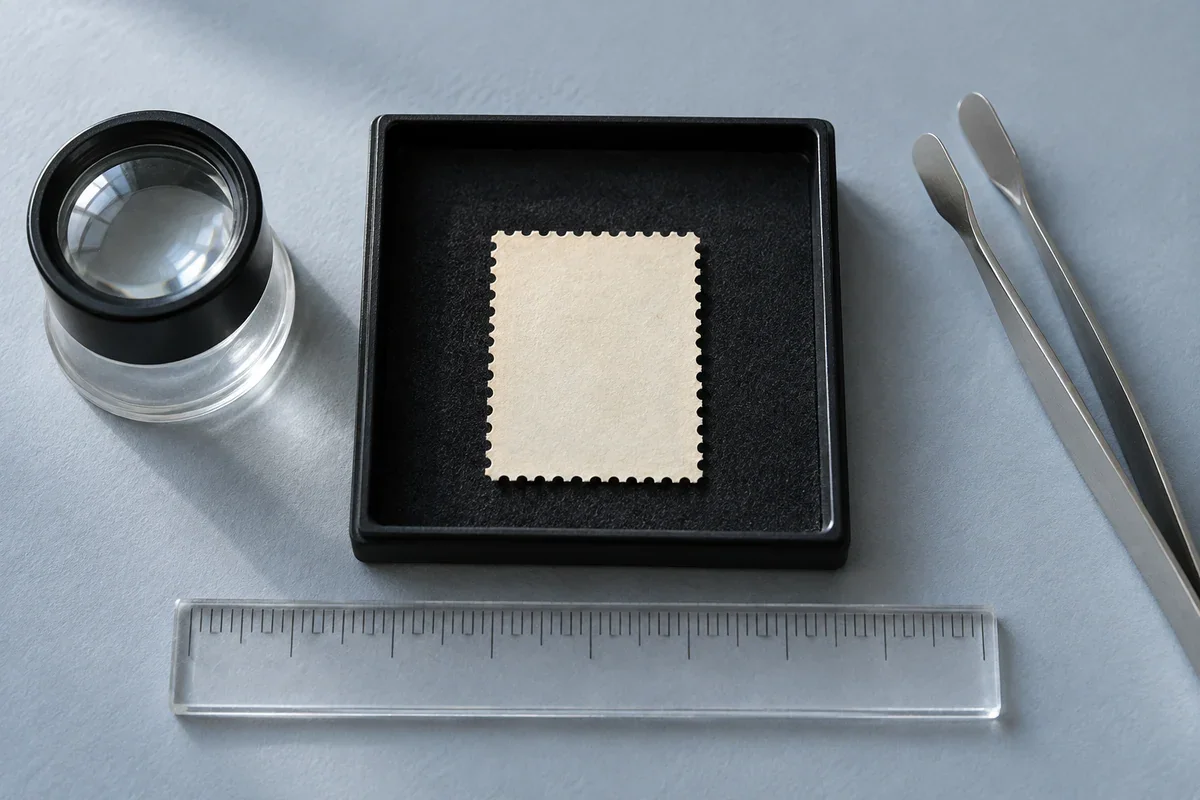
Examine the reverse in safe dry light first. A dark background and oblique light can help you look for an impressed feature without altering the stamp. If the mark is weak or partly hidden, write control-mark type unresolved. Do not infer A or B from an old postmark, an apparent shade or the letter attached to a catalog number.
Catalog suffixes and security-mark labels are different systems. A letter after a number can describe a combination of features in that catalog; it is not automatically the name of the reverse mark. Later watermarked groups also have lettered references. Consult the watermark guide for safe inspection choices, but use a Swiss specialist reference to interpret the actual mark. An ordinary front photograph cannot settle this distinction.
Separate white paper from paper containing fibers
URAY describes the final 1907/1908 printings as paper containing blue and red fibers.[7] The question is whether fibers belong to the paper, not whether a scan has colored flecks. Album dust, a postmark, a stain and a digital sharpening artifact can all distract from that physical question. Inspect both faces under magnification without scraping the surface.
Do not establish fiber paper by adjusting saturation until spots appear. Save a neutral-color photograph and record what you can actually see in hand. If colored material seems to sit on the surface, leave the classification open. URAY warns about imitation fibers added to white-paper stamps.[7] An attractive photograph does not exclude that alteration, especially when the seller's claimed variety is the reason for a high price.
Keep paper and security feature separate even when a catalog group combines them. A supposed fiber-paper stamp still needs the other checks. If the paper claim would change the comparison to a scarce specialist entry, seek in-hand examination before paying for that claim. The inspection cost and available evidence should guide the next step, not the largest catalog figure found online.
Condition and cancellation describe the actual single
Inspect the border's position relative to all four perforated edges, then describe paper faults independently. A centered figure inside an off-center printed frame is not a well-centered stamp overall. Shortened teeth, thins, creases and repaired edges should remain visible in your record. Do not photograph only the central allegorical figure when requesting a comparison.
For a used example, transcribe a readable town and date without filling in missing characters. Marken-Meyer's offers distinguish light cancellations and full town strikes.[1] Those are specimen descriptions, not proof that any readable Swiss postmark earns a premium. A cancellation date is also a use date, not necessarily the printing date or the year of the catalog entry.
An uncancelled front does not prove never-hinged original gum. If the back is mounted or hidden, keep its gum state unexamined. The table here contains used stamps only, so none of its rows supplies a mint or never-hinged comparison. The condition-grading guide helps describe faults without assigning a grade that your photographs cannot support.
Keep catalog numbers, sets and covers separate
Write Zumstein or Michel beside the number instead of recording a bare 69A. The price table shows that one offered stamp can carry both Zumstein 69A and Michel 61XA.[1] Do not transfer a suffix between catalog systems, remove it from a search or assume that a dealer's abbreviation is a universal classification. The catalog-number guide gives a record-keeping method for publisher and edition.
Wieland's own listings separate Seated Helvetia, numeral designs and Standing Helvetia, and distinguish white paper, fiber paper and security marks.[2] They also list sets. A price for a set applies to the described group, not to each stamp inside it. This is why a cheap-looking or expensive-looking series offer should not be placed in the single-stamp table without checking quantity and condition.
If your stamp remains on a cover, keep the entire envelope, markings and any accompanying postage intact. Do not soak it off simply because a loose-single comparable is easier to find. Joined pairs and blocks also retain information that a separated stamp loses. Record the complete object's format before requesting a specialist quote, and do not multiply one retail single price to manufacture a block or cover value.
Photograph the unresolved feature before checking value
Upload a straight-on front photograph with the denomination, oval design and all edges visible. In collector notes, state standing or possibly seated, denomination, colors, whether it is used, measured perforations and whether the back is available. Add paper or security-mark observations only when you made them physically. A note saying control mark unexamined is more useful than repeating an unsupported rare-variety claim.
Retain a separate reverse photograph and any intact-cover or block photograph in your own records. The checker can suggest a design and collector context from visible clues. It cannot authenticate added fibers, establish original gum or distinguish a faint embossed mark from a watermark using an ordinary front image. Return to the physical checks before adopting a specific suffix or a scarce-variety price.
Drop a stamp photo here
Show the full stamp, every perforation, and as much front detail as possible in even light.
Keep Swiss paper and control-mark checks with each stamp
Install Stamp Value Identifier & Scan for free on iOS or Android. Scan stamps individually, save results and organize your collection while you record perforations, paper observations and unresolved reverse-side questions.
Choose a comparable only after the missing check
If the design is seated, leave this price table and research the seated family. If it is standing but the perforations are unknown, measure them before selecting a lettered entry. If the reverse is unexamined, keep control mark or watermark unresolved. If a claimed fiber-paper variety rests only on colored spots in a photo, request better physical evidence rather than a more confident price estimate.
For a stamp matching one of the offered identities, compare condition, cancellation and format as well as the number. Keep the dealer URL, stock ID, currency and observation date together. Availability may change, and an asking price is not an offer to buy your collection. A later completed sale can strengthen the evidence only if its exact stamp, date, condition and fees are known. This article does not claim such a sale.
Frequently asked questions
Is every HELVETIA stamp a Standing Helvetia?
No. HELVETIA is Swiss country wording used on other designs. Look for the upright full-length figure inside the oval. A seated figure, large numeral or later portrait needs a different family identification before you use a price comparison.
Is the cross in an oval a watermark?
Do not use that description loosely. The early control marks are embossed reverse-side features, distinct from the later cross watermark. Inspect the physical back and use a specialist reference; the front alone does not establish the mark's type.[7]
What is an ordinary used 40-rappen example offered for?
On 6 October 2026 Marken-Meyer asked CHF 25 for CH-9214, described as Zumstein 69A, Michel 61XA, perforation 11¾, lightly cancelled HIRSLANDEN and in good condition. It is one used dealer offer, not a sale result or a universal 40-rappen value.[1]
Does FRANCO make the blue 25 stamp worth 25 francs?
No. The reference scan is a 25-rappen or 25-centime stamp. FRANCO is part of the postage-paid wording, not a franc denomination. Its original face value and today's collector price are also different quantities.[6]
Can an app confirm scarce fiber paper from a photograph?
A normal front photograph cannot prove that colored fibers are embedded in the paper or exclude added fibers. Keep that identification open, inspect the physical stamp and seek specialist examination when the paper claim affects a substantial purchase.[7]
Sources and further reading
Primary references and specialist resources used to prepare this guide.
- [1] Marken-Meyer: individual used Standing Helvetia offers, checked 6 October 2026
- [2] Wieland: separate Swiss design, paper and security-mark groups, checked 6 October 2026
- [6] Wikimedia Commons: genuine blue 25-rappen reference scan and public-domain rights
- [7] Briefmarken URAY: Standing Helvetia perforations, embossed marks and later papers, checked 6 October 2026